Many sales reps move too quickly to presenting a product or service. As a result, prospects feel pressured and see the salesperson as just another vendor trying to make a sale. The right questions help turn the conversation into a natural dialogue, build trust and make it easier to tailor solutions to the customer’s needs.
In this article, we’ll look at three key open-ended questions worth asking during sales conversations with potential customers. These simple techniques can help improve sales effectiveness and the quality of customer conversations. The examples are drawn from real sales conversations and sales processes.
Why are open-ended questions in sales so important?
Open-ended questions encourage prospects to elaborate on their answers and share additional information. They help sales reps better understand customer needs, expectations and perspectives.
Unlike closed-ended questions, open-ended questions encourage a natural dialogue and help build relationships. They give prospects the space to explain their situation, describe their challenges and share their past experiences.
This is particularly important when selling B2B products and services, where purchasing decisions often depend on trust and the quality of the sales conversation.
Good sales reps know that asking questions is primarily about understanding the customer and their needs. Only then is it time to present a product, service or potential partnership.
Open-ended vs closed-ended questions. What’s the difference?
Sales conversations can involve both open-ended and closed-ended questions. Each type has its place, but open-ended questions are generally more effective at the beginning of a conversation.
| Closed-ended questions | Open-ended questions |
|---|---|
| Are you looking for a system? | How does this process currently work in your company? |
| Do you have a budget? | What is your biggest challenge? |
| Are you interested? | What solutions have you tried before? |
Open-ended vs closed-ended questions. Why change the way you ask questions?
Closed-ended questions tend to elicit short answers, limit the conversation, make it harder to understand customer needs and can sometimes feel like an interrogation.
Examples of closed-ended questions:
- Are you looking for a new system?
- Do you have a budget?
- Are you interested?
Open-ended questions, on the other hand, encourage dialogue, help you understand the customer better, uncover their needs and increase their engagement.
Examples of open-ended questions:
- How does this process currently work in your company?
- What is your biggest challenge?
- What solutions have you tried before?
Knowing how to ask the right questions helps sales reps guide conversations effectively and gather information that can make a real difference to sales performance.
3 key sales questions that can change the course of a conversation
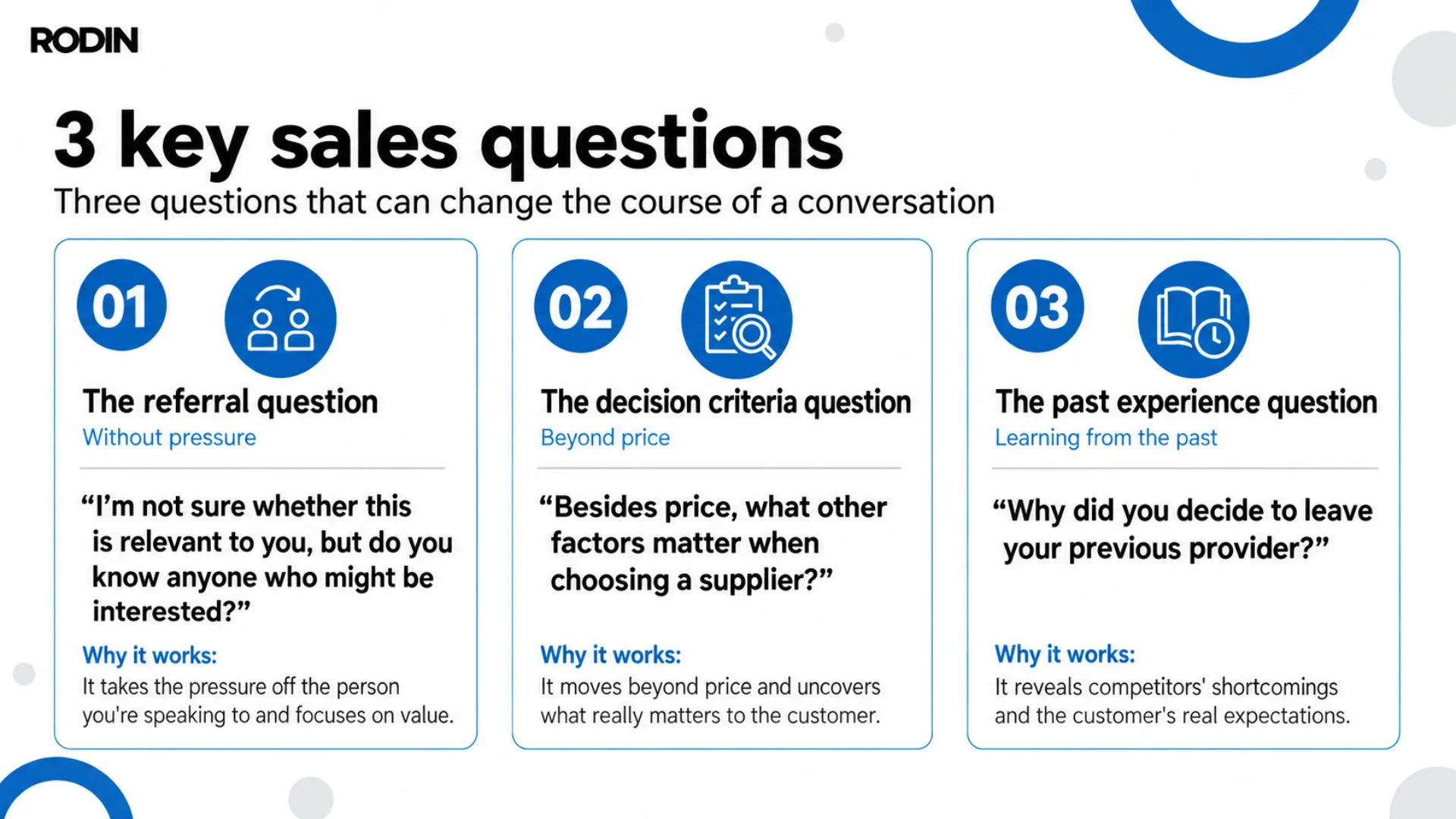
Question 1: “I’m not sure if this is relevant to you, but do you know anyone who might need it?”
This is one of the most effective questions to ask at the beginning of a sales conversation.
Many sales reps start by asking directly about a product or service:
- “Are you looking for a solution like this?”
- “Are you looking for a new supplier?”
- “Would you be interested in this service?”
This approach can create distance and undermine trust.
A much better way to start is with a question like:
“I’m not sure if this is relevant to you, but do you know anyone who might need it?”
At this point, focus on the benefits for the customer rather than the product itself.
For example:
Instead of asking:
“Do you need an accounting automation system?”
Try saying:
“I’m not sure if this is relevant to you, but do you know anyone who might want to automate their accounting and stop wasting time on spreadsheets?”
This question works particularly well during initial contact with potential customers, whether by phone, email or LinkedIn. It takes the pressure off the person you’re speaking to while encouraging them to think about a problem and possible solutions.
Question 2: “Besides price, what other factors matter to you when choosing a supplier?”
Price often comes up in sales conversations. It plays an important role in many purchasing decisions, but it is rarely the only factor that matters.
That’s why it’s worth asking:
“Besides price, what other factors matter to you when choosing a supplier?”
This question helps you:
- better understand the customer’s expectations,
- identify their actual decision-making criteria,
- find out what matters most to the person you’re speaking to,
- avoid competing on price alone.
Other factors that often matter to customers include:
- response times,
- quality of service,
- previous experience working together,
- reliability,
- communication,
- security,
- trust,
- availability of support.
Understanding these priorities helps you tailor your offer and guide the sales conversation more effectively.
A good salesperson knows that successful sales depend on understanding the customer’s needs and demonstrating the value of a solution, rather than competing on price alone.
Question 3: “Why did you stop working with your previous supplier, or have you used products or services like these before?”
This is one of the most useful questions to ask when you want to understand a prospect’s previous experiences.
Customers have often worked with another company or used a similar product or service before. Those experiences can have a significant impact on their expectations and decision-making.
That’s why it’s worth asking:
“Why did you stop working with your previous supplier, or have you used products or services like these before?”
This question can reveal valuable information about:
- what the customer felt was missing,
- what went wrong,
- what they expected,
- what they want to avoid,
- which previous solutions failed to meet their needs,
- why they made their earlier decision.
With this information, a sales rep can better understand the customer’s needs and recommend solutions suited to their situation.
It’s also a great way to make the conversation feel more natural and build a stronger relationship with the prospect.
How to ask open-ended questions effectively?
The questions themselves are only the starting point. How you conduct the conversation matters just as much.
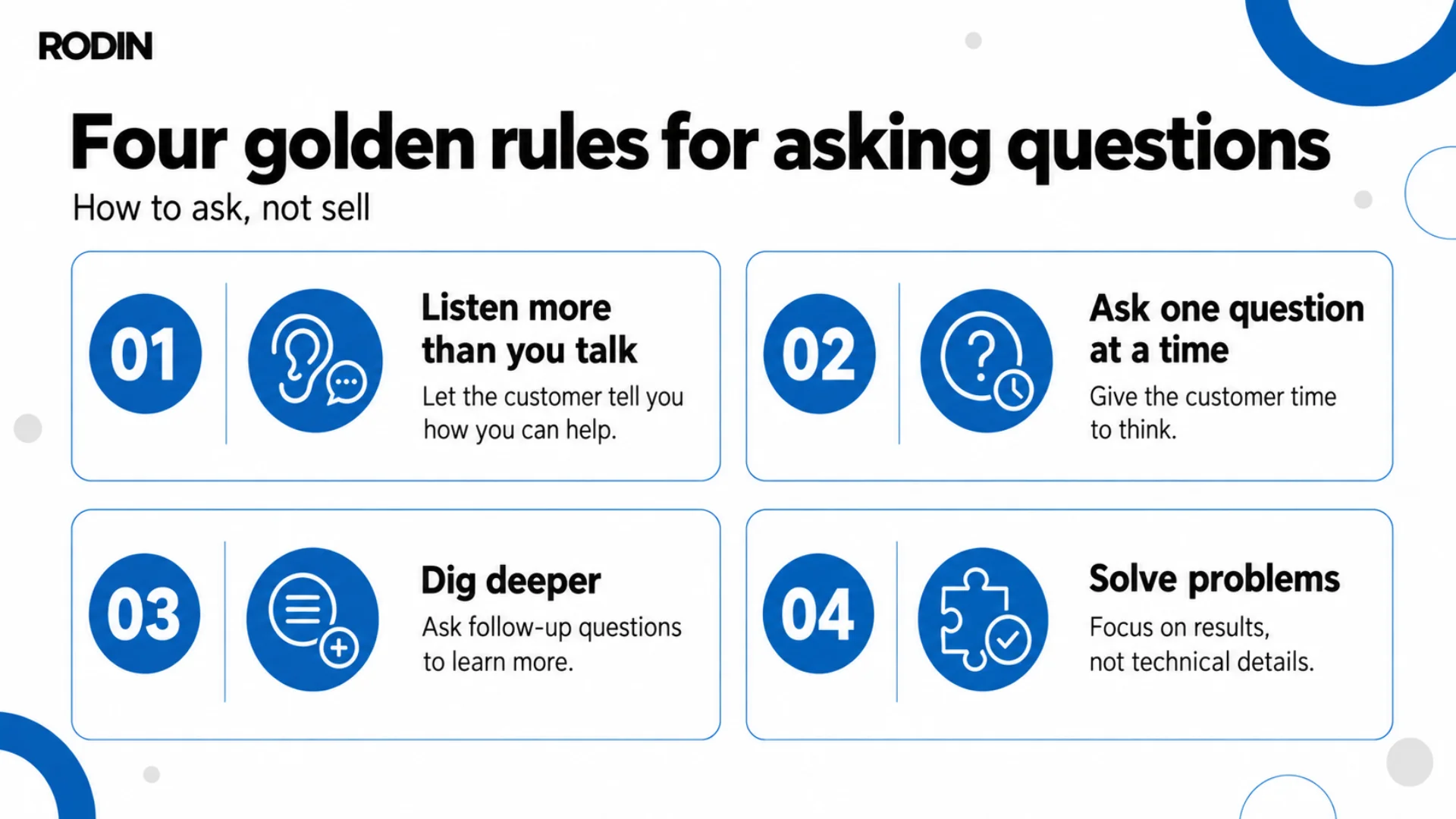
1. Listen carefully
Make the customer feel heard. Active listening helps you understand their needs and pick up on important details.
2. Ask one question at a time
Asking several questions at once can confuse the conversation. One question gives the customer more room to provide a clear, meaningful answer.
3. Ask follow-up questions
Important details often emerge as the conversation develops. Ask follow-up questions to explore the topic further.
4. Be clear about your goal
Every question should have a clear purpose:
- Understanding customer needs.
- Learning about their expectations.
- Identifying problems.
- Building relationships.
- Strengthening trust.
Common mistakes when asking questions
Moving to the sales pitch too quickly
Customers need time to explain their situation and challenges. Sales conversations work best when reps listen first and gather information before presenting an offer.
Relying only on closed-ended questions
Closed-ended questions limit the conversation and make it harder to understand customer needs. As a result, the dialogue can feel stiff and unnatural.
Failing to listen actively
The best follow-up questions often come naturally from what the prospect has just said.
Focusing only on the product
Customers care most about solving a problem and achieving results. The product or service is simply a means to that end.
Examples of open-ended questions in sales
Here are a few more open-ended questions worth asking during sales conversations:
- “What is your biggest challenge right now?”
- “How does this process work in your company?”
- “What is missing from your current solution?”
- “What are you looking for in a new supplier?”
- “What made you start looking for a different solution?”
- “What matters most to you?”
- “What would an ideal outcome look like?”
- “What goals are you hoping to achieve?”
- “What do you think is working well, and what could be improved?”
These questions help you better understand your prospects, their needs and how they think.
Do open-ended questions work across different industries?
Open-ended questions are useful in almost every industry and at different stages of the sales process.
You can use them in:
- B2B sales,
- service sales,
- marketing,
- online meetings,
- cold email outreach,
- social media,
- phone conversations,
- face-to-face sales.
Whether you’re selling a product, a service or consultancy, customers want to feel heard and understood.
That’s why asking the right questions is such an important skill in modern sales.
The best sales conversations start with the right questions
A good sales conversation isn’t about getting through a list of questions or pitching your offer at every opportunity. It’s about understanding what matters to the person on the other side of the table. The better you understand their challenges, priorities and expectations, the easier it becomes to have a meaningful conversation and recommend a solution that makes sense for them.
At Rodin, we know that effective sales starts long before the final offer. We help businesses improve their marketing and sales communication so they can reach the right people, build trust and turn more conversations into business opportunities.
Because when you ask better questions, you give yourself a better chance of finding the right answer.
Frequently asked questions
Open-ended sales questions encourage prospects to explain their needs in their own words rather than give a one-word answer. They help sales professionals gather useful information and understand the buyer’s priorities, giving sales teams a better basis for moving the conversation forward.
Thoughtful questions about the current process, frustrations and desired outcomes help uncover pain points that prospects may not mention at first. Asking about the prospect’s situation gives them space to share context and reveal their true priorities. These actionable insights help sales professionals identify motivators and recommend new solutions that address the buyer’s unique situation.
Rapport building questions show that you’re genuinely curious about the prospect’s perspective, not just trying to sell something. Actively listening positions sales reps as trusted advisors and helps build rapport without coming across as just a pushy salesperson.
Effective qualifying questions determine whether a prospect is a good fit by exploring their needs, budget, decision-making authority and timeline. These probing questions help sales professionals uncover budget, identify motivators and decide whether the opportunity is worth pursuing.
A useful guideline is to let the prospect do most of the talking. Some sales advice recommends a 70/30 speaking ratio, with the buyer speaking around 70% of the time. This isn’t a strict rule; the goal is to ask thoughtful questions, listen carefully and give the buyer space to explain their situation.
Yes. Open-ended questions help uncover the real issues behind objections instead of encouraging sales reps to make assumptions about the buyer’s concerns.
For example, asking “What would happen if this problem stayed unresolved?” can reveal urgency and the consequences of inaction. Understanding the objection makes it easier to address hesitation and explore a valuable solution before moving towards closing questions.
By exploring goals, challenges and expectations during sales discovery, reps can customize solutions to the buyer’s unique situation. This helps position them as a strategic partner rather than just another supplier.
The next stage should depend on the buyer’s needs, readiness and remaining concerns, not just the salesperson’s targets. Use follow-up and closing questions to check whether the prospect has the information needed to make a buying decision and what needs to happen before moving forward. Sales leaders should encourage their teams to focus on the buyer’s perspective while keeping the organization’s revenue goal in view.