
The social media landscape has been undergoing a major shift for several years now. After months of criticism directed at X (formerly Twitter), many users began moving to Bluesky, a new social media site backed by Jack Dorsey, the former Twitter CEO. Musk’s takeover of Twitter also played a significant role in accelerating interest in the Bluesky project, attracting people looking for something different from traditional social networks.
We took a closer look at what’s driving this shift and why Bluesky continues to gain traction while more users turn away from Musk’s approach.

Bluesky – what is it?
Bluesky is a new social media platform built around decentralization and user control. It runs on the AT Protocol, a technology designed to create a more open internet one where users can move their identity and data across different platforms without losing their presence online.
Joining the platform is straightforward you can join Bluesky through its website and start using the service almost immediately.
The interface offers a familiar, Twitter-like experience, making it easy for both early adopters and new users to get started. The Bluesky app is available on web, iOS, and Android, allowing people to stay connected across devices. As an independent company that originally grew out of a Twitter initiative, Bluesky Social gives users the ability to move accounts, follow others, and maintain continuity across environments.
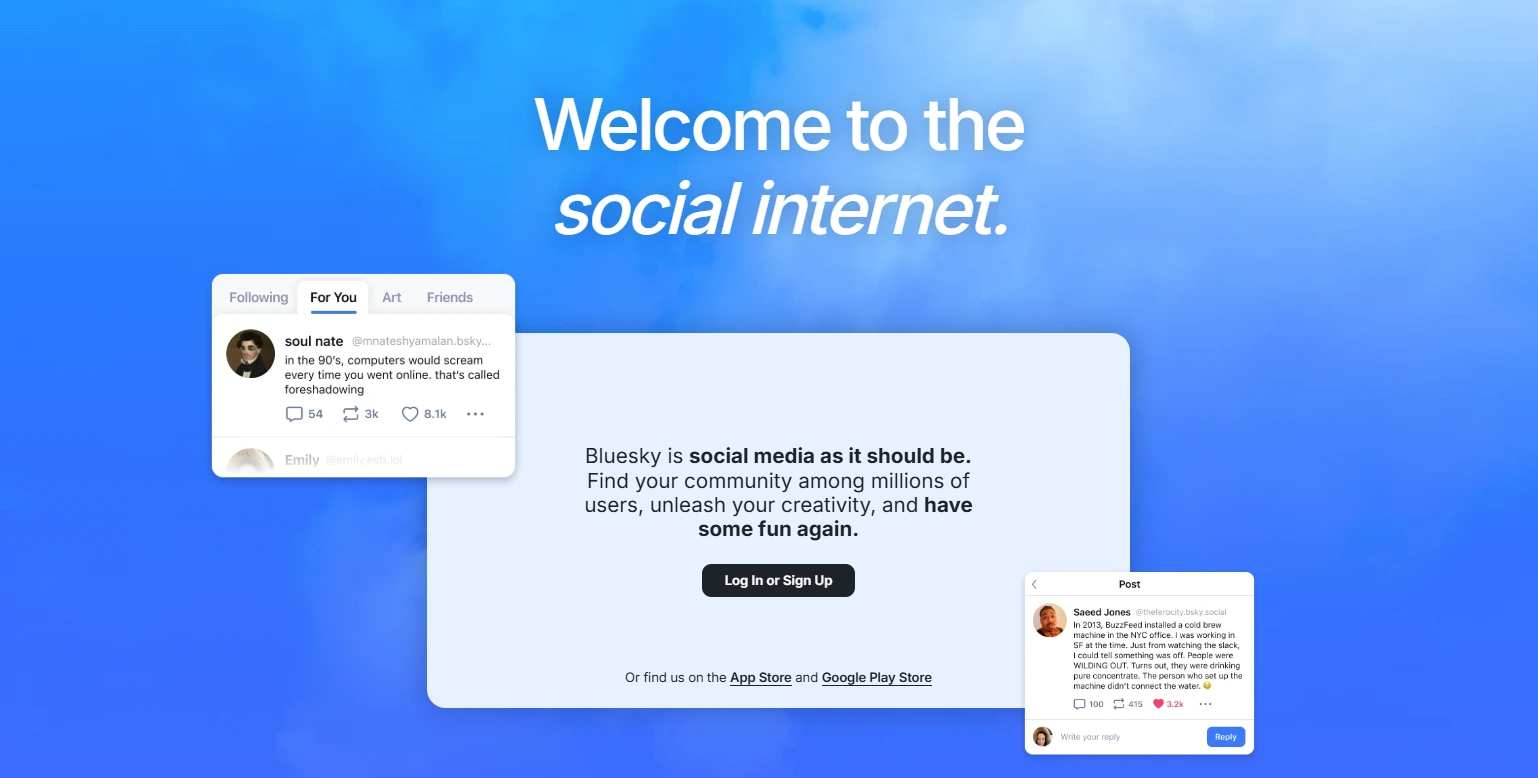
At first glance, Bluesky looks very similar to Twitter. You’ll find:
- short posts,
- the ability to like and reply,
- a familiar scrolling feed.
But the underlying philosophy is very different. Unlike X (formerly Twitter), Bluesky promotes transparency and reduces reliance on opaque, algorithm driven feeds. The platform offers:
- the ability to choose custom algorithms,
- the option to create custom feeds,
- more control over what content you see and how you interact with it.
There are still some limitations, especially around certain features and levels of personalization, but the direction is clear.
Getting started – username and account setup
Creating an account involves choosing a username (e.g. @name.bsky.social or using custom domains), setting a password, and uploading a profile photo. Using your own domain as a handle adds credibility and strengthens your identity on the platform.
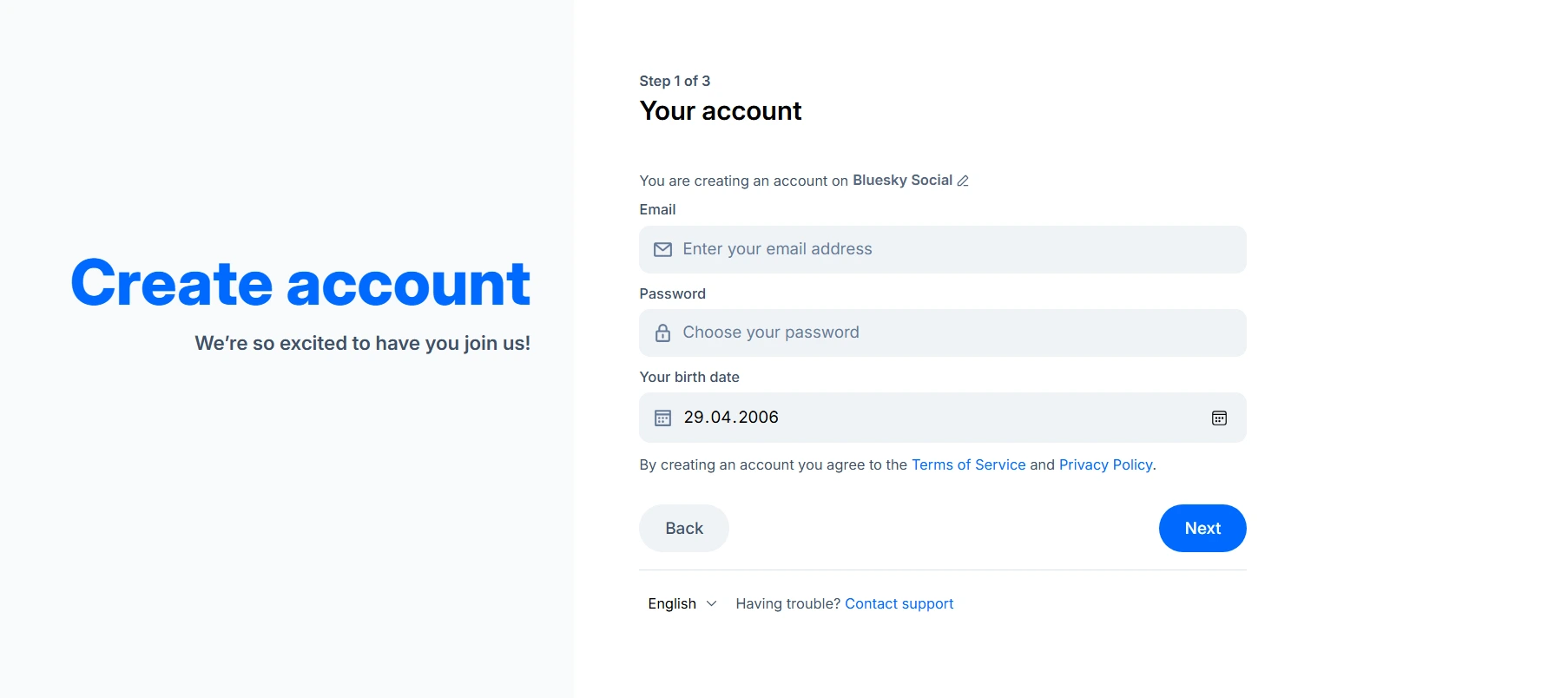
Once your account is set up, you can personalize your profile, adjust preferences, and manage interactions with other accounts. It’s a quick process that lowers the barrier to entry.
Key features and capabilities of bluesky
Bluesky is a decentralized social network that gives users a sense of freedom and control right from the start.
- The platform offers a simple onboarding process and profile personalization. Communication happens through posts, likes, replies, and direct messages, allowing both public and private interaction.
- Because Bluesky runs on an open protocol, users have greater control over their data and how the platform operates. This openness also allows developers to build on top of the system, which could expand the ecosystem beyond a single company.
- Bluesky also stands out for its lack of advertising, allowing users to focus entirely on content and interaction instead of sponsored messages.
- The platform works seamlessly across devices and offers flexible content customization. Users can adjust their feed using custom algorithms, tailoring what they see based on their interests.
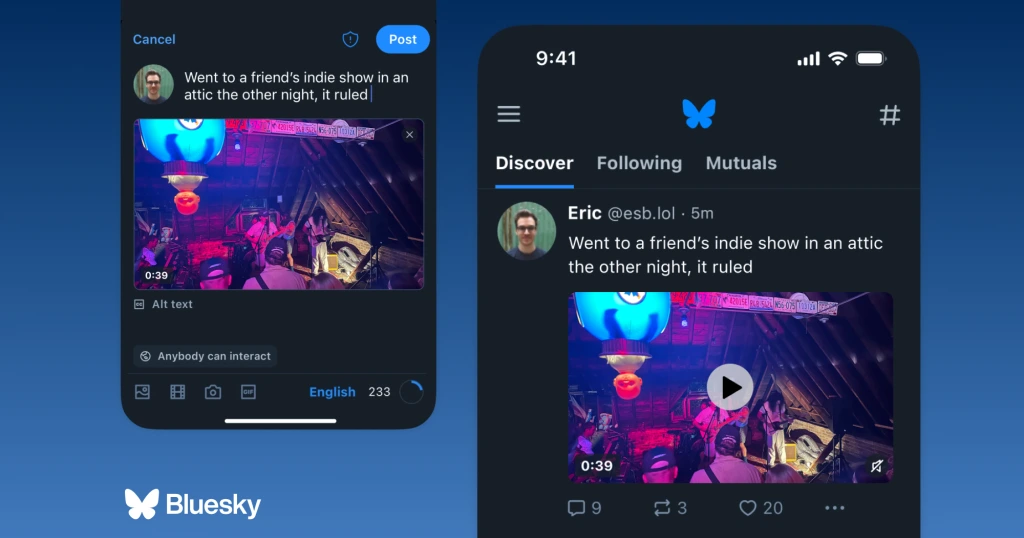
- For creators, Bluesky offers high-quality video uploads, which is still relatively rare across many social media platforms.
- Private messaging is already available, although end-to-end encryption is still in development.

Bluesky update!
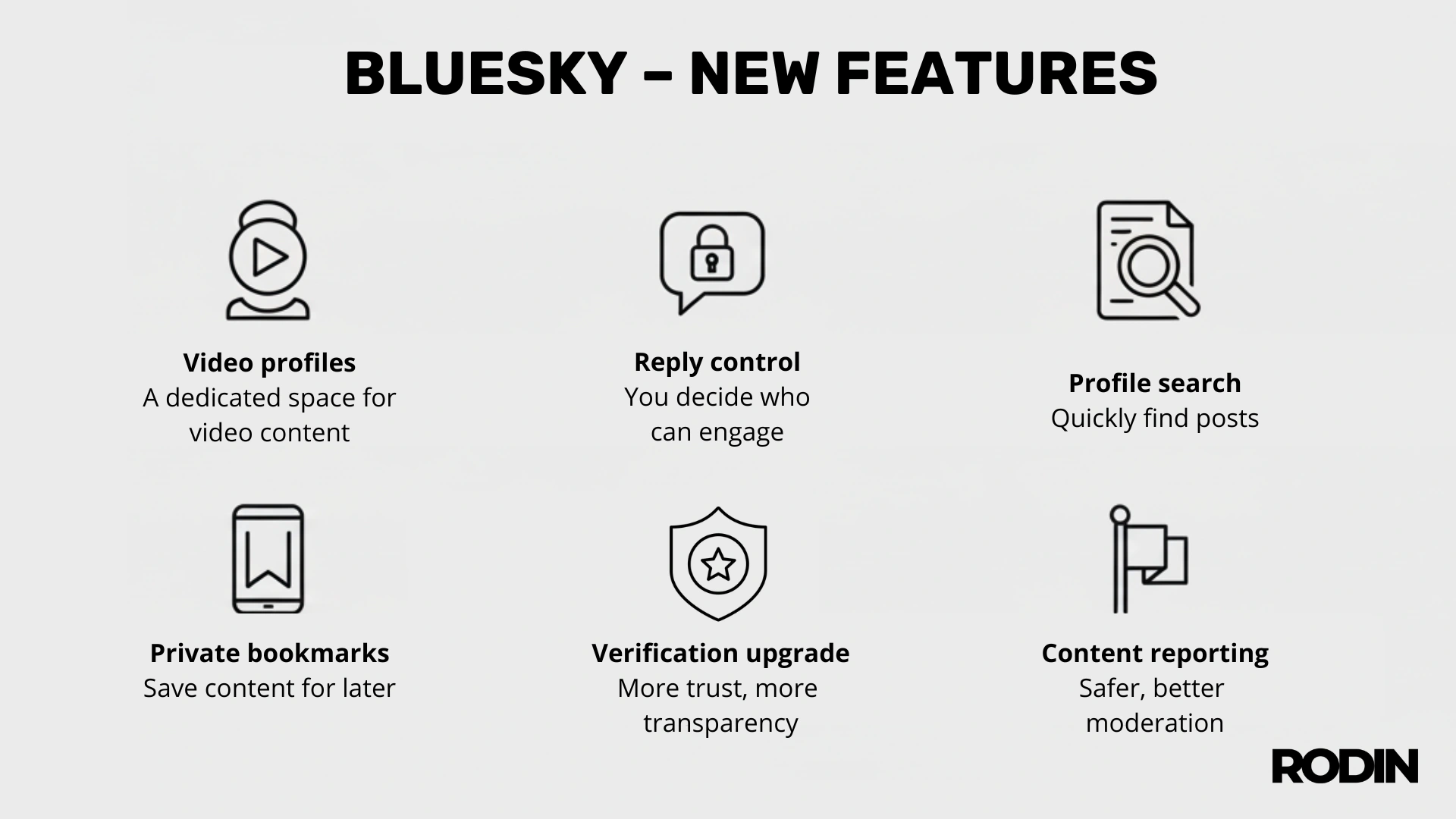
Bluesky has been steadily expanding its feature set, with major updates introduced throughout 2025 and further refined into 2026.
Among the most notable additions is a dedicated video tab on user profiles, making it easier to discover and organize video content. The platform also introduced more advanced reply controls, allowing users to decide who can respond to their posts, along with improved search functionality within profiles.
Additional improvements include private bookmarks on mobile devices and a more robust verification system, designed to increase trust and authenticity across the platform.
Safety and user comfort remain a top priority. Users can report inappropriate content or accounts, helping maintain a respectful and well-moderated community.
It’s also worth noting that while Bluesky began as an initiative led by Jack Dorsey, it now operates as a fully independent company. This independence allows it to compete on a global scale and continue developing an alternative model for social media one that prioritizes transparency, user control, and privacy.
New verification system on Bluesky
Bluesky has introduced a verification system that differs significantly from the paid model known from X. Instead of monetizing verification, the platform focuses on identity and authenticity.
Currently, there are three main ways to verify an account. Users can self-verify by linking their own domain, which allows them to replace the default handle (e.g. @name.bsky.social) with a custom domain-based username. This approach strengthens credibility and gives users more control over their identity.
Verification can also be granted through trusted partners. The “Trusted Verifiers” system allows organizations such as The New York Times to verify their journalists directly within the platform, helping increase the reliability of published content.
In addition, Bluesky may verify selected accounts directly through its own team.
Unlike X, verification on Bluesky is free, making it more accessible and less tied to paid subscriptions. This approach aligns with the platform’s broader philosophy of decentralization and user control.
Why are users leaving X for Bluesky?
Since Elon Musk acquired Twitter in 2022, the platform has faced growing criticism. Changes to moderation policies, the introduction of paid verification, and an increase in ads have pushed many users to look for alternatives. Reports from 2025 highlight a sharp rise in hate speech on X. Research by the Center for Countering Digital Hate identified hundreds of thousands of posts violating platform rules, with millions of views.
At the same time, legal disputes, such as X challenging transparency laws in New York, have raised further concerns about accountability.
Against this backdrop, Bluesky has gained significant media attention and continues to attract a growing user base.
How is Bluesky growing?
Since September 2024, Bluesky has experienced remarkable growth. The platform expanded from 10 million to over 38 million users by August 2025, an increase of 283% in less than a year.
Currently, Bluesky is gaining around 5.4 users per second, which translates to roughly 466,000 new users daily.
By October 2025, the platform had surpassed 38 million monthly active users globally. If this trend continues, projections suggest it could reach 53 million users by the end of 2025 and over 80 million by 2026.
For many, Bluesky is more than just an alternative, it’s a fresh start. The platform combines familiar features with a clean, intuitive design, making it easy for users to transition from Twitter-like environments.
Users can post, reply, share, and send private messages, while creators benefit from higher-quality media options. Demographically, the platform skews younger. Over 60% of users are under 35, with Gen Z making up the largest segment.
The future of Bluesky
Bluesky continues to evolve rapidly, with many of the features introduced in 2025 now being refined and expanded in 2026.
The platform is steadily moving toward stronger privacy controls, including the development of private accounts and end-to-end encrypted messaging, which are expected to significantly improve user security. Work is also ongoing on group messaging, richer media support within direct messages, and further enhancements to overall safety features.
One particularly interesting direction is Bluesky’s collaboration with Germ, a startup focused on secure communication. Together, they are working on implementing end-to-end encrypted messaging using the AT Protocol and Messaging Layer Security (MLS). This approach enables secure communication between users without requiring a phone number, aligning with Bluesky’s broader vision of privacy-first social networking.
Why it’s worth keeping an eye on Bluesky
Bluesky is a strong reflection of how user expectations toward social media are evolving. As concerns around privacy, data usage, and content manipulation continue to grow, more people are actively looking for more ethical and transparent alternatives. To succeed in the long term, the platform needs not only to attract new users, but also to retain them by offering effective moderation and high-quality content governance, both of which are essential for maintaining a safe and healthy community. At the same time, Bluesky must compete with major players such as Meta Platforms and TikTok. Its emergence is already pushing industry giants to rethink their existing strategies.
As of 2026, Bluesky continues to stand out particularly in contrast to competitors. Meta has faced ongoing criticism for changes to its content moderation approach, including scaling back certain fact-checking initiatives, while X (formerly Twitter) still struggles with issues related to hate speech and controversial moderation decisions. Against this backdrop, Bluesky is becoming an increasingly attractive option for users who value more responsible and transparent content moderation.
At the same time, the platform remains a space for everyday interaction. Users turn to Bluesky not only for discussions around current topics, but also to share their interests, passions, and personal content in a more controlled and community-driven environment.
Is Bluesky the future of Social Media and a step toward higher-quality video?
Although the road to global dominance is still long, Bluesky is already proving that there is room for innovation in the social media space. If the platform maintains its current pace of growth and avoids the mistakes made by its competitors, it has the potential to become a serious challenger to X and other major tech players.
According to experts at Rodin, the key factor behind Bluesky’s long-term success will be its ability to stay true to its current model one built on transparency and an ad-free environment. This stands in clear contrast to platforms that rely heavily on personal data monetization. The decentralized architecture of the AT Protocol gives users genuine control over their data, along with the ability to move their accounts across different platforms without losing their identity. This kind of flexibility could very well become a new standard for the future of social media.
For now, one thing is certain, Bluesky is a platform worth watching closely. The future of the internet may turn out to be a little more blue than we expected.
Frequently asked questions
Bluesky is a social media platform designed as an alternative to traditional social networks. The idea behind the Bluesky project is to create a more open and user-focused environment, where people have more control over their data and experience. As the platform has grown rapidly and attracted million users, it has gained significant media attention and become a real alternative to X (formerly Twitter).
Unlike most social media sites, where a single company controls everything, Bluesky operates on a decentralized model. This decentralized nature means users are not locked into one system and may eventually be able to move between different servers while keeping their identity. Compared to algorithm driven feeds on other platforms, Bluesky gives users more control over what they see.
Bluesky began as an initiative led by Jack Dorsey, the former Twitter CEO. Today, however, it operates as an independent company, with Jay Graber as Bluesky’s CEO. The platform continues to evolve with contributions from developers and the wider community.
To join Bluesky, you simply create an account through the website or Bluesky app. The process is quick and intuitive, making it easy for new users to get started. Once inside, you can connect with other accounts, follow topics, and start sharing posts right away.
One of the most unique features Bluesky offers is the ability to create custom feeds. Instead of relying on a single algorithm, users can choose from different feeds or build their own using custom algorithms. This helps reduce the “echo chamber” effect and gives users more meaningful control over their feed.
Yes, the platform includes direct messages, allowing users to communicate privately. In addition, Bluesky offers features like posts, likes, replies, and content sharing, creating a familiar, Twitter-like experience. The platform continues to expand its functionality while focusing on usability and staying connected.
Currently, Bluesky does not rely on traditional advertising or standard paid subscriptions. Instead, the platform promotes a model focused on user experience and transparency. This approach stands in contrast to many traditional social networks, where monetization often impacts visibility and reach.
Bluesky is definitely worth exploring, especially as its user base continues to grow at a global scale. With its focus on transparency, evolving moderation policies, and reduced exposure to issues like hate speech, it offers a refreshing alternative to existing platforms such as Meta Platforms’s Threads or X. For many users and early adopters, it represents a new direction for social media.