

E-commerce SEO
Our clients
What e-commerce SEO can do for your store?

Get found for the searches that matter
Your store starts showing up for the searches your customers actually make. We work on the visibility of your homepage, categories, subcategories, product pages and helpful content, so shoppers can find your products at different stages of the buying journey.

Bring in shoppers who are ready to buy
Effective e-commerce SEO helps you reach people who are actively looking for a product, comparing their options or getting close to a purchase. This kind of traffic is far more valuable than random visits to your website.

Make your store easier to navigate
E-commerce SEO starts with a well-organized site architecture. We check whether categories, filters, menus, internal links and product descriptions make sense for both shoppers and Google. This matters even more for large stores, where hundreds or thousands of products can quickly make navigation and indexing difficult.

Fix the technical issues holding your store back
Technical SEO affects how Google reads your store and how easily customers can use it. We look at page speed, mobile performance, indexing, 404 errors, redirects, duplicate content and structured data. A technically sound store is easier to crawl, easier to use and better prepared to compete in search.

Content that helps people choose
We create and optimize content that supports the buying process, from category descriptions and buying guides to rankings, FAQs and blog articles. Good content helps your store appear for relevant searches, answer real customer questions and make it easier to choose the right product.
What e-commerce SEO can do for your store?

Get found for the searches that matter
Your store starts showing up for the searches your customers actually make. We work on the visibility of your homepage, categories, subcategories, product pages and helpful content, so shoppers can find your products at different stages of the buying journey.

Bring in shoppers who are ready to buy
Effective e-commerce SEO helps you reach people who are actively looking for a product, comparing their options or getting close to a purchase. This kind of traffic is far more valuable than random visits to your website.

Make your store easier to navigate
E-commerce SEO starts with a well-organized site architecture. We check whether categories, filters, menus, internal links and product descriptions make sense for both shoppers and Google. This matters even more for large stores, where hundreds or thousands of products can quickly make navigation and indexing difficult.

Fix the technical issues holding your store back
Technical SEO affects how Google reads your store and how easily customers can use it. We look at page speed, mobile performance, indexing, 404 errors, redirects, duplicate content and structured data. A technically sound store is easier to crawl, easier to use and better prepared to compete in search.

Content that helps people choose
We create and optimize content that supports the buying process, from category descriptions and buying guides to rankings, FAQs and blog articles. Good content helps your store appear for relevant searches, answer real customer questions and make it easier to choose the right product.
Is Google sending your customers to the competition?
Fill out the form to get an initial visibility analysis of your online store.
Why e-commerce brands can't afford to ignore SEO?

Paid traffic stops the moment you stop paying
Paid campaigns can generate traffic quickly, but once the budget stops, the traffic often does too. SEO builds visibility that can keep bringing potential customers to your store over time, reducing your reliance on paid traffic.
Shoppers do their homework before they buy
Shoppers rarely buy from the first store they find. They compare products, reviews, prices, delivery times and the credibility of the brand. Strong e-commerce SEO helps your store show up while they are researching and comparing their options.

Google looks beyond your content
Ranking a store today depends on more than keyword selection. Site speed, architecture, content quality, internal linking, mobile usability, valuable backlinks and the overall user experience all matter.

Who can benefit from e-commerce SEO?
-
Large online stores with extensive product ranges -
New online stores -
Stores that want to rely less on paid traffic -
Brands with traffic but not enough sales -
Companies operating in highly competitive industries
For large online stores, SEO helps keep the site structure under control, increase the visibility of category pages and improve product indexing. This becomes particularly important when the range changes frequently or includes hundreds or thousands of products.
The bigger the store, the easier it is for technical and structural problems to go unnoticed. Filters can create unnecessary URLs, important categories can become difficult to reach, and some products may not be indexed properly. A well-planned SEO strategy helps Google understand how the store is organized while making it easier for customers to find the products they need.
A new store needs a strategy that gives it a realistic chance of appearing in search results and competing with more established brands. E-commerce SEO helps build visibility from the ground up, starting with the right site structure, categories, product pages and search terms.
Getting these foundations right from the beginning can prevent costly changes later. The way products are organized, URLs are structured and content is created affects how easily Google can crawl and index the store. Getting these elements right early makes it easier to expand the store without creating SEO problems later.
If most of your sales come from paid campaigns, SEO can become an additional and more stable source of traffic. It does not replace advertising overnight, but it can gradually build visibility for products and categories that customers are already searching for.
Organic search can also give your business more flexibility when advertising costs rise or campaign performance changes. Instead of paying for every visit, a strong organic presence can continue bringing potential customers to your store without a direct cost for each click. For many e-commerce brands, SEO is a practical way to diversify where their customers come from.
A high number of visits does not necessarily mean that a store is performing well. Sometimes the problem is not a lack of traffic, but poor site structure, incomplete content, slow pages, an unclear offer or a complicated path to purchase. In these cases, SEO needs to look beyond rankings and consider what happens after someone reaches the store.
Looking at which pages attract organic traffic, what searches bring users there and how they move through the store can reveal where potential customers drop off. This shows which products or categories need more visibility and what may be stopping visitors from buying.
In industries where many stores sell similar products, standing out in search becomes much harder. Valuable content, technical SEO, customer reviews, link building and a well-planned SEO strategy can all help strengthen a store’s position and give it a better chance of competing for valuable searches.
Competition also means that having a well-designed store is rarely enough on its own. Competitors may already be investing in category pages, product content, digital PR or link building. Looking at what competitors do well also shows where your store can compete more effectively.

For large online stores, SEO helps keep the site structure under control, increase the visibility of category pages and improve product indexing. This becomes particularly important when the range changes frequently or includes hundreds or thousands of products.
The bigger the store, the easier it is for technical and structural problems to go unnoticed. Filters can create unnecessary URLs, important categories can become difficult to reach, and some products may not be indexed properly. A well-planned SEO strategy helps Google understand how the store is organized while making it easier for customers to find the products they need.
A new store needs a strategy that gives it a realistic chance of appearing in search results and competing with more established brands. E-commerce SEO helps build visibility from the ground up, starting with the right site structure, categories, product pages and search terms.
Getting these foundations right from the beginning can prevent costly changes later. The way products are organized, URLs are structured and content is created affects how easily Google can crawl and index the store. Getting these elements right early makes it easier to expand the store without creating SEO problems later.
If most of your sales come from paid campaigns, SEO can become an additional and more stable source of traffic. It does not replace advertising overnight, but it can gradually build visibility for products and categories that customers are already searching for.
Organic search can also give your business more flexibility when advertising costs rise or campaign performance changes. Instead of paying for every visit, a strong organic presence can continue bringing potential customers to your store without a direct cost for each click. For many e-commerce brands, SEO is a practical way to diversify where their customers come from.
A high number of visits does not necessarily mean that a store is performing well. Sometimes the problem is not a lack of traffic, but poor site structure, incomplete content, slow pages, an unclear offer or a complicated path to purchase. In these cases, SEO needs to look beyond rankings and consider what happens after someone reaches the store.
Looking at which pages attract organic traffic, what searches bring users there and how they move through the store can reveal where potential customers drop off. This shows which products or categories need more visibility and what may be stopping visitors from buying.
In industries where many stores sell similar products, standing out in search becomes much harder. Valuable content, technical SEO, customer reviews, link building and a well-planned SEO strategy can all help strengthen a store’s position and give it a better chance of competing for valuable searches.
Competition also means that having a well-designed store is rarely enough on its own. Competitors may already be investing in category pages, product content, digital PR or link building. Looking at what competitors do well also shows where your store can compete more effectively.

See what’s blocking your store from ranking
We’ll analyse your store and show you what needs to be improved.
3 steps to effective e-commerce SEO

01. Get in touch
Tell us about your store, products and sales goals. We’ll assess where you stand and how your competitors are performing.

02. Build your SEO strategy
We’ll create a plan covering SEO, keywords, technical optimisation, content, internal linking and off-site activities.

03. Implement, analyse and grow
We optimise your store, create content and track the results, adjusting the strategy as your visibility grows.
Why Rodin for e-commerce SEO?
-
We connect SEO, content and sales -
We understand e-commerce -
We work with data, not assumptions -
We think long term
E-commerce SEO does not work in isolation from your products, margins, customer behaviour and buying journey. A store needs more than visibility in Google to generate sales. The strategy should support the products and categories that matter most to the business.
SEO, content marketing, data analysis and user experience all influence how a store performs in organic search. Bringing these areas together helps turn search visibility into relevant traffic and, ultimately, more sales.
An online store has very different needs from a standard service website. Categories, filters, products, variants, availability, images, reviews and checkout all matter. Each of these elements can affect how easily users find products and how effectively search engines understand the store.
Technical issues, slow pages or a poorly planned structure can quickly become a problem for larger stores. SEO recommendations need to take into account how the store is built, managed and used by customers.
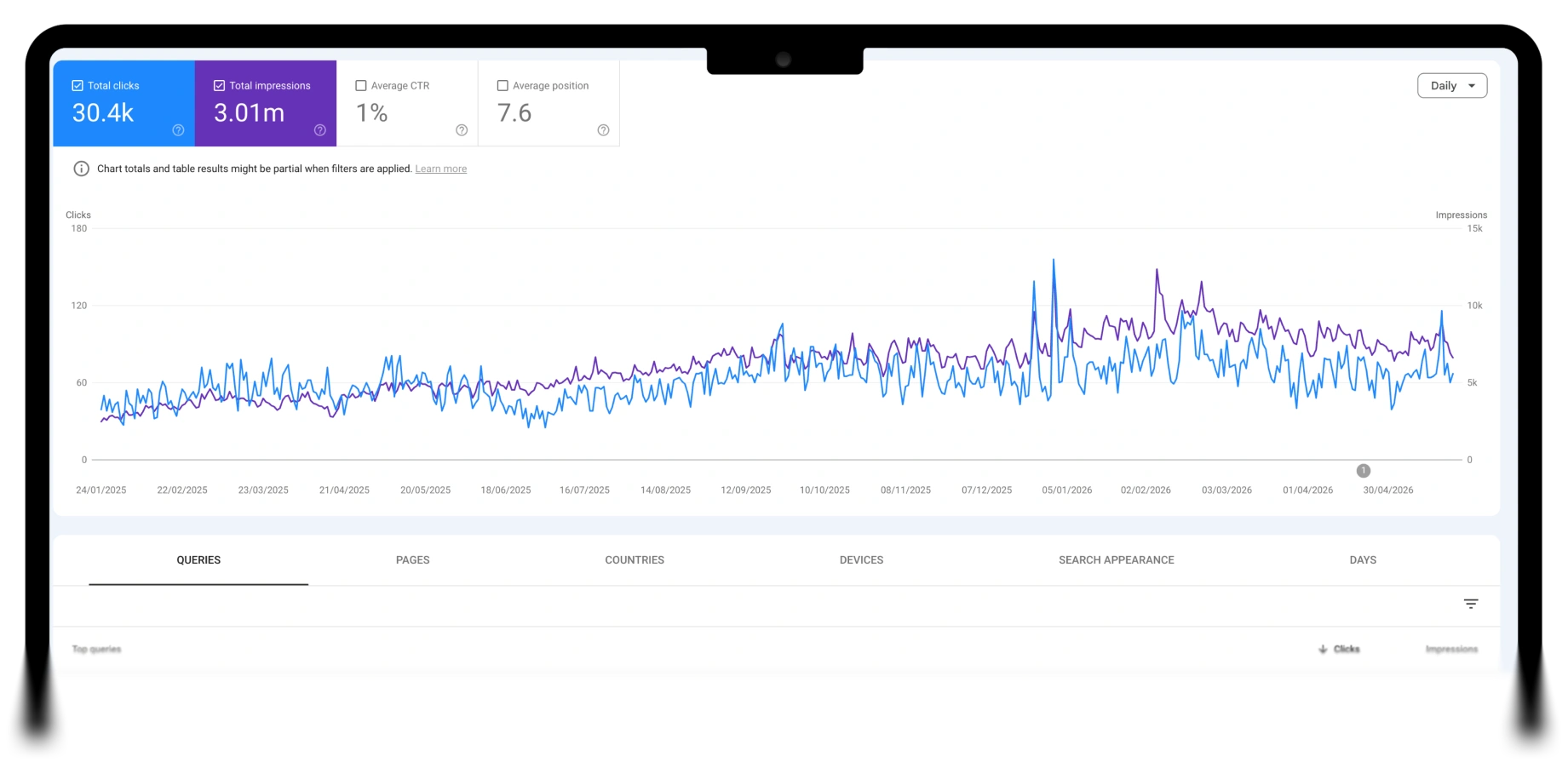
Data from Google Search Console, Google Analytics 4 and SEO tools shows what is actually happening on the site. Search queries, clicks, visibility, conversions, technical issues and user behaviour all help identify where the biggest opportunities lie. The result is a clearer picture of what is working and where the store is losing potential.
This makes it easier to decide what deserves attention first, whether that means content optimisation, technical SEO, category expansion, link building or improving the user experience. Priorities are based on evidence rather than guesswork.
E-commerce SEO does not produce lasting results overnight. It requires consistent work, testing and adjustments as the strategy develops. Search visibility changes over time, and the work needs to keep pace with those changes.
The aim is steady growth in organic visibility, qualified traffic and sales. A well-planned SEO strategy can become a reliable source of traffic as the store grows, rather than a one-off optimisation project.
E-commerce SEO does not work in isolation from your products, margins, customer behaviour and buying journey. A store needs more than visibility in Google to generate sales. The strategy should support the products and categories that matter most to the business.
SEO, content marketing, data analysis and user experience all influence how a store performs in organic search. Bringing these areas together helps turn search visibility into relevant traffic and, ultimately, more sales.
An online store has very different needs from a standard service website. Categories, filters, products, variants, availability, images, reviews and checkout all matter. Each of these elements can affect how easily users find products and how effectively search engines understand the store.
Technical issues, slow pages or a poorly planned structure can quickly become a problem for larger stores. SEO recommendations need to take into account how the store is built, managed and used by customers.
Data from Google Search Console, Google Analytics 4 and SEO tools shows what is actually happening on the site. Search queries, clicks, visibility, conversions, technical issues and user behaviour all help identify where the biggest opportunities lie. The result is a clearer picture of what is working and where the store is losing potential.
This makes it easier to decide what deserves attention first, whether that means content optimisation, technical SEO, category expansion, link building or improving the user experience. Priorities are based on evidence rather than guesswork.
E-commerce SEO does not produce lasting results overnight. It requires consistent work, testing and adjustments as the strategy develops. Search visibility changes over time, and the work needs to keep pace with those changes.
The aim is steady growth in organic visibility, qualified traffic and sales. A well-planned SEO strategy can become a reliable source of traffic as the store grows, rather than a one-off optimisation project.
Talk to our Marketing Director
Choose a convenient time for a 15-minute conversation about your business.
Frequently Asked Questions
E-commerce SEO is the process of improving an online store so that its products and category pages can appear higher in relevant search results. It combines technical SEO, keyword research, on-page SEO, content optimisation, site structure, internal links and other SEO practices that help search engines understand the store.
The goal is to increase organic traffic by making it easier for potential customers to find the right products through Google and other search engines. A good SEO strategy takes into account search intent, relevant keywords and the way people actually browse and shop online.
An ecommerce website usually has a much more complex structure than a typical service website. It can include hundreds or thousands of product pages, category pages, filters, variants and different paths to the same content. The way an ecommerce platform handles these elements can have a direct impact on search visibility.
That makes technical SEO particularly important. Site architecture, internal links, indexing, duplicate content, product descriptions, title tags and page speed can all affect how effectively search engines crawl and understand an ecommerce store. SEO also needs to work with the way products are organised, updated and sold.
The cost of e-commerce SEO depends on the size of the store, the competitiveness of the market and the amount of work required. A small online store with a simple structure will have very different needs from a large ecommerce business with thousands of products and hundreds of category pages.
Before recommending a budget, we look at the current state of the store, its search engine rankings, technical issues, content, website traffic and competitors. This helps identify where SEO efforts can have the greatest impact instead of applying the same approach to every store.
There is no fixed timeframe because results depend on the starting point, competition, site condition and scope of the SEO strategy. Some improvements can become visible within a few months, while building strong and consistent organic traffic usually takes longer.
E-commerce SEO is an ongoing process that involves technical improvements, content, keyword research, internal linking and analysis of search queries. As the store develops, the strategy also needs to adapt to changes in search behaviour, competitors and search engine results.
Yes. Paid ads can generate traffic quickly, but they require a continuous advertising budget. SEO helps build an organic search channel that can continue bringing visitors without paying for every click.
For many ecommerce businesses, the strongest approach is to combine SEO with paid ads rather than treating them as competing channels. Paid campaigns can support short-term goals, while organic search can build visibility for relevant keywords, long tail keywords and product-focused searches over time. This makes SEO a valuable part of a broader marketing strategy.
Yes, but simply making product descriptions longer will not improve rankings. Product pages need useful, original information that helps both customers and search engines understand what the product offers.
Good product descriptions should naturally include relevant keywords, product details, features, use cases and answers to common customer questions. When performing keyword research, we also look for product-specific and long tail keywords that reflect how potential customers actually search. Large ecommerce stores need to watch for duplicate content and avoid keyword stuffing across product pages.
Yes. Page speed affects both the user experience and the technical performance of an online store. Slow web pages can make shopping frustrating, particularly on mobile devices, and can contribute to users leaving before completing a purchase.
As part of technical SEO, we can analyse Core Web Vitals, site speed, image sizes, scripts and other technical aspects that affect loading times. We also look at how these elements affect the overall experience across different web pages, particularly important product and category pages.
In many competitive markets, link building can be an important part of an e-commerce SEO strategy. High quality backlinks from relevant websites can strengthen the authority of a store and support its ability to compete in search engine results pages.
The focus should be on quality rather than simply acquiring as many links as possible. Depending on the business, opportunities may include relevant websites, expert publications, industry content, partnerships and guest posting. The links should make sense for the brand, the audience and the pages they lead to.
Yes, when it has a clear purpose within the SEO strategy. Blog posts can target informational search queries that product and category pages are not designed to answer. They can also help potential customers compare products, understand their options and make purchasing decisions.
The most effective content is connected to the store’s offer. Relevant articles can attract organic traffic, answer questions at different stages of the buying journey and use internal links to guide readers towards relevant pages, categories and product pages.
Start with an SEO audit. Before changing content or adding new keywords, it is worth checking how the store is currently performing and whether technical problems are limiting its visibility.
We look at areas such as Google Search Console data, site structure, category pages, product pages, indexing, page speed, internal links and existing search queries. We can also use keyword research tools such as Google Keyword Planner alongside other SEO tools to identify relevant keyword opportunities. Depending on the store, we may also assess structured data, meta descriptions and other elements that can affect how pages appear in organic search results.
Based on this analysis, we can build an e commerce SEO strategy around the areas most likely to improve organic search visibility, attract more relevant visitors and support long-term ecommerce success.