Expanding into a new country often starts with confidence
You already have a working SEO setup, proven digital marketing strategies and a website that performs well in your main market. Poland looks like a natural next step, especially if you’re already operating across European markets. Then the Polish version goes live and nothing really moves.
We’ve seen this more times than we can count. Not from the outside, but from inside projects where companies had already invested time, budget and internal resources into entering the market. Everything looked right at first glance. The structure was there, the content was there, the technical side was handled. What was missing only became visible once the results didn’t follow.
That’s where most guides stop being useful. They focus on SEO services, tools, checklists and generic best practices. They don’t show how those decisions actually play out when you’re working across languages, markets and different types of audiences. This article comes from that perspective.
From working with companies like United Multimodal, Schroter, Explain Visually, Imperial Citizenship or Entremise, where SEO had to function across multiple countries and language versions. Different industries, different business models, but a very similar challenge at the core: how to build visibility in a market that doesn’t behave like the one you’re used to.
If you’re entering Poland and want to avoid the usual trial-and-error phase, this will give you a much clearer starting point.
Entering Poland with SEO is easier said than done
On paper, the plan looks clean. You already have SEO in place, your website ranks, you have content, structure and often solid domain authority. The next step seems obvious: translate the site, adjust a few keywords and expect things to pick up.
In reality, that approach rarely delivers results. Poland requires a different way of thinking about search, competition and user behaviour, so what works in Germany or the UK often doesn’t carry over in a meaningful way.
We’ve seen companies spend months preparing Polish versions of their websites that looked technically correct and aligned with their existing strategy, yet failed to gain traction in search engines. The gap usually appears much earlier in the process, at the level of decisions that shape the entire setup.
Why most international SEO strategies fail in the Polish market?
Most issues start much earlier than execution. Many companies carry over assumptions from their main market and treat them as a solid starting point. The idea seems reasonable, especially when the offer stays the same. In practice, search behaviour, language and competition introduce enough differences to make those assumptions unreliable.
Search intent varies more than it might seem at first glance. The same service can be described in several ways, and the phrasing that works in one market may not exist in another in any meaningful way. Direct translations often sound correct, but they don’t reflect how people actually search.
We’ve worked with companies entering Poland from the UK, Germany and the US, and the pattern is consistent. They come in with translated landing pages, keyword lists based on their original market and content that reads naturally in English, yet feels slightly off in Polish. The result is a setup that looks complete, but struggles to build visibility in search results.
The issue becomes more visible at the keyword research stage. Instead of relying on translated phrases, the focus shifts to how Polish users describe the same need, what variations they use and which queries actually carry search demand.
In one of our projects, the translated keyword was technically accurate and aligned with the original strategy, yet it generated almost no traffic. The majority of visibility came from a different phrase that didn’t appear in direct translation and only surfaced during deeper analysis. That adjustment reshaped the direction of the entire SEO strategy.
What a well-executed SEO process looks like when entering Poland?
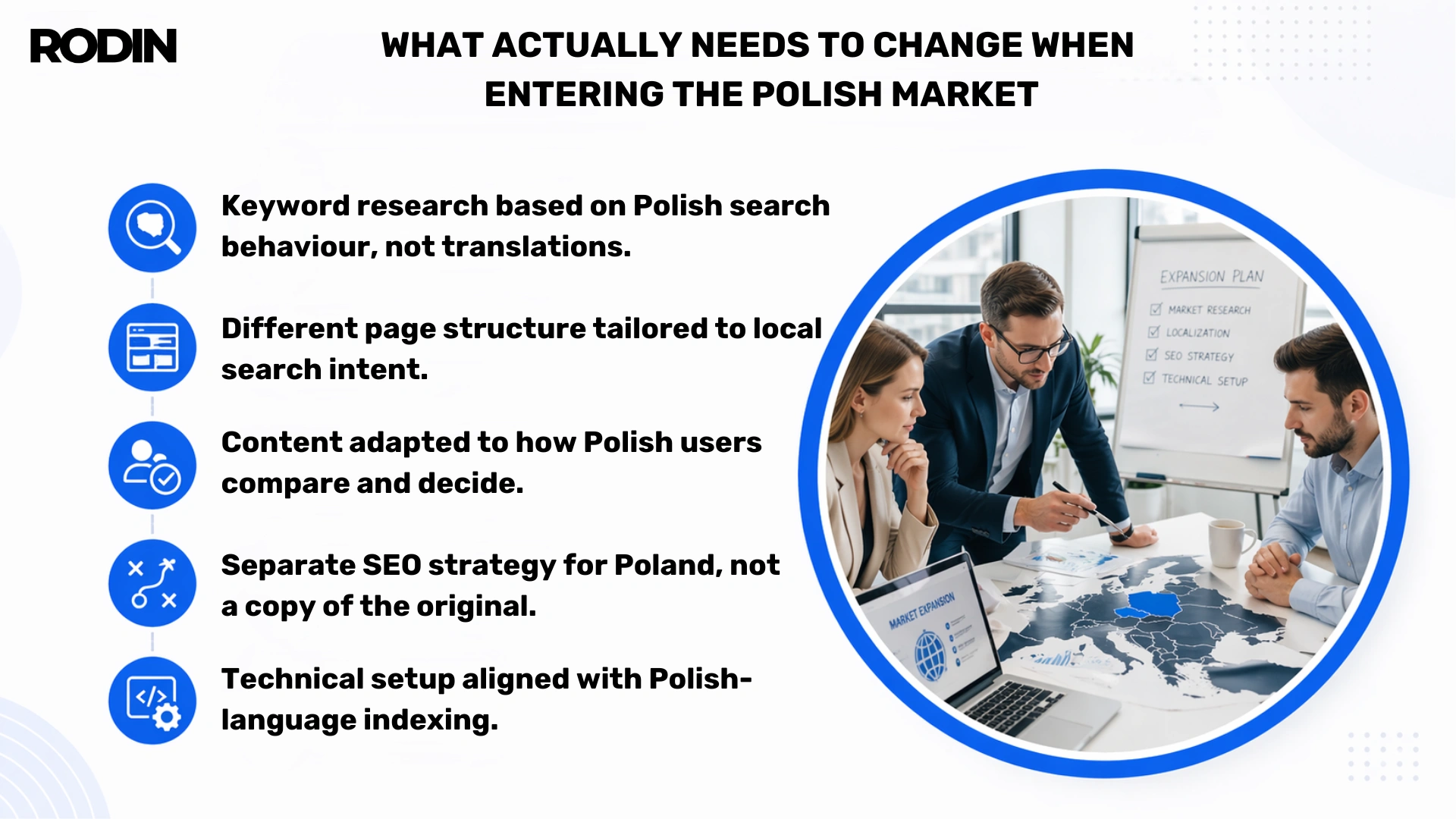
Entering a new market requires a shift in thinking. Instead of extending what already exists, you start from a different angle and decide what actually deserves visibility in this market, how it should be structured and in what order it should grow.
1. The first real decision is prioritisation
Not every service should be pushed at once. Not every page needs to exist. In many cases, only a part of the offer has real potential in Poland.
What’s often surprising is how uneven that potential can be.
In one of our projects, a company assumed that their full offer would perform similarly across markets. After analysing search demand and competition in Poland, it turned out that only a small part of their services had strong visibility potential. The rest either had very low search volume or was dominated by local competitors with years of presence.
Focusing on that narrower segment allowed us to build traction much faster. Instead of spreading effort across dozens of pages, we concentrated on a few areas where visibility was realistically achievable. Once those started generating organic traffic and improving website rankings, expanding the structure became a much more controlled process. This kind of prioritisation often decides whether SEO starts gaining momentum or stays flat for months.
2. Then comes structure
Instead of copying your existing website, you build a version aligned with how users search in Poland. That might mean fewer pages with clearer intent, or more landing pages if demand is more fragmented. There is no template you can reuse blindly. The difference shows up in how users enter the website.
In some markets, broader category pages perform well because users search in a more general way. In Poland, we often see more specific queries that lead directly to focused landing pages. That changes how the entire site should be organised.
We’ve worked on projects where keeping the original structure resulted in pages that were technically correct but invisible in search results. Rebuilding the structure around actual queries created entirely new entry points from search engines and significantly improved organic traffic.
Structure shapes visibility much more than most teams expect.
3. Content follows structure
This is where many companies default to content marketing as volume production. That approach doesn’t hold up in a new market. Each page needs to reflect specific search intent, not just exist.
The difference becomes obvious when you look at how users interact with the page.
If the content reflects how they think about the problem, they stay longer, explore further and are more likely to convert. If it feels slightly off, even if it’s grammatically correct, engagement drops quickly.
In projects like Explain Visually or Imperial Citizenship, the shift happened when we moved away from adapting existing content and started shaping it around local expectations. That included changing how services were described, how benefits were presented and how decisions were framed.
Those adjustments may look subtle from the outside, but they have a direct impact on search rankings, website traffic and overall SEO performance. That’s usually the point where visibility starts to grow in a consistent way.
Technical SEO is where small mistakes become big problems
Technical SEO becomes more important when you operate across languages. What looks like a small issue in a single market can scale into a serious problem when you add multiple versions of the same site.
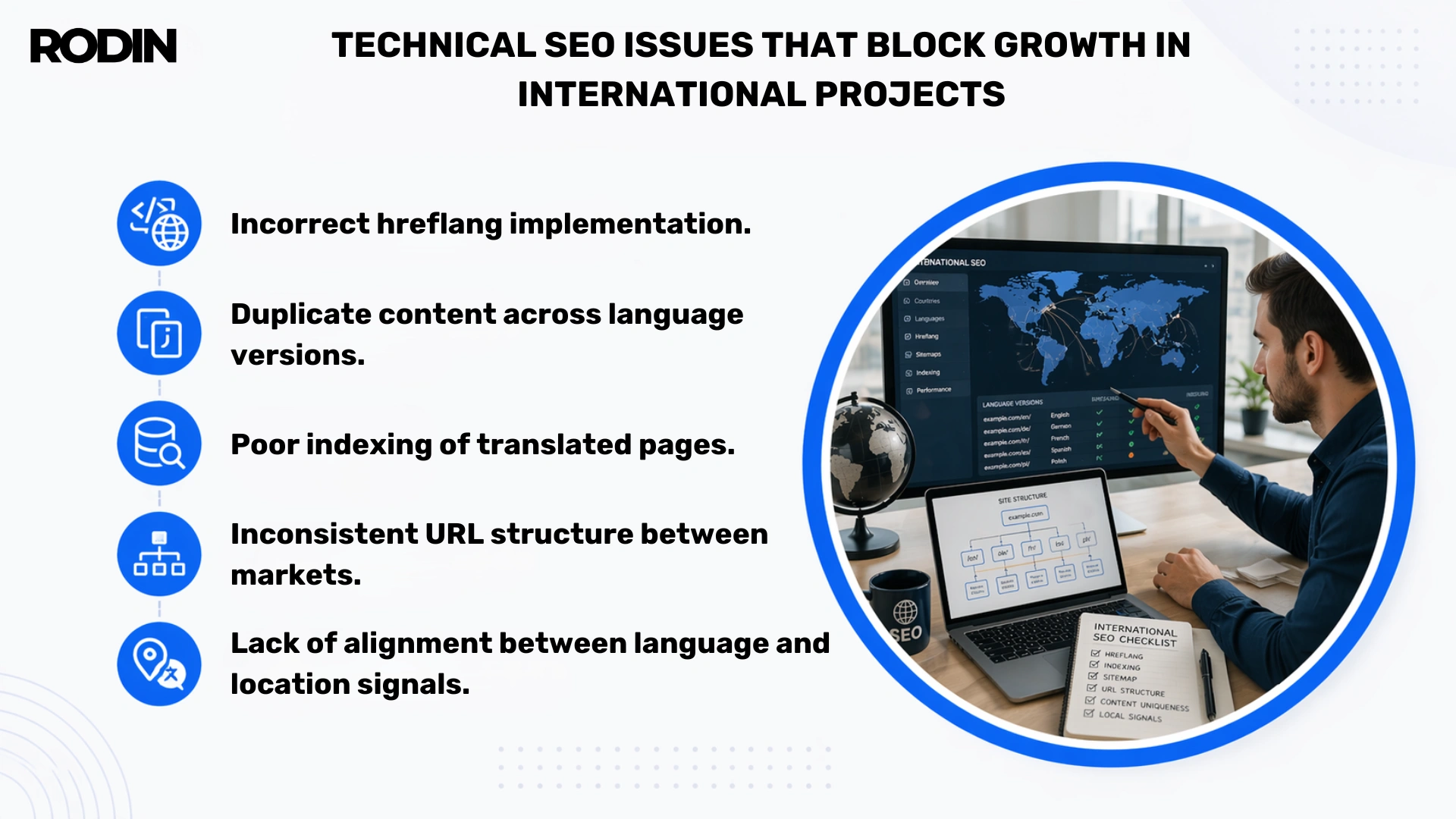
We often see international websites where search engines struggle to understand which version should rank in which country. That affects indexing, search engine rankings and ultimately organic traffic. Technical SEO, especially in multilingual setups, is much closer to information architecture than most people realise.
A common situation looks like this:
You have three language versions. All of them are indexed. All of them are technically accessible. But Google keeps showing the wrong version in the wrong market. German users land on English pages. Polish users see content that was meant for a different audience.
Nothing is “broken” in the obvious sense, yet performance stays inconsistent. What’s happening underneath is a lack of clear signals. Search engines don’t just need access to your pages, they need clarity. Which version is primary, how they relate to each other and where each one should appear in search results. Without that clarity, even well-optimised pages struggle to reach stable rankings.
Another issue shows up when companies scale content too quickly. They launch dozens or hundreds of pages across different language versions, assuming that more pages will automatically increase visibility. What actually happens is that indexing slows down, crawl budget gets diluted and many of those pages never properly enter search results.
We’ve seen projects where reducing the number of indexed pages and focusing on a smaller, cleaner structure improved performance faster than expanding further. That’s not intuitive, but it happens often.
There’s also a layer most teams don’t think about until it becomes a problem: consistency. Not just in URLs or tags, but in how the entire system behaves. If one language version uses a different logic for URLs, metadata or internal linking, it creates friction. Individually, those differences seem small. At scale, they start to interfere with how search engines interpret the site.
That’s why technical SEO in international projects is less about fixing isolated issues and more about building a structure that stays predictable across all versions.
Link building in Poland works differently than you expect
Link building is one of the areas where companies assume they can reuse the same approach everywhere. They can’t. The Polish market has its own ecosystem. Different types of websites, different expectations and different ways of building authority.
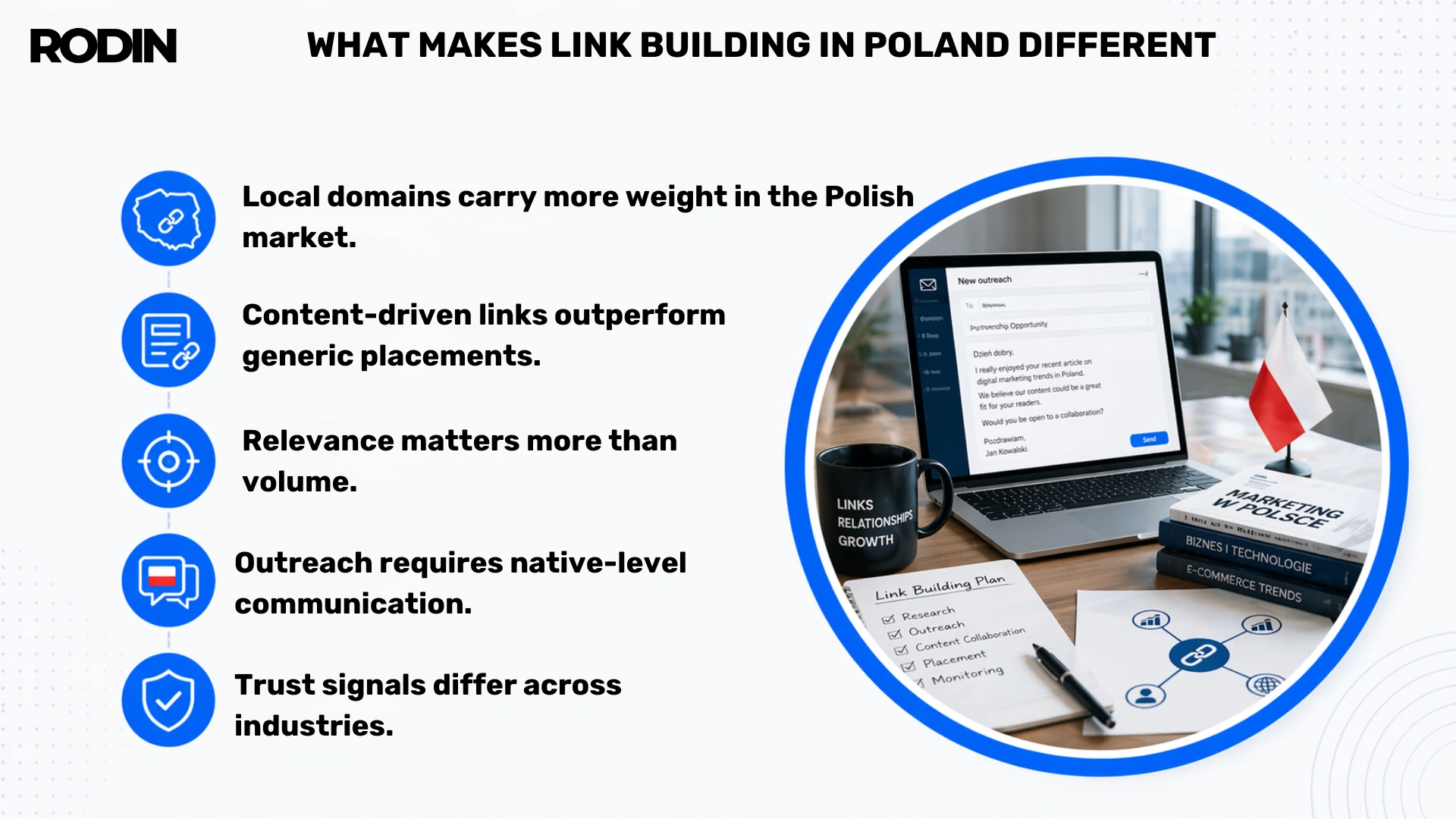
Effective link building strategies in Poland are not about scaling numbers. They are about building credibility in the local market.
We’ve worked on projects where improving a small number of high-quality links had more impact than large-scale campaigns with low relevance. That shift often changes how SEO performance evolves over time.
Working across languages is not just about translation
When companies expand into Poland, they usually start with translation because it feels like the fastest way to launch. The structure is already there, the content exists, so adapting it seems efficient. The problem appears when that translated version enters search results and fails to connect with how users actually think, compare and make decisions.
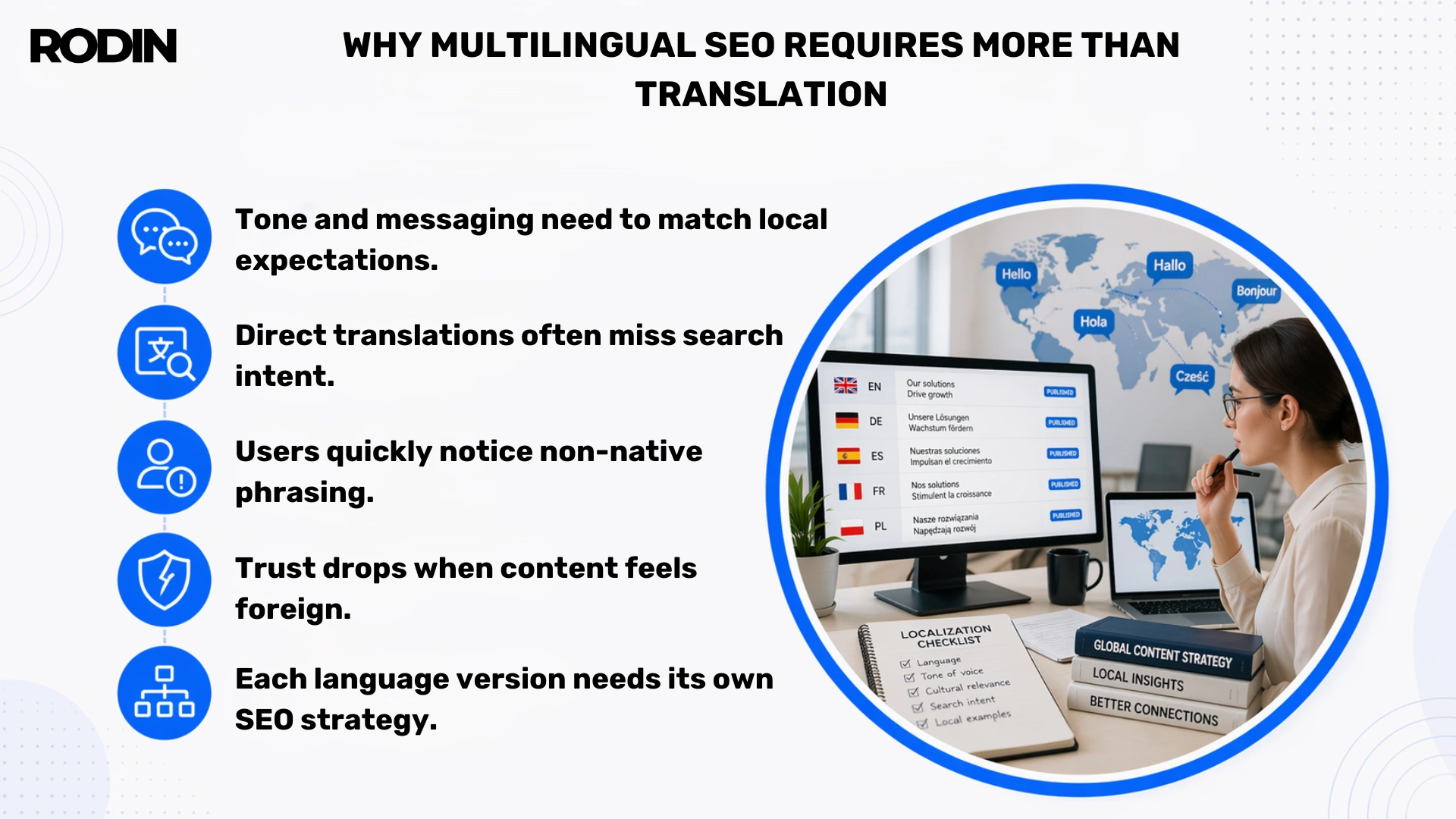
Language carries context. The same service can be described in a more direct, more technical or more benefit-driven way depending on the market. In Poland, certain phrases sound too formal, others too generic, and some simply don’t exist in the way they do in English. That gap affects how pages perform, because search engines pick up on engagement signals. If users don’t recognise the phrasing or feel that the content doesn’t reflect how they would describe the problem, they leave faster and interact less.
Where most companies lose momentum and how to avoid it
Expanding into Poland rarely fails because of a single mistake. It usually slows down through a series of small decisions that seem reasonable at the time. Reusing existing structures, translating content too directly, targeting the wrong segments first or spreading efforts too thin across multiple areas. Each of those choices on its own doesn’t look critical. Together, they shape whether SEO becomes a growth channel or just another ongoing cost.
In our projects like United Multimodal or Akif Capital, the challenge was never just about entering Poland. It was about making SEO work alongside existing markets, without breaking what already performed well and without creating disconnected strategies for each country. That requires a different level of coordination.
Keyword research needs to reflect local demand without losing alignment with the overall positioning. Content needs to feel native in each language, while still supporting one coherent message. Technical structure has to scale across versions without creating confusion for search engines. When those elements start working together, SEO stops being a set of tasks and becomes a system.
Choosing an SEO partner who understands growth across markets
By the time you start comparing SEO agencies, most of them will sound convincing. They will talk about rankings, traffic, visibility and digital marketing services. The language is similar, the promises are similar and even the deliverables often look alike. The difference becomes clear much later, in how decisions are made.
A strong partner looks at SEO through the lens of your business, not just search engines. They focus on where growth actually comes from, which markets deserve priority and how different elements of your strategy connect across countries.
That perspective changes how SEO campaigns are planned, how resources are allocated and how results are measured. It also makes collaboration easier.
Because instead of constantly adjusting tactics, you’re building something that evolves in a consistent direction. SEO becomes part of a broader digital strategy, aligned with your business objectives and adapted to how your markets actually work.
And that’s usually the point where SEO starts delivering results that go beyond rankings and traffic.
Frequently asked questions
SEO services in Poland for international businesses require a more tailored approach than standard local campaigns. Instead of relying on translated keywords or existing structures, the process starts with thorough keyword research in the Polish language and a clear understanding of local search intent.
That’s what allows for building effective SEO strategies that actually support keyword rankings and drive organic traffic. In practice, this means adapting both content marketing and technical SEO aspects to match how Polish users search and interact with content, rather than trying to replicate what worked in another market.
Comprehensive SEO services should go beyond basic optimization. You should expect a mix of keyword research, content marketing, technical SEO and link building strategies, all aligned with your business objectives. A good digital agency will also focus on enhancing online visibility across search engine results, not just improving positions for a handful of keywords.
For businesses seeking growth, the goal is not only visibility, but consistent website traffic and long-term SEO performance.
It plays a central role. Thorough keyword research determines which phrases can realistically generate traffic and which ones only look good on paper. Without it, even well-executed SEO campaigns struggle to gain traction.
In international projects, keyword analysis needs to be done separately for each market. What supports keyword rankings in one country may have no impact in another, which is why search optimization always starts with local data and not assumptions.
Only at a very general level. The core direction can stay consistent, but tailored SEO strategies are needed for each market. That includes adapting content marketing, keyword targeting and even how services are positioned.
We’ve seen companies in Poland and across European markets achieve better results when they treat each market as a separate layer within one strategy, rather than trying to force a single model everywhere.
SEO rarely works in isolation. In many cases, it complements search engine marketing, social media marketing and broader digital marketing strategies. For example, SEO can support long-term organic traffic growth, while PPC campaigns help validate search intent and accelerate visibility in competitive areas.
When combined properly, these channels improve overall online visibility and create more consistent results across different stages of the customer journey.
Technical SEO becomes more important as complexity increases. Managing multiple language versions, aligning structures and ensuring proper indexing requires a solid understanding of search engine algorithms. Tools like Google Analytics and Google Search Console help monitor performance, but the real challenge lies in building a structure that search engines can interpret correctly. Without that, even strong content struggles to appear in search engine results.
Look beyond the offer itself. Top SEO companies differ less in what they promise and more in how they think. A strong SEO agency based in Poland will focus on your business objectives, use data-driven SEO services and communicate clearly about how they plan to drive results.
It’s also worth paying attention to how they use SEO tools, how they approach keyword research and whether they can explain their SEO practices in a way that makes sense for your business.
Results depend on your starting point, competition and how well your strategy is adapted. In most cases, you can expect gradual improvements in website traffic, keyword rankings and overall online visibility. The more aligned your SEO efforts are with real search behaviour and business goals, the more stable those results become over time.
For companies entering new markets, the goal is not just visibility, but building a foundation that supports long-term growth.