The situation of a new brand entering a competitive market
Not long ago, a client came to us with a question that, on the surface, sounded completely reasonable. They asked whether it would be possible to pause SEO activities for one or two months.
The company was new, operating on a fresh domain, and building visibility from zero. For many new businesses, organic search quickly becomes the primary source of website visitors, making early SEO efforts especially critical. On top of that, it was a medical business, which immediately puts it in one of the most demanding categories in search. Competing there means not only going up against other companies investing heavily in marketing, but also dealing with how carefully Google approaches medical content. It takes more time, more verification, and more consistency before anything starts ranking properly.
We had been working on their positioning for around three to four months. The first effects were already visible. Some pages were starting to gain traction, initial rankings were appearing, and the overall direction looked promising, especially considering how competitive that space is.
And this is exactly the point where the question about pausing came up.
Why short-term budget pressure leads to risky decisions
The reason behind it was not unusual. The client had several investments happening at the same time and started looking for areas where expenses could be temporarily reduced.
SEO often becomes the first candidate in that situation. It does not produce immediate spikes. There is no clear moment where you can say, we turned this on yesterday and today we have results. The process takes time and, in the early stages, requires patience.
From the client’s perspective, the thinking was quite natural. They had already invested a few months, they could see something starting to move, so stepping away for a short period did not seem like a major decision. However, it’s important to recognize that SEO should be viewed as an ongoing SEO program rather than a short-term campaign.
The difficulty is that SEO does not behave like channels where you can stop and resume without consequences. The work that is done builds up gradually, layer by layer. Visibility grows because there is continuity. Once that continuity is interrupted, the process does not simply wait. Continuing your SEO program can help maintain and grow organic traffic, which brings more qualified users to your site.
The dangerous illusion of “just a short break”
A pause of one or two months sounds small. In practice, it is enough to disrupt the rhythm that search engines expect to see.
To understand the consequences, consider what happens if you stop SEO efforts. Regular publishing, updates, and activity signals are part of how websites gain and maintain visibility. When those signals disappear, even temporarily, it affects how the site is evaluated. At the same time, competitors continue publishing, expanding their content, and improving their pages.
It is worth remembering what happens when a page reaches higher positions. Other companies start analyzing it, trying to replicate or improve it, and pushing it down in the results. If the original site slows down, that process accelerates.
There is also a practical consequence that is often underestimated. A page that brings steady traffic from top positions can lose most of it once it drops even a few places. Moving from top three to lower positions can mean going from thousands of visits to almost none, simply because users rarely go further down the results.
When work resumes after a break, the situation is different from where it was left. Rankings have shifted, competitors have moved forward, and part of the previous effort needs to be rebuilt before new progress can even begin. Stopping SEO creates a deficit that forces you to pay a catch-up tax later, requiring significantly more effort and time to regain lost rankings.
This is why what looks like a short pause often turns into a longer recovery.
SEO is not a switch, it is a continuous process
Why SEO cannot be turned on and off
One of the most common misunderstandings about SEO comes from comparing it to paid campaigns. In paid channels, you can stop spending, wait, and then restart without affecting past performance. The system is still there, waiting for your budget.
SEO does not work like that.
When the client asked about pausing for one or two months, the assumption behind the question was that everything would simply hold its position and continue later from the same point. In reality, search visibility depends on ongoing activity. Content gets crawled, evaluated, compared, and re-ranked constantly. If you stop optimizing, you risk declining search rankings, technical decay, and losing your competitive advantage as competitors continue their efforts.
If that activity slows down or disappears, the signals weaken. Over time, this affects how the website is perceived by search engines. Positions begin to shift, sometimes gradually, sometimes faster than expected. Continuous SEO helps businesses adapt to changes in search engine algorithms, ensuring ongoing visibility.
The snowball effect of SEO growth
A better way to understand SEO is to look at it as something that builds over time. Every article, every update, every internal link contributes to the overall strength of the domain. This ongoing effort creates seo momentum, where each action compounds the effects of previous work, leading to sustained progress.
At the beginning, progress feels slow. Then things start to connect. Pages support each other, authority increases, and visibility grows more noticeably. This is similar to compound interest—small, consistent SEO actions accumulate and can lead to exponential growth in search visibility, lead generation, and revenue over time. That is why after a few months, results often begin to appear, even in competitive industries. The snowball effect means that SEO builds long-term organic visibility that continues to drive traffic even if you scale back efforts later.
This is also why interruptions are so costly. When the process is ongoing, each new action adds to the previous one. When it stops, that accumulation slows down and can start to reverse. You are no longer building on top of momentum. You are trying to regain it.
How algorithms reward consistency and freshness?
Search engines and other platforms pay close attention to consistency. Regular updates, new content, and ongoing activity show that a website is maintained and relevant.
Search algorithms are designed to reward sites that consistently provide fresh, relevant content, while deprioritizing those that become dormant or outdated. When content appears regularly, it creates a pattern. Algorithms pick up on that pattern and are more likely to revisit, re-evaluate, and promote those pages. Users also respond to it, because they see that the website is active and up to date.
Understanding search intent is also crucial—aligning your content with what users are truly looking for helps ensure your pages meet both user needs and algorithmic expectations. When that pattern breaks, the effect is noticeable. Fewer updates mean fewer reasons to revisit the site. At the same time, competitors who continue publishing gain an advantage. They provide newer, more up-to-date content, which gradually becomes more attractive both for users and for search engines.
This is why consistency plays such a central role. It is not about intensity or short bursts of activity. It is about maintaining presence over time and allowing the system to keep moving forward. Investing in SEO is a long-term strategy that builds a proprietary, high-converting asset for your business.
The importance of content updates
Keeping your website’s content up to date is one of the most effective ways to maintain and improve your search engine rankings. Search engines like Google are constantly looking for signals that a website is active, relevant, and providing value to users. When you regularly update your content, you’re sending a clear message: your website is a reliable source of fresh information. This not only helps your pages appear higher in search results, but also drives more organic traffic to your site. Over time, these updates can significantly impact your online visibility and increase the likelihood of converting visitors into customers.
Why fresh content signals relevance
Fresh content is a powerful indicator of relevance for search engines. When your website is consistently updated with new information, it shows that you’re keeping pace with changes in your industry and addressing the evolving needs of your target audience. Search engines reward this by improving your search rankings, making it easier for users to find your site when they’re looking for up-to-date answers. For your audience, regularly refreshed content builds trust and encourages them to return, knowing they’ll always find the latest insights and solutions. In a landscape where rankings can shift quickly, staying current is essential for maintaining your position.
How regular updates sustain rankings and engagement
Consistent content updates are key to sustaining both your search rankings and user engagement. By continuously adding relevant content, your website remains visible in search engine results, attracting a steady stream of website visitors from organic sources. This ongoing activity not only helps you hold onto your rankings, but also encourages more interactions—such as comments, shares, and repeat visits—which further boost your site’s authority in the eyes of search engines. Ultimately, regular updates create a cycle of organic traffic growth, higher engagement, and increased opportunities for conversions, all of which contribute to long-term business success.
What happens when you stop SEO?
1. Loss of trust from algorithms
When SEO activity slows down or stops, the first thing that changes is how your website is perceived. Search engines continuously evaluate content, looking at how often it is updated, how relevant it is, and whether it remains useful compared to other pages.
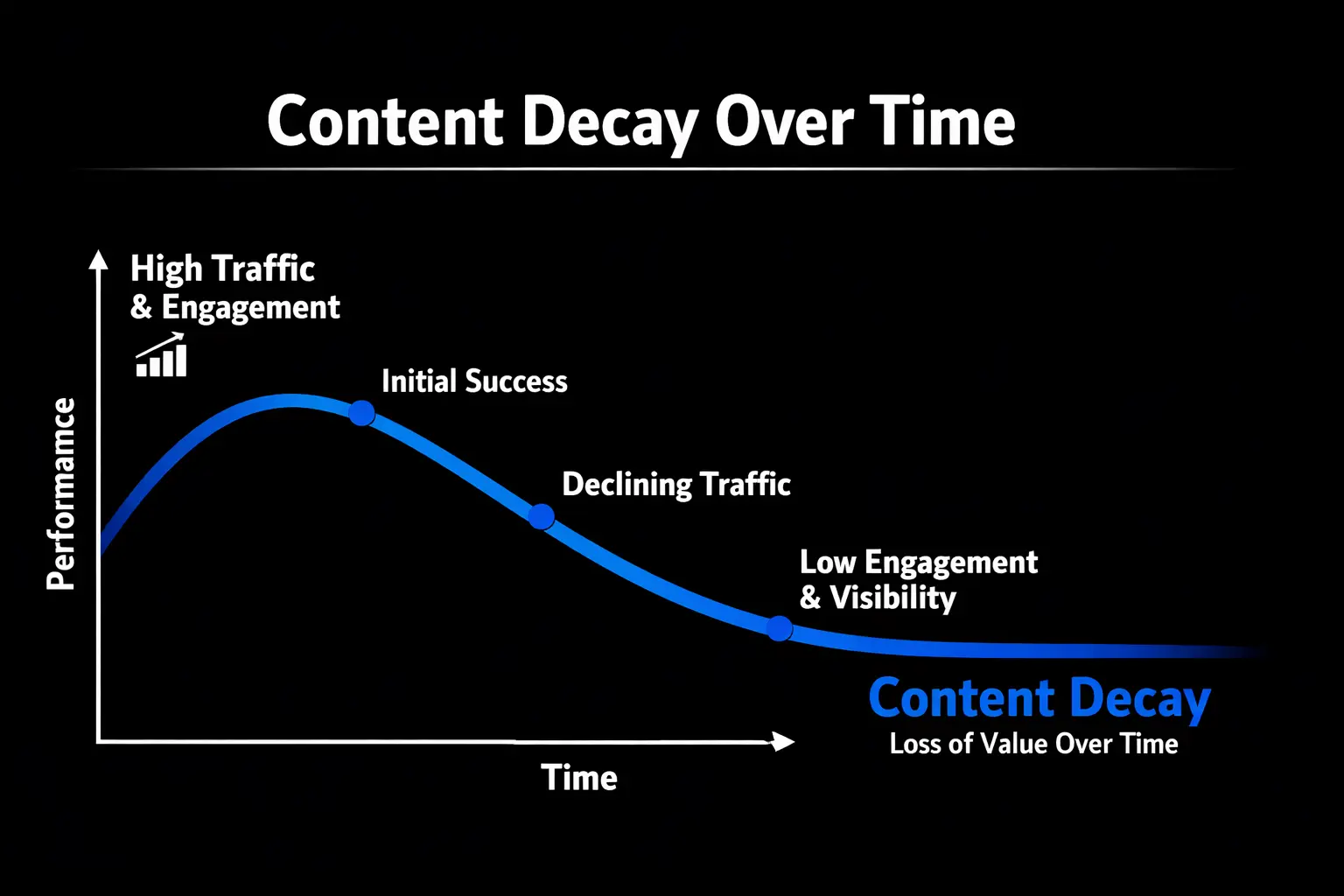
If new content stops appearing and existing pages are not updated, the site gradually becomes less active in the eyes of the algorithm. Outdated content quickly loses its edge, causing a drop in search rankings and visibility. It does not happen overnight, but over time the signals weaken. Crawling frequency can decrease, updates are less frequent, and the overall presence of the site starts to fade compared to more active competitors. Pausing SEO can lead to a loss of authority, making it harder to regain search rankings later.
This is particularly visible in industries where accuracy and freshness matter. Content that is not maintained begins to lose its edge, even if it performed well before. Organic growth and organic success depend on continuous effort—pausing SEO disrupts this process and can make recovery more challenging and costly.
2. Competitors taking over your rankings
At the same time, your competitors are not standing still. While one website slows down, others continue publishing, improving their content, and targeting the same keywords. As a result, competitors gain an edge and competitors overtake your site in search rankings, especially if you pause your SEO efforts.
It is a very common pattern. When a page reaches high positions, especially within the top three or top five results, it becomes a reference point. Other companies analyze it, look at its structure, its content, and try to create something better or more up to date.
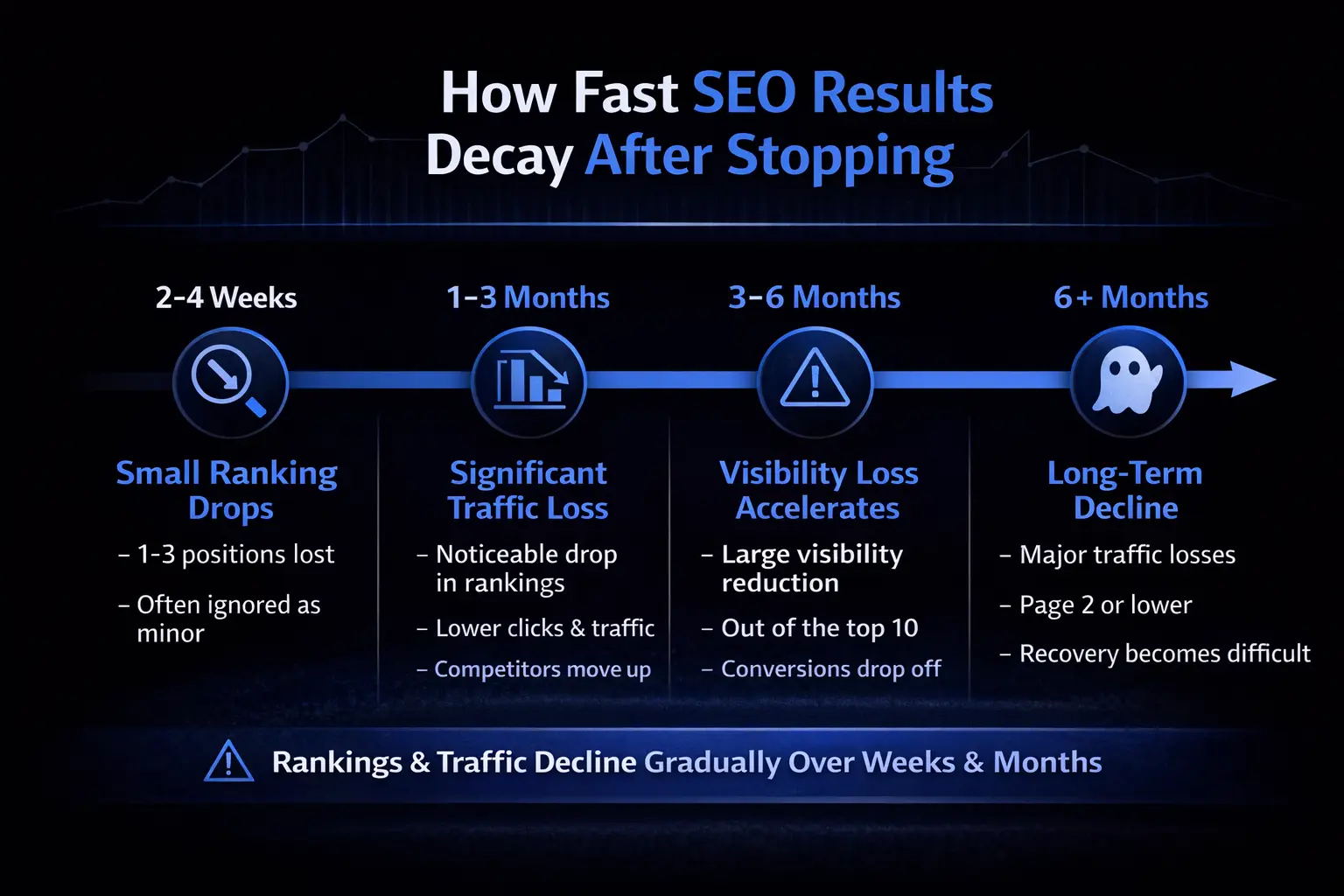
If your activity stops, even temporarily, it creates space. Competitors fill that space quickly. New articles appear, existing ones get expanded, and over time they begin to move ahead in rankings. Rankings for competitive keywords may start to slide as early as months 3-4 due to paused SEO efforts. When SEO efforts are paused, competitors who continue their optimization will quickly surpass your rankings.
This process does not require a dramatic change. Small improvements on multiple competing pages are often enough to shift positions.
3. Rankings drop faster than they grow
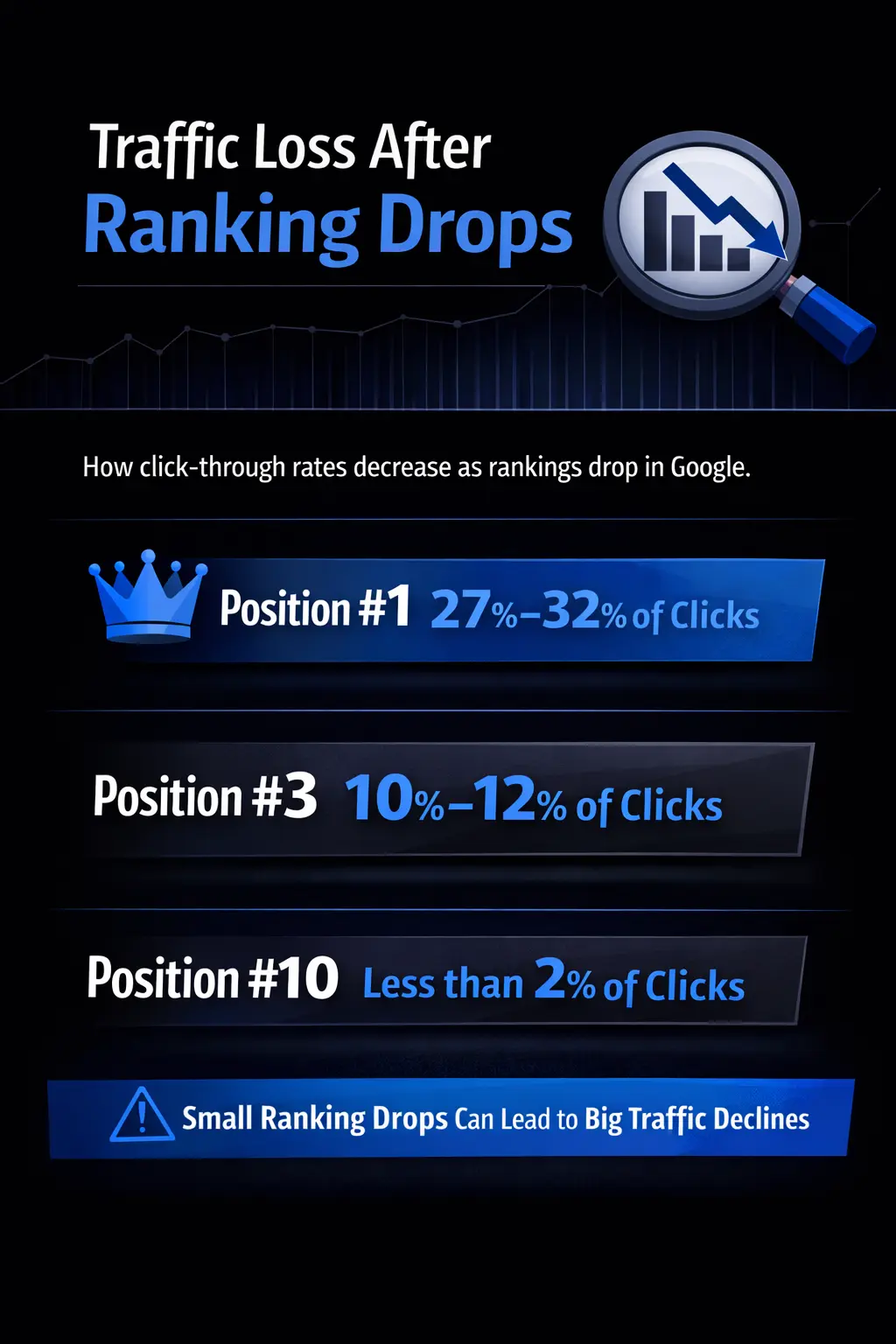
There is also an asymmetry in how rankings behave. Reaching top positions usually takes time. It requires consistency, multiple iterations, and gradual improvements across many pages.
Losing those positions can happen much faster. Once a page starts to slip, it often continues moving down as newer or more relevant content takes its place. This rankings slip is often seen in the keyword positions of your primary keywords, where even a small drop can have a big impact on visibility and traffic.
The impact becomes clear when you look at traffic. A page that generates steady visits from a top position can lose most of its traffic after dropping just a few spots. In fact, a drop of just one or two spots in search rankings can result in a 10-20% reduction in organic traffic. By month 3, competitive keywords often slip 2-3 positions, potentially causing a 10-20% decrease in traffic. Between months 5 and 8, organic traffic can decrease by 25-40% as primary keywords drop to lower pages. Users rarely go beyond the first few results, so even a small decline in ranking can translate into a significant drop in visibility.
When this happens across several pages, the overall effect becomes difficult to ignore. Recovering those positions later requires not only regaining what was lost, but also catching up with everything competitors have built in the meantime.
Actively monitoring competitors
In the fast-moving world of search engine optimization, actively monitoring your competitors is a critical part of any effective digital marketing strategy. By keeping a close eye on what other businesses in your space are doing, you can spot new opportunities, identify potential threats, and refine your own SEO strategy to stay ahead. This proactive approach helps you maintain your share of organic traffic, adapt to changes in the market, and ensure your website remains competitive in search results.
How to spot competitor moves early
Spotting competitor moves early requires a combination of the right tools and a strategic mindset. Start by regularly reviewing your competitors’ websites to see what new content they’re publishing, which keywords they’re targeting, and how their site structure evolves. Tools like Google Alerts can notify you when competitors are mentioned online, while backlink analysis platforms reveal shifts in their link-building efforts. Monitoring their social media channels and content marketing campaigns can also provide clues about their SEO strategy. By actively tracking these signals, businesses can quickly adapt their own SEO approach, respond to emerging trends, and ensure their website remains visible and relevant in Google’s search results. This ongoing vigilance is essential for any business that wants to maintain a strong presence online and continue attracting organic traffic.
The brutal reality of losing top positions
Traffic collapse from small ranking drops
One of the most underestimated aspects of SEO is how sensitive traffic is to ranking positions. On paper, moving from position two to position five does not look dramatic. In practice, the difference is often massive.
If a page sits in the top results, it can generate a steady flow of traffic every month. But once it drops lower, that flow can shrink to a fraction of what it used to be. When SEO efforts are paused, organic sources fall sharply and rankings can enter a free fall, leading to a rapid and severe drop in organic traffic and visibility. Leads and conversions can decline by 25-40% within 5-8 months of pausing SEO. It is not unusual to see a page go from around a thousand visits to just a few dozen, simply because users rarely click beyond the first few results.
This is not about losing visibility entirely. The page is still there. It is just no longer being chosen.
Why users rarely go beyond top results
User behavior in search has been consistent for years. Most clicks go to the first few positions, and attention drops sharply after that. By the time you reach the lower half of the first page, the number of clicks is already limited. Anything beyond that becomes almost invisible.
Top search results attract high intent traffic—visitors who are specifically seeking in-depth, authoritative information and are much more likely to convert.
This means that even a small drop in ranking can have a disproportionate impact. The difference between being seen and being ignored often comes down to just a few positions.
From a business perspective, this translates directly into fewer leads, fewer inquiries, and less revenue coming from organic traffic.
Increased difficulty of regaining lost rankings
Once positions are lost, getting them back is rarely a simple reversal of what was done before. During the time your activity slowed down, competitors continued to build their presence. They published more content, updated existing pages, and strengthened their positions.
Coming back into the process means working against that new reality. It often requires more effort than it did the first time, because now you are not only rebuilding your own visibility, but also competing with stronger pages than before.
There is also the issue of momentum. When SEO is done consistently, each action supports the next one. After a break, that continuity is gone, and part of the work involves restoring it before real progress can happen again.
This is why losing top positions is not just a temporary setback. It tends to extend the timeline and increase the effort needed to return to where you were.
Seo vs paid ads: a critical difference
Why ads can be paused without consequences?
When companies look for quick ways to reduce marketing costs, paid ads are often compared directly with SEO. On the surface, both require ongoing investment, so it feels natural to treat them the same way. But their mechanics are completely different.
Paid campaigns are built on a simple principle. You pay for visibility, and when you stop paying, the visibility disappears. This is the core of paid advertising: results are immediate but only last as long as you continue to invest, unlike SEO, which builds long-term organic presence. What matters is that nothing deteriorates in the background. The system does not remember that you paused. When you return and activate campaigns again, you are essentially picking up from the same starting point, using the same structure, the same targeting, and the same setup.
There is no accumulated loss during the break. The only thing you lose is the traffic you could have generated while the ads were inactive.
Why SEO behaves differently over time?
With SEO, the situation unfolds in a much less forgiving way. Visibility depends on how your website evolves over time in relation to other websites. Your digital infrastructure—the foundational technical and content systems that support SEO—must be maintained to ensure ongoing organic visibility. Content is compared, updated, and re-evaluated continuously, and positions shift as a result of that process.
When activity slows down, your website does not stay in place waiting for you to come back. It gradually becomes less competitive. Maintaining technical health and promptly addressing technical issues such as slow page speed, broken links, and mobile usability is crucial to prevent a decline in search engine rankings and user experience. Other sites continue publishing, updating, and improving their pages, which changes the entire landscape.
This means that after a break, you are not returning to the same environment. You are entering a space where others have moved forward, and your previous position is no longer guaranteed. A website is a living piece of software that requires continuous monitoring to prevent technical decay.
Long term vs short term marketing impact
This difference becomes especially important when decisions are made under budget pressure. Pausing ads reduces costs immediately and can be reversed at any time without affecting long-term positioning.
With SEO, the effects are delayed and often only become visible after some time. A temporary pause may seem like a small adjustment in the moment, but its consequences tend to appear later, when rankings start to shift and traffic begins to decline. Pausing SEO efforts disrupts organic search performance and undermines the organic growth that comes from consistent optimization. In fact, pausing SEO activities leads to a gradual decline in search rankings, organic traffic, and lead generation, typically noticeable after 3–6 months.
From a broader perspective, this changes how both channels should be managed. Paid ads are flexible and can be adjusted depending on current needs. SEO requires continuity, because its results depend on what happens over weeks and months, not just on what is done today.
SEO is like a living system and needs maintenance
Going to the dentist regularly… or urgently?
There is a pattern that shows up not only in marketing, but in many areas of business. As long as nothing seems wrong, it is easy to delay action. SEO often falls into that category.
When traffic is coming in and rankings are stable, there is no immediate pressure to keep investing at the same level. The urgency simply is not there. It feels similar to skipping a dentist visit when there is no pain. Everything seems fine, so it can wait. In fact, during the first 1–2 months of pausing SEO, rankings and traffic may remain stable, leading to a false sense of security.
The problem appears later. Neglecting regular SEO maintenance can result in technical issues such as broken links and declining core web vitals, which harm user experience and search rankings and can require complex, resource-intensive fixes. Once visibility starts dropping or rankings are lost, the reaction becomes urgent. At that point, however, the situation is already more difficult and requires more effort to fix.
This delayed response is one of the main reasons why SEO performance often fluctuates more than it should.
The plant analogy and ongoing care
Another way to look at SEO is through something much more tangible. It behaves more like a system that needs regular care than a one-time setup.
Content needs to be created, updated, and expanded. Pages need to be improved. Signals of activity need to remain consistent. When all of this is happening, the website develops naturally and continues to grow.
If that process is interrupted, even for a relatively short period, the effects start to show. The site does not develop at the same pace, and over time it becomes less competitive compared to others that continue working. Algorithmic decay can cause entire pages to drop from search results, leading to significant decreases in organic traffic and keyword rankings across multiple pages. Additionally, maintaining SEO is crucial for ensuring your site appears in ai generated answers, as neglecting SEO allows competitors to be cited more frequently by AI-powered search systems, increasing their visibility.
Coming back after a break does not immediately restore the previous state. Part of the effort goes into rebuilding what has been lost along the way. Competitors who continue SEO efforts will often surpass the rankings of paused SEO efforts, allowing them to seize market share.
The cost of neglect vs regular work
From a distance, reducing or pausing SEO can look like a way to control costs. In practice, it often shifts those costs into the future, where they tend to be higher.
Maintaining steady activity usually requires a predictable level of effort. Letting that activity drop creates gaps that later need to be filled. Rankings need to be rebuilt, content needs to be updated, and momentum needs to be regained before further progress can happen. Stopping completely can cause your site to lose valuable positions in search results, making it much harder to regain visibility. After a pause, the negative effects can go into full swing, with outdated content and technical issues accelerating the decline in rankings and visibility.
Consistent SEO is essential for maintaining visibility for your business online, ensuring a steady flow of visitors and potential customers. Over time, this leads to a situation where irregular work becomes less efficient than consistent work. Not because the tasks themselves change, but because the starting point is no longer the same.
This is why SEO behaves more like a system that responds to regular input. The more stable the process, the more stable the results tend to be. The longer SEO is paused, the more difficult it becomes to recover lost ground, as competitors continue to optimize and gain visibility.
Frequently Asked Questions (FAQ)
Yes, it does. SEO is often compared to fitness; without consistent efforts, your results will deteriorate over time. In competitive niches like the medical sector, search engines reward consistency and freshness. A break disrupts the rhythm of optimization, meaning you don’t just stand still – you actually fall behind as the digital landscape evolves.
While you might not see a drop on day one, the decline is inevitable. Companies that pause SEO efforts due to budget constraints may face declining traffic, lost search rankings, and decreased revenue within 1-3 months. Initially, you might lose your hold on featured snippets, followed by a gradual slide of your primary keywords to the second or third page of results.
Because you will have lost momentum. SEO works on a “compounded growth” principle. When you stop investing, your backlink profile may weaken compared to active competitors, and your technical health begins to decay. When you resume, you aren’t starting from where you paused; you are starting from a deficit, fighting to regain ground that others have already claimed.
For many businesses, paid ads are a “switch” that can be toggled. However, SEO is a consistent investment in a long-term asset. Unlike ads, which stop the moment the budget runs out, SEO builds organic authority that leads to higher conversion rates over time. Relying only on ads while pausing SEO is a short-term fix that often leads to higher customer acquisition costs in the long run.
Search engines prioritize websites that demonstrate ongoing authority and relevance. Continuous content creation sends signals to algorithms that your site is active and trustworthy. This consistent effort ensures you continue to rank higher than competitors who let their content go stale, which is especially critical in industries where information changes rapidly.
It is always better to scale back than to stop. Maintaining a baseline of consistent effort preserves your site’s authority and prevents technical decay. Total cessation leads to a “catch-up tax” – a reality where the cost of recovering lost positions is significantly higher than the cost of maintaining them in the first place.