
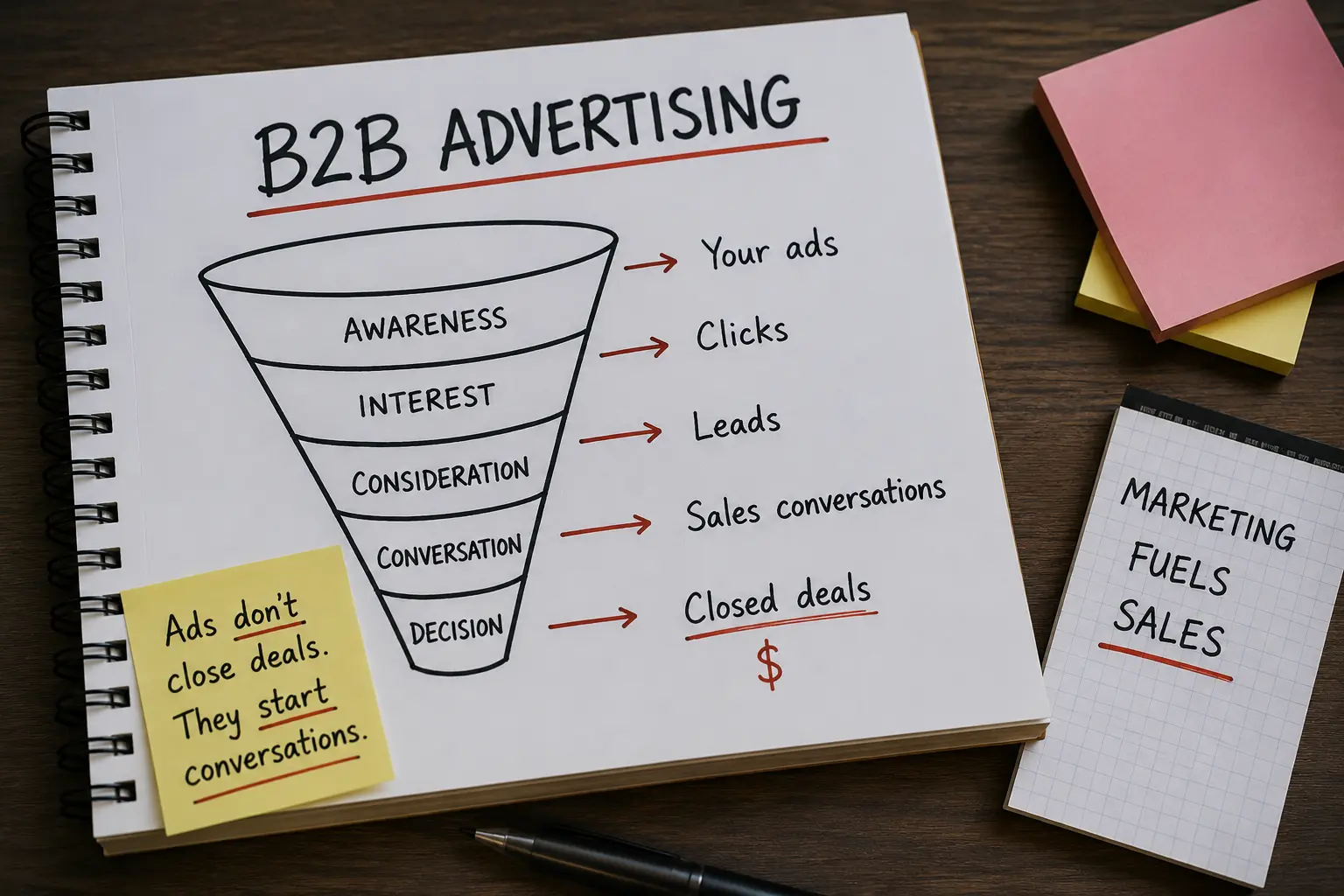
The truth is that B2B advertising is often judged using the wrong criteria. Business leaders expect ads to generate immediate sales, just as they often do in business-to-consumer (B2C) markets. However, B2B marketing operates in a completely different environment. Decision-making processes are longer, buying committees are larger, and professional buyers rarely make purchasing decisions after seeing a single advertisement.
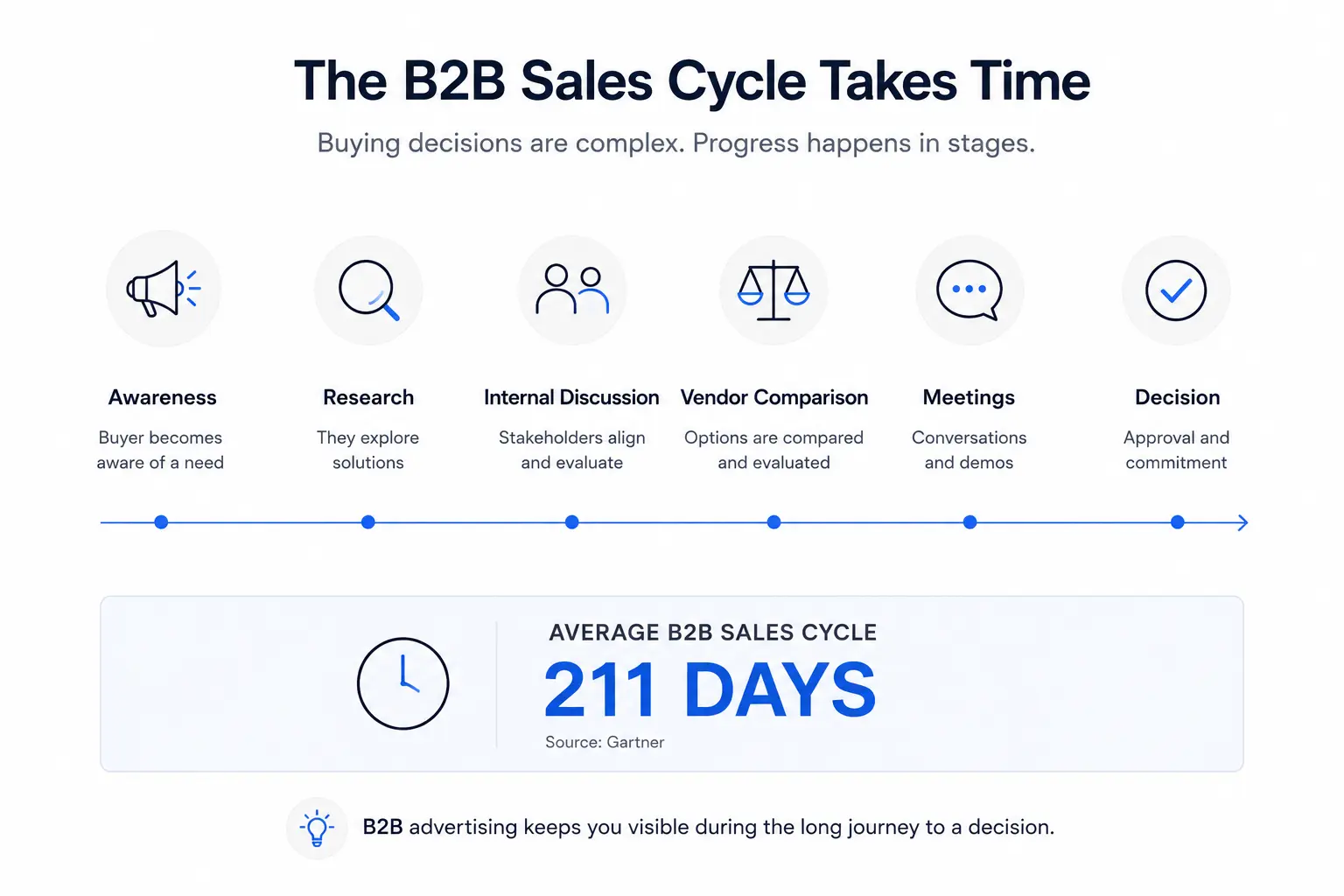
In fact, the average B2B sales cycle lasts 211 days, and most B2B purchases require buy-in from multiple stakeholders. Business buyers are highly informed domain experts who evaluate products and services carefully before making a commitment. This is why B2B advertising focuses on long-term relationships and trust rather than immediate transactions.
The market itself continues to grow. B2B digital ad spend is projected to reach $48.15 billion by 2026, proving that companies still see enormous value in advertising. Yet success depends on understanding the real purpose of marketing. B2B marketing builds brand awareness, nurtures potential customers, and creates familiarity long before sales conversations begin.
The most effective B2B marketers understand that advertising is not a shortcut to closing deals. Instead, it serves as a strategic tool that supports lead generation, strengthens brand awareness, and helps businesses stay top of mind throughout complex buying journeys.
Let’s look at why B2B advertising is often misunderstood and how to make it work more effectively.
Want the short version first?
This article expands on an episode of the Beyond Marketing podcast. If you’d rather hear the discussion directly from Jim Rodin, press play below. Then come back for a deeper dive into the ideas, examples, and strategies covered in the episode.
The biggest reason why B2B advertising fails
A few days ago, we spoke with a client who had spent years working with different marketing agencies. They operate in a highly specialized B2B market, supplying products for stadiums, events, and large venues. Their goal was straightforward: reach decision-makers and generate new business opportunities. The problem was what they expected ads to achieve…
Many companies approach B2B advertising with a business-to-consumer mindset. They launch campaigns, wait for leads to appear, and expect prospects to move directly from clicking an ad to signing a contract. That approach rarely works when you’re selling high-value products or services.
B2B purchases usually require buy-in from multiple roles. Procurement teams, managers, directors, technical specialists, and financial stakeholders may all participate in the decision-making process. B2B marketing often involves larger buying committees than B2C marketing, which makes the journey significantly longer.
When someone is making a purchasing decision that could affect their department, budget, reputation, or business performance, they need confidence in the company behind the offer. One display ad, one LinkedIn campaign, or one email rarely provides enough information to earn that confidence.
This is one of the main reasons many B2B marketers become frustrated with advertising. They measure campaigns based on immediate sales outcomes, while business buyers are still researching, comparing vendors, discussing options internally, and gathering information.
The average B2B sales cycle lasts 211 days. For enterprise-level products and services, the process can easily take much longer. During that period, prospects may interact with your website, social media content, email campaigns, case studies, events, sales representatives, and industry publications before making a decision. If you’re expecting a single campaign to close a deal on its own, you’re likely evaluating success using the wrong benchmark.
Why B2B and B2C advertising follow different rules?
If you’re selling directly to consumers, a purchase can happen within minutes. Someone sees an ad, likes the offer, clicks through, and places an order. The financial risk is relatively low, the decision affects only one person, and emotions often play a significant role. B2B buyers operate differently.
A business purchase may influence an entire department, a team’s productivity, operational costs, or long-term company growth. The stakes are much higher, which changes how people evaluate products and services. B2B advertising focuses on logic and ROI for professional buyers. Before approving a purchase, decision-makers want to understand the business value, expected outcomes, implementation process, and potential risks.
Research supports this behavior:
Eighty-five percent of business buyers value flawless engagement as much as product quality, while 89% of business decision-makers prefer personalized advertising content.
Generic campaigns aimed at broad audiences struggle to create meaningful engagement because buyers expect communication that reflects their industry, challenges, and goals.
Many marketers assume professional audiences make decisions based solely on data. Human behavior remains part of every buying process.
Interestingly, 64% of B2B decision-makers feel ads lack humor and emotional appeal. Buyers still respond to stories, trust, credibility, and memorable experiences.
The difference lies in how those emotions are used. A consumer may buy a pair of shoes after seeing a compelling social media ad. A company investing hundreds of thousands of dollars in a new solution needs evidence, case studies, conversations, demonstrations, and internal approval.
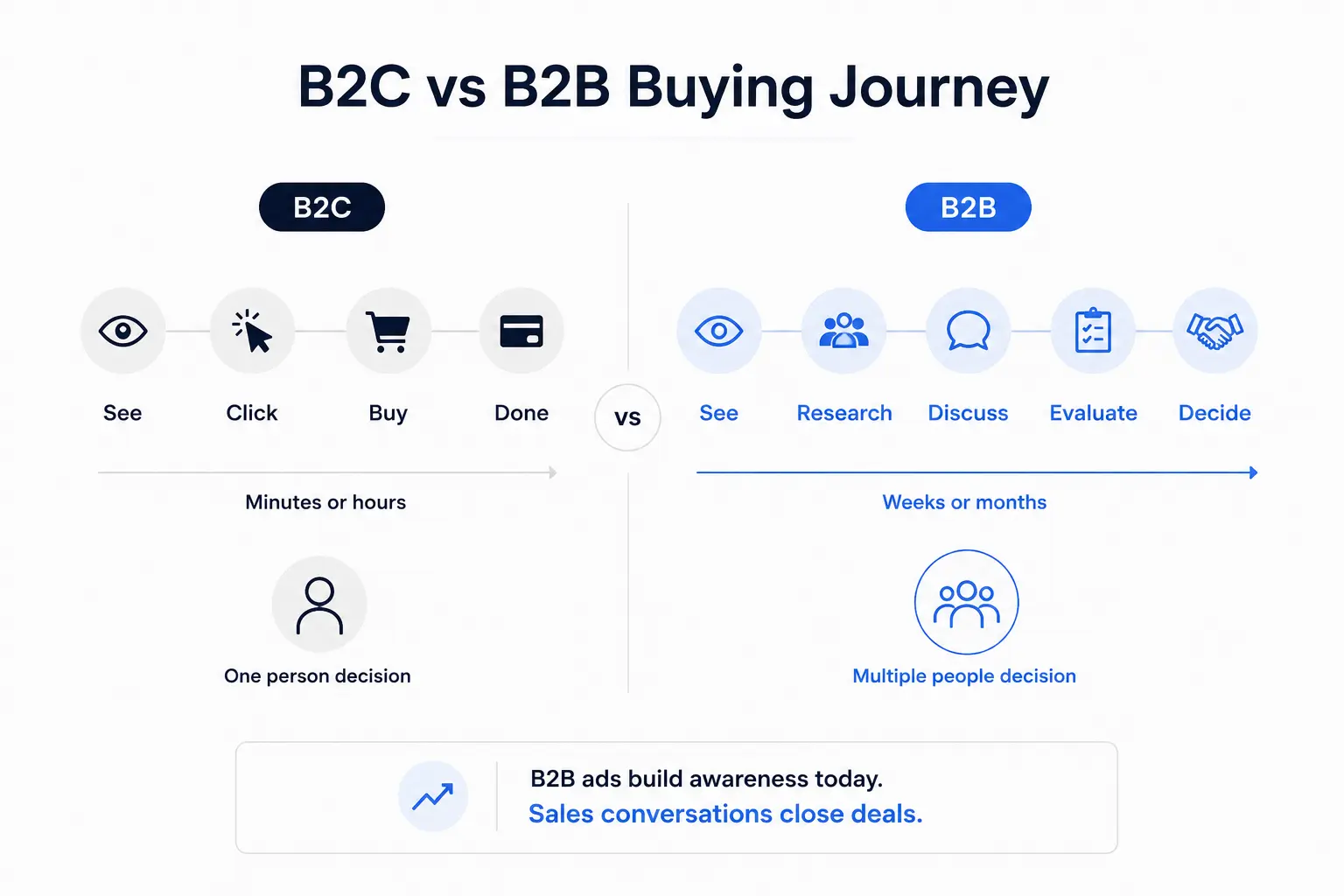
This is why B2B marketing targets decision-makers in organizations through multiple touchpoints. Social media, LinkedIn, email marketing, content marketing, search engine visibility, events, webinars, and direct outreach all contribute to the buying journey.
The question is whether your advertising strategy matches the way business buyers make decisions?
Trust is the real product you’re selling first
One of the most interesting observations is the comparison between business relationships and personal relationships.
Researchers have suggested that developing genuine familiarity with another person can take dozens of hours of interaction. While a business relationship follows different rules, the underlying principle remains relevant: trust takes time.
B2B advertising must build trust over time
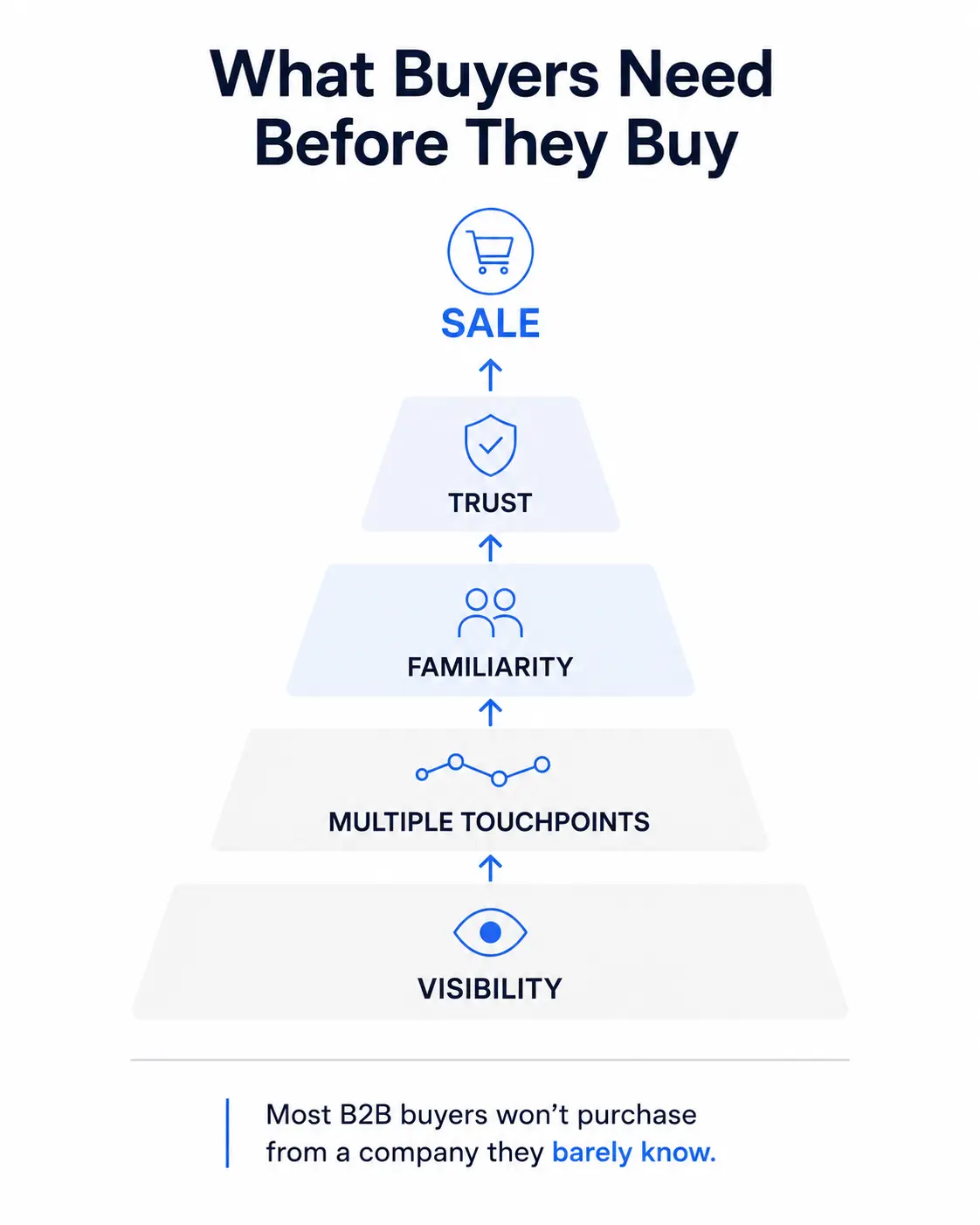
A single campaign rarely creates enough confidence for someone to choose your company over established competitors. Buyers want to know who you are, what you stand for, and whether your team can deliver what you promise. This explains why brand awareness remains one of the most valuable goals in B2B marketing.
When prospects repeatedly encounter your company through content marketing, LinkedIn activity, industry publications, webinars, newsletters, case studies, and advertising campaigns, familiarity starts to grow. The next email feels less intrusive. The next LinkedIn message receives more attention. The next sales call feels less like a cold outreach attempt.
Trust develops through repeated exposure
Sixty-nine percent of customers expect connected experiences across digital channels. When someone visits your website, follows your social media content, downloads a resource, and later receives a relevant email, they expect every interaction to feel consistent.
Disconnected marketing efforts create friction
Consistent experiences strengthen credibility and keep your brand top of mind throughout lengthy decision-making processes. This is one of the reasons B2B marketing focuses on building long-term relationships with businesses rather than chasing quick wins.
How effective B2B advertising supports sales?
Many companies expect advertising to generate sales. The strongest B2B campaigns generate opportunities for sales conversations. That distinction matters because marketing and sales serve different functions throughout the customer journey. Marketing creates visibility, captures attention, and builds familiarity. Sales teams turn that interest into relationships, meetings, proposals, and contracts.
Advertising should make your company recognizable and reduce resistance when your sales team reaches out later. The goal is to warm up potential customers before a direct conversation takes place.
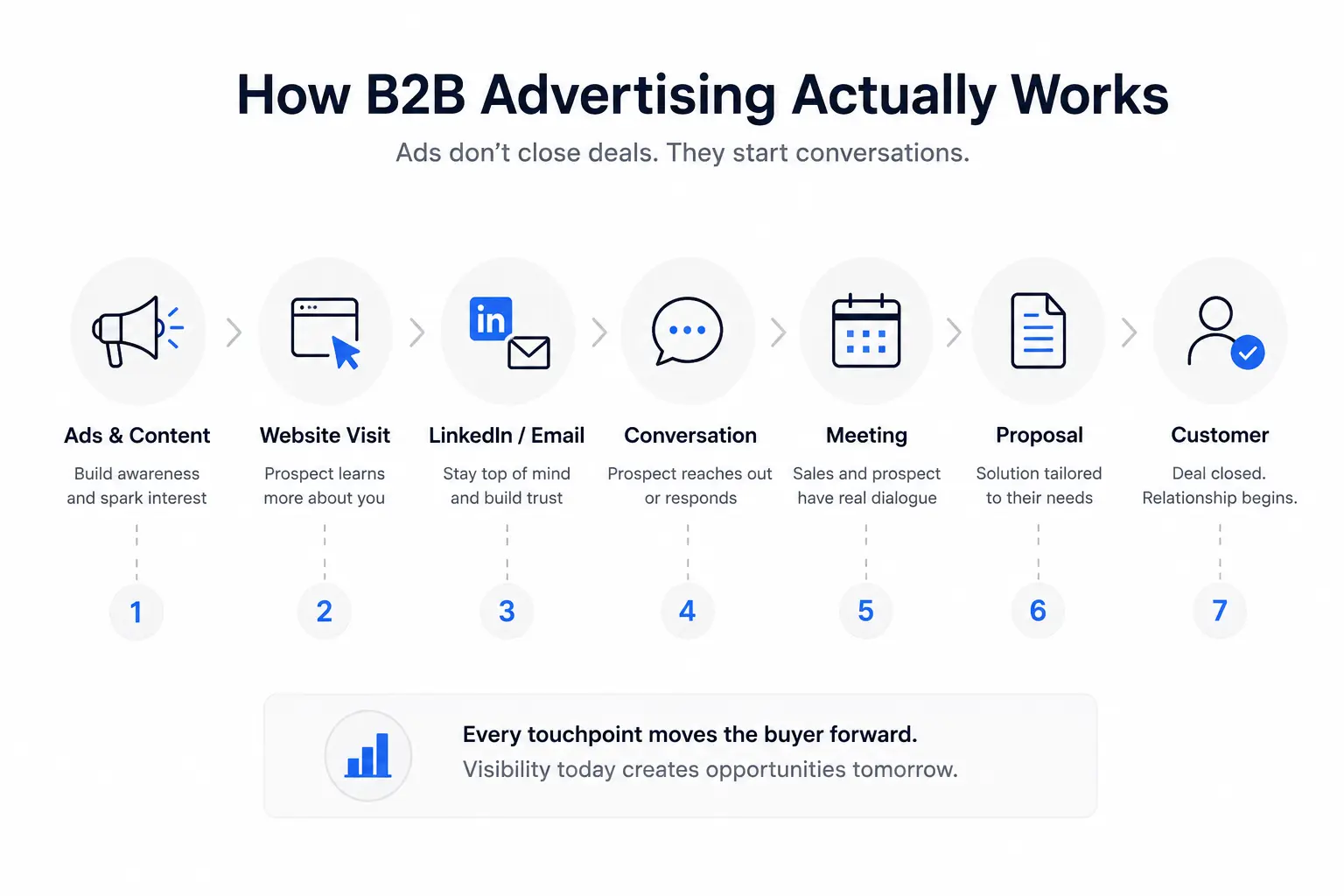
Every touchpoint moves the buyer forward
A typical B2B buyer rarely follows a straight path. Someone may discover your company through LinkedIn, visit your website a week later, read a case study, subscribe to your newsletter, see a retargeting ad, attend a webinar, and eventually schedule a call with your team.
Each interaction creates another touchpoint. These touchpoints help buyers become familiar with your brand and your expertise. They also help your company stay visible while prospects evaluate different vendors and discuss options internally.
For this reason, lead generation campaigns should be measured using more than clicks and impressions. Pipeline value often provides a more accurate picture of campaign health because it reflects engagement and sales opportunities rather than isolated marketing metrics.
Visibility creates opportunities for conversations
One of the strongest ideas is that you’re not selling the product immediately.
- You’re selling the next step.
- Sometimes that next step is a website visit.
- Sometimes it’s a LinkedIn connection request.
- Sometimes it’s a discovery call.
- Sometimes it’s a free consultation.
Every small commitment increases engagement and helps move prospects toward a buying decision. High-value B2B sales often require dozens of interactions before a contract is signed. The larger the investment, the more trust and validation buyers need before moving forward.
Why LinkedIn plays a central role in B2B marketing?
LinkedIn remains one of the most effective platforms for reaching professional audiences. B2B advertising relies heavily on LinkedIn because it allows marketers to target specific industries, company sizes, job functions, and seniority levels. This makes it easier to reach decision-makers who influence purchasing decisions. The platform also supports account-based marketing (ABM), a strategy that focuses marketing efforts on high-value accounts rather than broad audiences.
Eighty-six percent of account-based marketing practitioners report improved win rates, while 80% say it improves customer lifetime value.
These results explain why account based marketing continues to gain popularity among B2B marketers.
Turning website visitors into sales opportunities
A website visit doesn’t automatically become a lead. Many businesses lose opportunities because they treat anonymous traffic as a dead end.
Modern B2B marketing strategies increasingly focus on identifying buying signals. When a visitor repeatedly views service pages, pricing information, or case studies, those actions may indicate growing interest. Signal-based outreach involves monitoring intent signals and using them to guide sales activity. Combined with CRM data, this approach helps sales teams prioritize prospects who are already engaging with the brand.
This creates a much smoother experience than contacting random companies without any indication of interest.
A B2B advertising framework that works
If your goal is generating qualified leads, booking meetings, and creating long-term revenue opportunities, your marketing strategy should support the entire buying journey.
The companies that see the strongest results from B2B advertising rarely rely on a single channel or campaign. They combine content, outreach, paid advertising, and sales activities into one connected system.
Build awareness before asking for a meeting
Many buyers will encounter your company for the first time through a search engine, social media platform, industry publication, podcast, webinar, or advertisement. At this stage, they are looking for information. This is where content marketing becomes valuable. Educational articles, case studies, industry insights, videos, and expert commentary help position your company as a credible source of knowledge.
Video content is becoming increasingly important in B2B advertising strategies because it allows businesses to communicate expertise quickly while creating stronger engagement. The objective is simple: become familiar before your competitors do.
Capture and nurture interest
Once prospects become aware of your brand, the next goal is maintaining that attention. A visitor who downloads a resource, reads several blog articles, follows your LinkedIn page, or subscribes to your newsletter is showing interest. This is where lead nurturing becomes essential.
Email campaigns, remarketing ads, educational content, and relevant industry updates help keep your company visible while prospects move through their decision-making process. Many organizations underestimate how long this process can take. Patience is a competitive advantage.
Use account-based marketing for high-value accounts
Not every prospect deserves the same level of attention. When you’re targeting enterprise clients or large organizations, account based marketing can significantly improve results. ABM focuses marketing efforts on high-value accounts that closely match your ideal customer profile. Instead of targeting broad audiences, marketers create highly personalized digital experiences designed for specific companies, industries, or decision-makers.
B2B advertising uses personalized Account-Based Marketing (ABM) because business buyers expect relevant communication.
Eighty-nine percent of business decision-makers prefer personalized advertising, and 86% of ABM practitioners report improved win rates.
ABM complements traditional marketing strategies by helping teams focus resources where the potential return is highest.
Align marketing and sales
One of the most common reasons campaigns underperform has nothing to do with advertising. The issue often appears between departments.
- Marketing generates leads.
- Sales follows a different process.
- Customer service stores information elsewhere.
- Data becomes fragmented and opportunities disappear.
Successful B2B companies create alignment between these teams. Sixty-three percent of marketers use the same CRM system as sales and service departments, making it easier to share information and maintain a consistent customer experience. When marketing and sales work together, prospects receive more relevant communication and move through the funnel more efficiently.
Measure the right KPIs
Poor measurement creates poor decisions. If you’re evaluating every campaign based solely on immediate sales, you’ll miss the full picture. Top B2B KPIs include lead generation, ROI, conversion rates, sales opportunities, pipeline value, and customer acquisition costs.
A campaign that generates awareness among the right target audience may contribute to future revenue long before a contract is signed. This becomes especially important when multiple stakeholders are involved in the buying process. A single click rarely tells the whole story.
Combine SEO, PPC, and outbound marketing
The strongest B2B marketing strategies combine multiple channels.
- SEO helps your content appear when buyers research solutions.
- PPC campaigns increase visibility for high-value keywords.
- LinkedIn advertising supports audience targeting.
- Email outreach helps start conversations with prospects already familiar with your brand.
SEO and PPC integration helps capture top-of-funnel educational traffic while supporting lead generation efforts further down the funnel. When these channels work together, buyers encounter your company repeatedly throughout their research process. That familiarity often becomes one of the deciding factors when it’s finally time to choose a vendor.
The growing role of AI in B2B advertising
Artificial intelligence is becoming a larger part of B2B marketing strategies every year.
AI-driven targeting is used by 25% of B2B advertisers today, and 60% of B2B advertisers plan to pilot AI-driven personalization in 2026. AI-driven targeting is expected to remain one of the key focus areas for marketers looking to improve campaign performance.
These technologies help marketers identify patterns, segment audiences, personalize messaging, and uncover buying signals that would otherwise remain hidden. Technology can improve efficiency. Trust, expertise, and relationships still influence purchasing decisions.
A highly personalized campaign may help you secure a meeting. The quality of your offer, your team, and your communication will determine whether the opportunity moves forward.
Your ads may be working better than you think
Many B2B companies stop advertising because they don’t see an immediate return. A campaign launches, traffic increases, more people visit the website, engagement grows. Yet no contracts are signed within a few weeks, so the conclusion is simple: the ads didn’t work.
The problem is that most B2B buyers were never planning to purchase after seeing a single ad. They need time to compare options, involve colleagues, discuss budgets, evaluate risks, and build confidence in the company they’re considering. During that process, every interaction matters. A LinkedIn post, a case study, a webinar, a website visit, an email, or an ad may seem insignificant on its own. Together, they shape how buyers perceive your business.
The companies that get the most from B2B advertising understand this. They use ads to stay visible. They use content to demonstrate expertise. They use sales conversations to build relationships. Every activity serves a specific purpose and supports the next step in the buying journey.
If you’re measuring success by asking, “Did this ad close a deal?”, you’re probably asking the wrong question. A better question is: “Did this ad help move the right buyer one step closer to a conversation?” For most B2B companies, that’s where growth starts.
Continue reading
B2B advertising is only one piece of the puzzle. If you’re interested in attracting qualified leads through organic search, take a look at our article on SEO services in Poland for international businesses and learn how international companies use SEO to build visibility and generate demand in competitive markets.
Frequently asked questions
Most B2B purchases involve multiple stakeholders, larger budgets, and longer evaluation periods. Buyers often spend months researching products and services before contacting a vendor. Advertising helps create awareness and keeps your brand visible throughout that journey, but the final purchase decision usually depends on conversations, demonstrations, proposals, and internal approval processes.
B2C campaigns typically target individual consumers who can make purchasing decisions on their own. B2B advertising targets professional buyers and decision-makers who must consider budgets, business objectives, implementation requirements, and potential risks. The buying process is usually longer and involves several stakeholders, which means marketing efforts must support a much more complex customer journey.
Lead generation is one of the most important goals, but successful B2B advertising also focuses on brand awareness, trust building, audience education, and creating opportunities for future sales conversations. Many campaigns are designed to keep a company top of mind until prospects are ready to engage with a sales team.
The answer depends on your target audience and industry. LinkedIn remains one of the most effective channels because it allows marketers to reach specific job titles, industries, company sizes, and decision-makers. Search engine advertising can also perform well when buyers actively look for solutions. Many businesses combine LinkedIn, Google Ads, content marketing, email campaigns, and social media to maximize reach and engagement.
For many organizations, yes.
Account-Based Marketing (ABM) focuses resources on high-value accounts that closely match an ideal customer profile. Rather than targeting broad audiences, marketers create personalized campaigns for specific companies and decision-makers.
Research shows that 86% of ABM practitioners report improved win rates, while 80% say it enhances customer lifetime value. These results explain why ABM continues to be a popular strategy among B2B marketers.
Content marketing plays a critical role throughout the buying process. Articles, case studies, reports, webinars, videos, and industry insights help educate buyers and demonstrate expertise. Since business buyers are highly informed domain experts, they often look for valuable information long before contacting a supplier. A strong content strategy helps companies build credibility and attract qualified leads organically.
Start by aligning advertising with the customer journey. Focus on reaching the right target audience, producing valuable content, using personalized messaging, and creating consistent experiences across digital channels. Marketing and sales teams should also work closely together to ensure leads receive relevant follow-up communication. Measuring pipeline growth, lead quality, and engagement often provides more meaningful insights than tracking clicks alone.
Artificial intelligence is already influencing how marketers identify audiences, personalize campaigns, and analyze customer behavior. AI-driven targeting is used by 25% of B2B advertisers today, and many more organizations are investing in AI-powered personalization.
These tools can improve efficiency and help marketers deliver more relevant experiences. Strong relationships, trust, and industry expertise will continue to play a major role in winning business, regardless of how advanced advertising technology becomes.