

AI tools have become an integral part of marketers’ day-to-day work. That is hardly surprising. Artificial intelligence is highly capable when it comes to writing, testing and optimisation. Machine learning algorithms can often do it faster than a human. That does not mean, however, that all you need to do is click “generate” and wait for success. What really drives results is a smart marketing strategy and the right mix of technology and audience insight. AI supports personalisation, optimisation and marketing automation, making marketers’ work easier and more effective.
In this article, we will show you how to use AI-generated content in advertising so your campaigns do not just look good, but actually perform. AI makes it possible to create more engaging content that captures attention and improves the effectiveness of your marketing communication.
What exactly is artificial intelligence?
Artificial intelligence (AI) is one of those terms everyone recognises, but not everyone can define with precision. In simple terms, it is a set of algorithms capable of processing vast amounts of data in a short time and drawing conclusions in a way that resembles human reasoning. Advanced AI algorithms, where neural networks play a major role, can identify patterns and predict customer behaviour, enabling faster and more accurate marketing decisions.
In marketing, artificial intelligence is mainly used to analyse consumer behaviour based on data and to create content. Data analysis is essential for effective marketing because it helps brands better understand their audience, optimise campaigns and personalise communication.
Importantly, AI algorithms can also predict campaign performance and even optimise campaigns on their own. Sounds impressive? It is, provided you know how to use that support wisely.
When we talk about AI-generated content, we are mainly referring to content created by generative AI. This type of artificial intelligence can independently generate text, images, audio and even video content. It is no longer just about automation. It is a creative collaboration between humans and machines, powered by machine learning tools. And this is exactly the technology reshaping advertising.
Why does artificial intelligence matter in marketing and advertising?
Artificial intelligence is not just another tool. It is a new way of thinking about advertising. For marketers and marketing agencies, it offers a way to analyse customer data faster than any human ever could. On top of that, it predicts consumer behaviour and tailors messaging to audience preferences at exactly the right moment. And it does all of that in real time.
With AI, you can improve the efficiency of your content marketing without sacrificing quality or customer trust. And that is only part of the picture. The potential of AI can also be used in advertising campaigns.
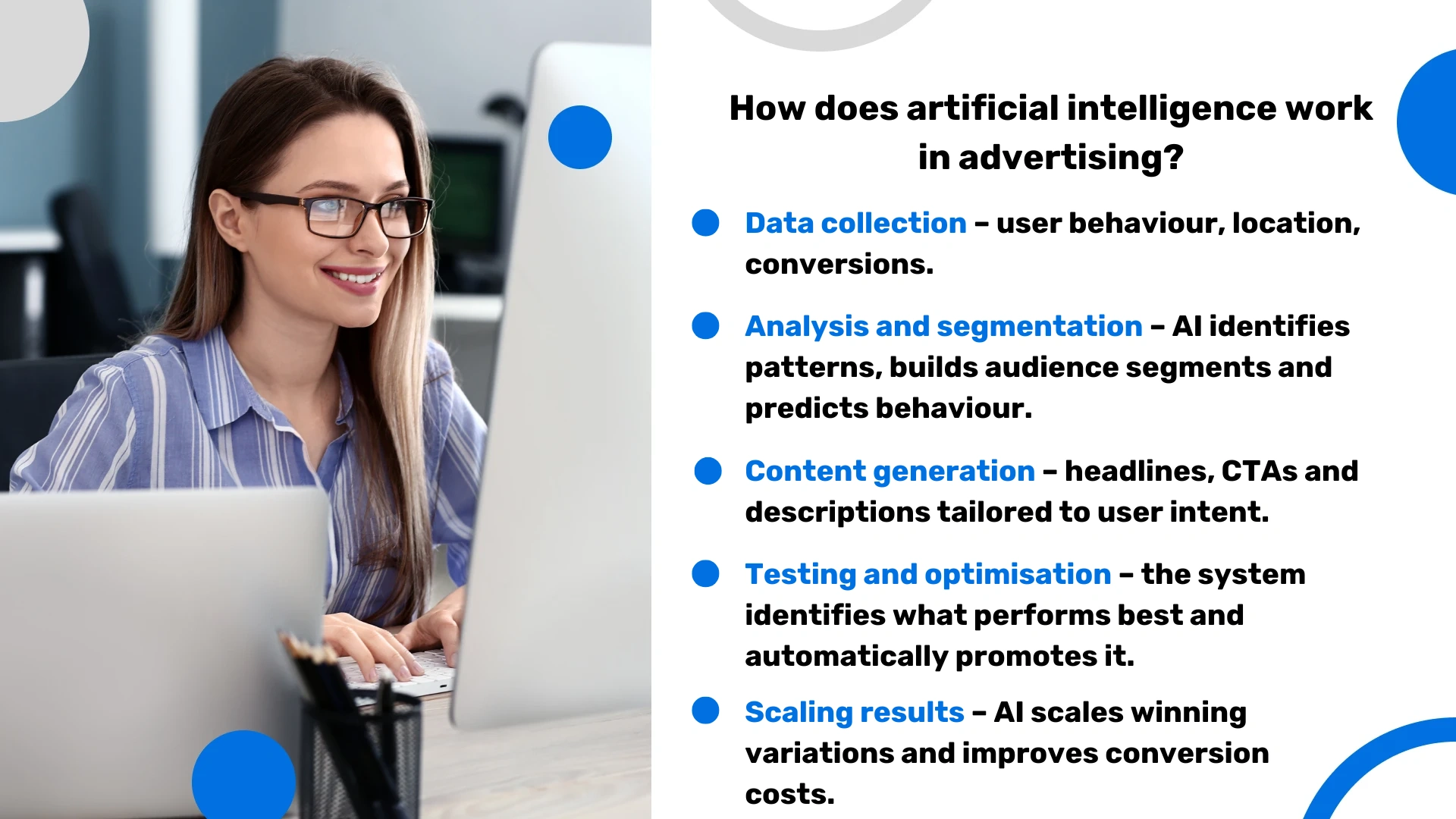
Machine learning makes it possible to test multiple variations of copy, headlines, visuals and CTAs. As a result, you can draw conclusions from thousands of user micro-interactions. That means you are no longer shooting in the dark. By analysing data, you can hit the target with precision, because your online advertising is closely aligned with what users actually need. AI understands context, analyses trends and learns continuously. This allows it to respond faster than you can plan your next campaign.
What is more, AI-generated content in advertising saves time and helps teams use their budget, energy and resources more efficiently. Automating tasks that once required hours of manual work, such as A/B testing or segmentation, gives you space to focus on what matters most: strategy and creative direction. And when a campaign is properly set up and supported by AI, it does not just keep running and learning. It also automates and optimises the entire marketing campaign, significantly improving performance and delivering real results, even while you sleep.
How can you use AI-generated content to create ads?
Not long ago, advertising relied heavily on intuition, a marketer’s experience and painstaking testing. Today, artificial intelligence has entered the process as a true partner in campaign creation. It speeds up the work, but it also changes its quality. In practice, this means analysing topic-specific data, predicting outcomes and personalising the message.
What is more, AI supports data analysis at every stage of the campaign, helping brands manage content more effectively and build stronger audience engagement. And most importantly, it learns in real time. At a time when campaign success is measured not just by clicks, but above all by the relevance of the message, that kind of support is invaluable.
It is worth noting that using AI-generated content in advertising opens up a whole new level of efficiency and scalability. AI plays a key role in content creation, supporting the process of generating and optimising messaging, which speeds up work and improves communication with customers. But how do you use it wisely? Where does AI truly deliver, and where is human creativity still essential? Let us take a closer look.
Creating headlines and ad copy with AI tools
One of the most obvious and, at the same time, most effective uses of AI-generated content is creating text for campaigns. Artificial intelligence can produce dozens of versions of headlines, ad copy and calls to action in just seconds. These can easily be adapted to different styles and target groups, while AI enables content personalisation on a scale we have never seen before.
What is more, this type of content can be tested in real time and changed dynamically depending on performance. This makes it possible to quickly adapt copy to the preferences of different audiences, including both content personalisation and adjustments for global and multilingual markets. The result is a major time saving and a significant advantage when it comes to A/B testing and identifying the winning message faster.
Scaling campaigns with artificial intelligence
You cannot deny that manually preparing content for dozens of ad segments can be time-consuming and expensive. AI-generated content in advertising solves that problem. It allows you to create personalised ad messaging at scale for different locations, personas, stages of the funnel and channels, including social media. What is more, artificial intelligence makes it possible to target different audience groups with precision, adapting content to their specific needs and preferences.
A single message can have countless versions. With AI, you can manage multiple marketing campaigns at the same time, while ensuring that each variation is tailored linguistically and contextually to individual needs. And all of that can happen in minutes rather than days.
Creating dynamic and contextual content
AI works with behavioural data. This makes it possible to generate dynamic ad content tailored to the current needs and behaviours of each user. Artificial intelligence automates content generation based on live data, enabling fast and effective personalisation of the message. This means advertising is no longer a fixed statement. It becomes a flexible narrative that evolves in real time.
For example, a user looks at product X. Machine learning algorithms generate copy that refers directly to that product’s features. The whole process of creating effective ads becomes more streamlined and optimised thanks to AI, making it easier to match the message to the audience. If that same user returns a week later, they may see an ad with a completely different message, generated on the basis of their previous behaviour.
Generating visual content – images, animation and video
AI does not stop at words. Today, more and more tools can also generate visual content, including images, display ad graphics, short video and product animations. This type of visual content can be used across a wide range of advertising formats, opening up new possibilities for marketers. It is a game changer for creative teams, especially when there is a need to quickly test several stylistic directions or prepare materials at scale. AI-generated visuals can serve as a first draft, a source of inspiration or even a ready-made creative asset, with artificial intelligence providing real support throughout the content creation process.
Optimising ad campaigns in real time
AI-generated content does not have to be static. In advanced performance marketing campaigns, artificial intelligence can not only create content but also optimise it in real time. What is more, AI enables marketers to manage multiple ad campaigns at once, using ad templates to maintain consistency and support more efficient collaboration at every stage of the campaign.
For example, a campaign may be testing three different versions of copy. AI determines which one performs best with a specific audience segment, continuously monitors performance and automatically swaps in the best-performing content to maximise campaign effectiveness. It is like having an assistant that works 24/7, with no coffee breaks.
Still, it is worth remembering that no AI tool will ever replace human creativity. Artificial intelligence can support it, strengthen it and expand it, but never fully replace it.
Automating advertising processes with AI
Modern marketing is not just about creativity. It is also about managing multiple processes smoothly and simultaneously. Artificial intelligence brings an entirely new level of automation to advertising campaigns, allowing marketers to focus on strategy while repetitive tasks are handled by algorithms. Thanks to AI in marketing, brands can respond faster to shifts in customer behaviour, manage budgets more effectively, optimise content and target audiences with greater precision.
Automating advertising processes is key to improving campaign performance, saving time and maximising return on investment. AI is increasingly taking over routine tasks such as planning, testing and publishing, enabling your team to work faster and more effectively than ever before.
Automatic campaign planning and launch
One of the biggest advantages of using artificial intelligence in marketing is the ability to automatically plan and launch ad campaigns across social media. AI analyses historical data, market trends and real-time customer behaviour to independently determine the optimal advertising budget, identify the most effective keywords and create personalised ad content. As a result, every campaign is more precisely aligned with audience preferences, and the message reaches exactly the people it should.
This level of automation not only speeds up campaign rollout, but also enables ongoing optimisation. AI monitors results and makes adjustments in real time, maximising campaign effectiveness and return on investment. It is a solution that works for both large and smaller businesses, helping them stay ahead of the competition and respond more effectively to market demand.
Managing content schedules and publication
In social media, it is not just about what you publish, but also when and how often. Using AI to manage content scheduling and publication across social media makes it possible to align messages more precisely with the rhythm of your target audience’s day-to-day life.
Algorithms analyse user activity, preferences and previous interactions to automatically identify the best times to publish posts. As a result, your content reaches people when they are most likely to engage, which translates into higher interaction rates and stronger campaign performance.
Automating this process saves time and ensures your marketing activity remains consistent and effective, even when you are managing a large number of communication channels.
Automated A/B testing and message optimisation
Artificial intelligence is also transforming the way ad messaging is tested and optimised. By using machine learning and advanced data analysis, AI can automatically run A/B tests across multiple ad variants at the same time. The system identifies which messages resonate best with the target audience, predicts the effectiveness of individual creatives and dynamically adjusts the message to maximise results.
Automated A/B testing makes it much easier to identify the strongest-performing solutions quickly, removing guesswork and shortening the time needed to optimise campaigns. As a result, your marketing activity becomes more precise, more efficient and more strongly focused on measurable results, while every part of your ad budget works harder for your success.
Need help managing your company’s social media? Explore our offer: Social media for your company
Using artificial intelligence in advertising – why is it worth it?
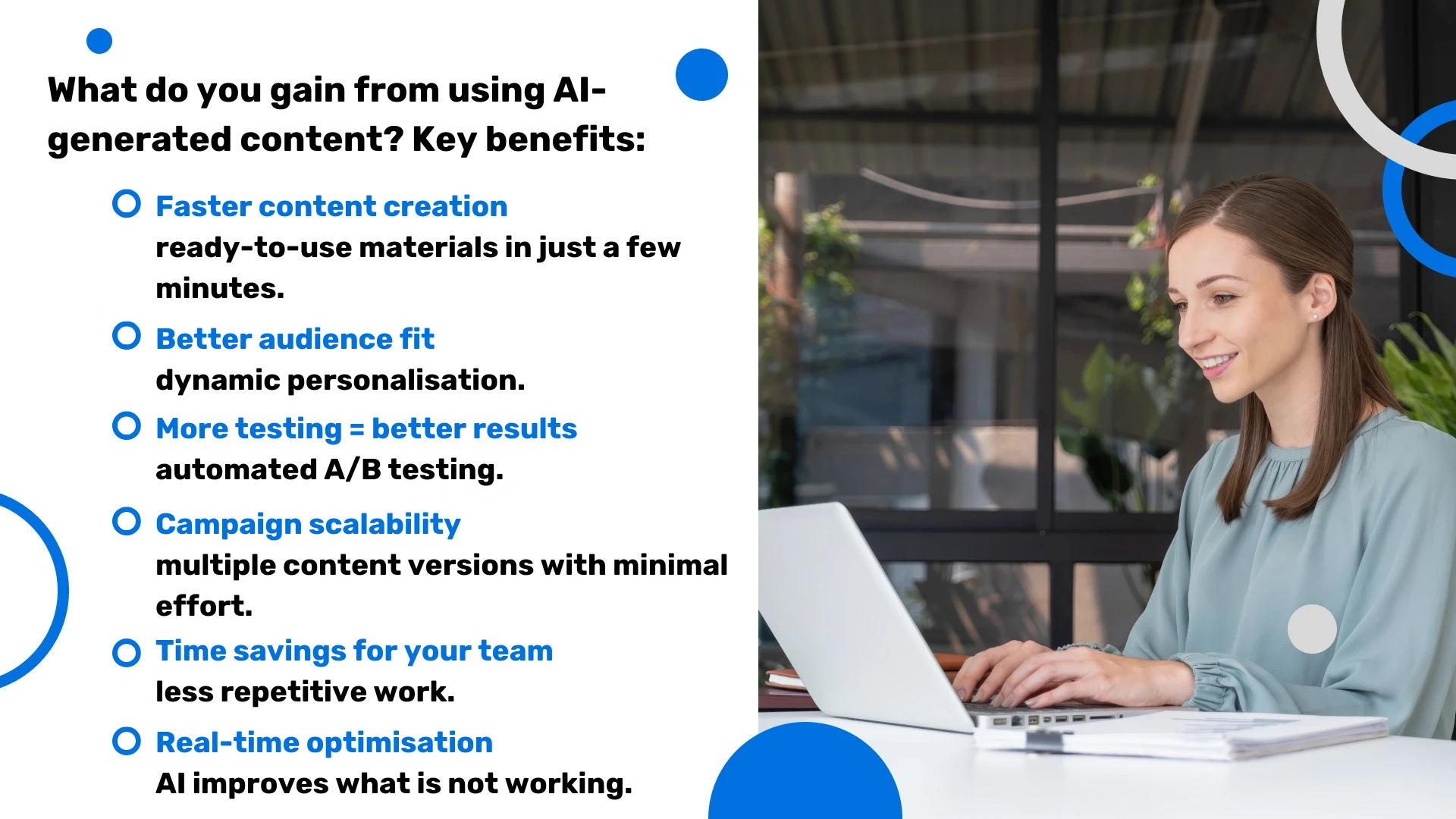
The answer to the question in the heading is simple: because advertising built on data works faster, more accurately and, quite often, far more effectively than expected. AI-generated content is not a substitute for creativity. It is its ally. It makes it possible to create content that not only looks good, but more importantly, hits the mark. It is built on the analysis of audience intent, emotion and context.
With AI, you can generate dozens of message variations, test, optimise and scale campaigns almost instantly, at a level that until recently was only available to major brands with massive budgets. In other words, using artificial intelligence primarily means improving campaign effectiveness and increasing user engagement. It is also worth emphasising that data quality and the way AI is applied within the advertising process have a direct impact on overall campaign efficiency.
Most importantly, AI does not sleep. It learns, responds in real time, adapts to user behaviour and follows trends. And it does not work in isolation. It integrates with ad platforms, analyses performance and even suggests improvements. That means less guesswork and more clarity. For marketers, it saves time while also providing a competitive advantage that is impossible to ignore.
AI-generated content in social media and beyond – where does it work best?
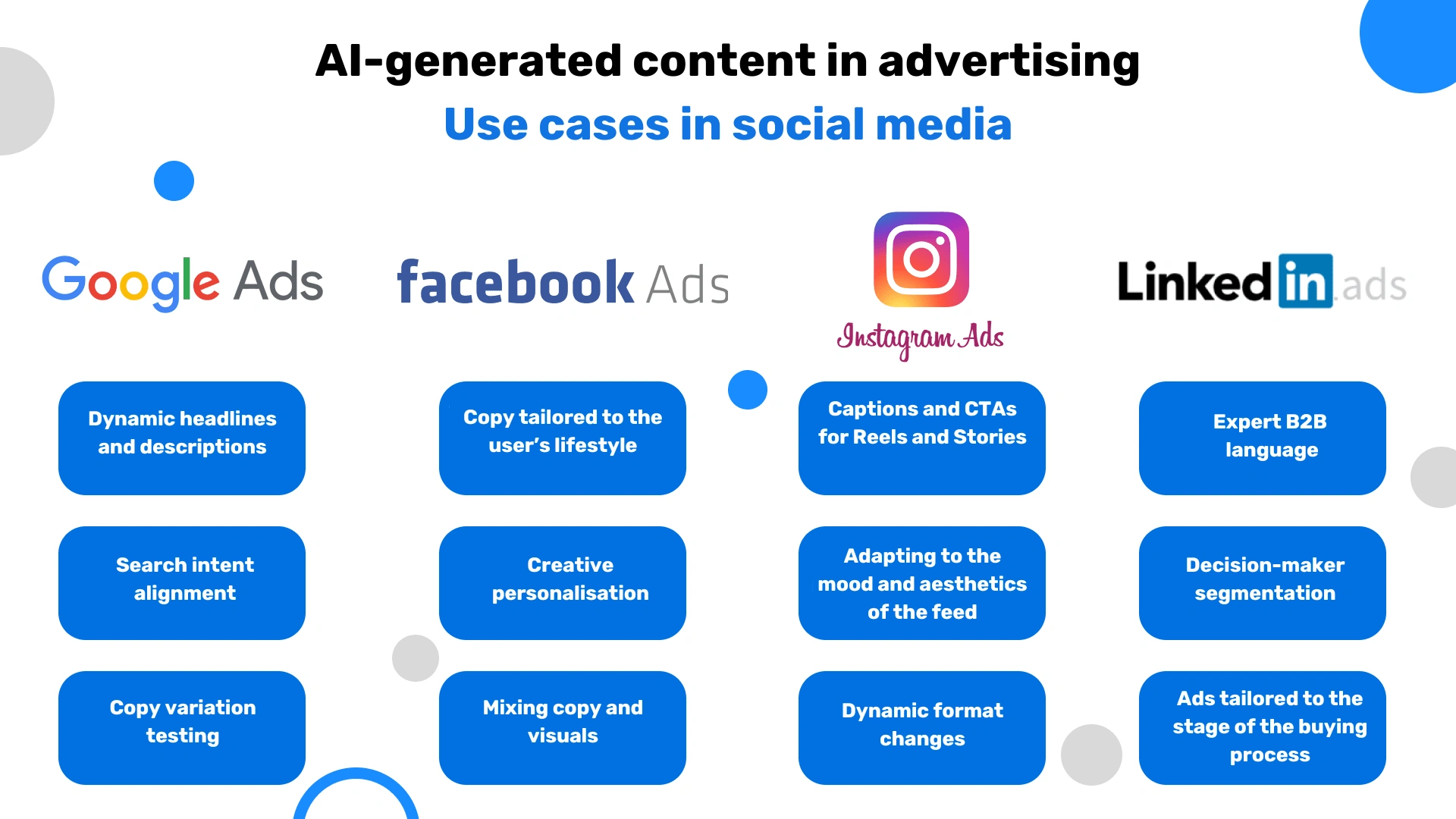
It is not enough for content to be good. It needs to be good here and now, exactly where your audience is. AI-generated content in advertising gives you the ability to instantly generate copy, visuals and video, but the real power of this technology lies in how well it can tailor content to a specific context. Content also needs to appear on the right platform, in the right format, for the right user. Social media is one of the most important channels for AI-powered advertising, offering opportunities to analyse sentiment, monitor customer opinions and track market trends.
In this section, we will break down the most important ad platforms and show you how AI-generated content in advertising does more than just create content. It can also manage campaigns, optimise budgets, personalise communication and deliver ads to carefully selected audiences in real time.
Google Ads – deliver personalised advertising
With Google Ads, every word matters. The user is actively searching, focused and ready to click, but only if what they see matches their intent perfectly. This is where AI acts as both strategist and analyst, making it possible to:
- Generate ad copy – AI creates dozens of headline, description and extension variants. It takes into account the search context, the user’s location, time of day and historical data. It also adapts the tone of voice to the product type and stage of the funnel.
- Target precisely and dynamically adjust the message – artificial intelligence can instantly analyse user behaviour online. It considers interests, location and the way users interact with content. On that basis, it builds highly detailed audience segments. This ensures that ads are shown exactly where they should be. What is more, AI does not operate statically. It adjusts messaging in real time, reacting to campaign results and learning which offer variations produce the best outcomes.
- Automate testing and optimisation – Google can automatically combine headlines and descriptions, but it is AI that identifies the combinations most likely to convert.
- Manage bids – AI monitors CPC, conversion rate and basket value. Based on that, it determines how much a click is worth. If it predicts a purchase is likely, it is willing to bid more.
- Predict ad performance – artificial intelligence algorithms can forecast campaign outcomes by analysing historical data and current trends.
Facebook Ads – advertising that knows who it is talking to
There is no denying that Facebook is a powerhouse when it comes to targeting. But simply knowing your target audience is not enough. AI makes it possible to understand and analyse that audience more effectively, which leads to better-performing campaigns. What really matters is how you speak to people. And this is where AI truly shines.
Above all, it can generate content for different audience segments. Based on demographic data, behaviour and lifestyle, it can write one message for a young father in Warsaw and a completely different one for an entrepreneur in the Tricity area. That means your ads become genuinely personal.
AI can also be used to create and combine copy, headlines, CTAs and visuals. As a result, a campaign can launch with multiple variants from day one. AI observes what performs best and pushes the strongest creative forward.
Artificial intelligence also makes 1:1 personalisation possible. Facebook users see content tailored not only to their history with your brand, but to their activity across the wider ecosystem. AI enables advanced message personalisation, increasing campaign effectiveness and helping brands build stronger relationships with their audience. It decides whether the user should see a video, a graphic, a carousel or plain text, and shapes the content accordingly.
Interestingly, machine learning algorithms can also be used for budget management. The system decides which ads deliver the best cost per conversion. You set the goal. AI handles the rest.
Instagram Ads – emotion in a second
On social media, aesthetics and emotion matter. In the case of Instagram Ads, artificial intelligence does not just write copy. It also understands how users respond to visuals and messaging. With AI, you can create effective content for reels, stories and carousels. The generated content can be perfectly adapted to fast-moving formats, while remaining consistent in length, tone and structure with the way people consume content there: quickly and effortlessly.
AI also makes it easier to match advertising to the mood of the target audience. By analysing language and trends, it creates content that blends naturally into a user’s feed. Interestingly, it does not look like advertising at all. It feels like part of the content the user already knows and enjoys. On top of that, AI tools help brands maintain a consistent image by creating engaging content that strengthens how the company is perceived in the market.
Campaign optimisation also becomes easier. Instagram, through Meta Ads, allows AI to analyse how long a user watches a video, where they stop and what they click. It then adjusts the ads accordingly, generating more engaging content that improves audience interaction and campaign performance.
Can you generate ads for TikTok?
TikTok is a platform with huge potential and a very specific cultural code. This is where AI can make a real difference. With its help, it becomes possible to:
- Generate content in the language of virality – AI can write scripts for short videos, adjust humour, pacing and vocabulary, and tap into current trends. It can sound like a native TikTok creator rather than a brand speaking from a billboard. It also analyses customer needs to better tailor content to their expectations and preferences.
- Use behavioural targeting – AI analyses which videos users scroll past, which ones they watch twice, what they comment on and even what they react to instinctively. To do this, it uses data from different sources, such as social media, purchase history and browsing behaviour, allowing it to target ads more effectively while making them feel like content.
- Optimise automatically – the system learns continuously. It changes message order, CTAs, clip length and thumbnails. If it sees something working, it accelerates it. If not, it cuts it.
- Create ads that fit the feed – thanks to recommendation algorithms, AI can place ads between organic content in a way that feels completely natural. And that leads to significantly higher engagement rates.
LinkedIn Ads – AI for B2B that thinks strategically
On LinkedIn, a good creative is not enough. Competence and tone matter. Here, AI becomes a partner in conversations with decision-makers and industry leaders. Above all, it helps create expert-level content regardless of the audience segment. It understands the industry, the language and the expectations. It generates ads that build trust instead of pushing too hard to sell.
AI is also highly effective when it comes to targeting. Algorithms analyse networks, professional history and user activity to determine who should receive a lead magnet and who is better suited to a case study. It also optimises campaigns for lead quality, not just clicks. LinkedIn Ads powered by AI focuses on conversion value, meaning the actual quality of acquired leads. And that makes a major difference in B2B.
How does AI affect advertising campaign performance?
At the end of the day, it is not about who has more creatives. It is about who gets better results. Artificial intelligence is not a gimmick here. It is a real accelerator of campaign effectiveness. It helps create ads that are more relevant, more personal and more cost-effective.
What is more, AI makes it possible to predict campaign performance based on historical data, allowing strategies to be optimised before a campaign even launches. How does it do that? Let us look at it more closely.
Personalised advertising that genuinely lands
There was a time when advertising had one task: reach the widest possible audience with one universal message. That logic is now becoming outdated. AI enables highly precise ad targeting. With today’s tools, you can create dozens of versions of the same message, tailored to specific people, their interests, lifestyle and even the way they communicate. It feels more like a conversation than a loudspeaker.
These systems analyse not only the basic metrics, but also scroll speed, click history and search intent. On that basis, they build messaging that truly resonates. The same product can be presented as a stylish gift, a practical solution or part of a desired lifestyle, depending on who sees the ad. The result? Higher engagement and a much better chance that the user will take the next step.
Real-time ad optimisation
AI does not wait for your reports. It creates them, analyses them and makes changes before you have time to draw conclusions. A campaign that performs only moderately does not need to drag on for weeks. If a piece of copy is not attracting clicks, if a creative is not holding attention or if an audience segment is not responding, AI already knows. And it is already acting. It also keeps an eye on budget, helping you reduce losses. That means you can focus on ideas instead of micromanagement.
Faster results, without guesswork
With AI, you stop relying on instinct alone. The system analyses hundreds of campaign data points, including who clicked, when, on what device and at what stage they dropped off, then identifies what is actually working. Artificial intelligence makes decisions based on historical data, which enables more accurate forecasting and deeper analysis.
You no longer need to manually create dozens of versions and wait weeks to compare them. AI tests, compares and selects the highest-performing options automatically. That means you can scale good results faster and avoid wasting budget on campaigns that might work, but probably will not.
Message relevance – saying exactly what matters
AI-generated content is not just about speed of production. It is also about creating content that is more relevant to the user’s context, intent and emotions. These systems analyse what has worked before, not only for your brand, but across the entire industry. They use advanced data analysis to optimise ad content even further, making personalisation more effective. On that basis, they create messages aligned with current trends, formats and audience preferences.
It is like having a copywriter who knows your persona better than you do. And who writes in exactly the way they want to read.
Does AI-generated content in advertising really work?
Rather than quoting numbers that may become outdated tomorrow, let us put it plainly: marketers using AI-generated content can see the difference. Better CTRs. Lower conversion costs. Faster decisions. Less frustration. And more time for what truly matters: strategy, creativity and ideas. It is worth emphasising that AI can bring measurable advertising benefits to your business.
AI is changing advertising not because it is trendy, but because it enables smarter, faster and more effective action. Modern marketing uses artificial intelligence to achieve better results, from trend analysis and content optimisation to campaign automation. And the effects are visible not only in reports, but above all in campaign performance.
Where can AI fall short? Risks, pitfalls and limitations
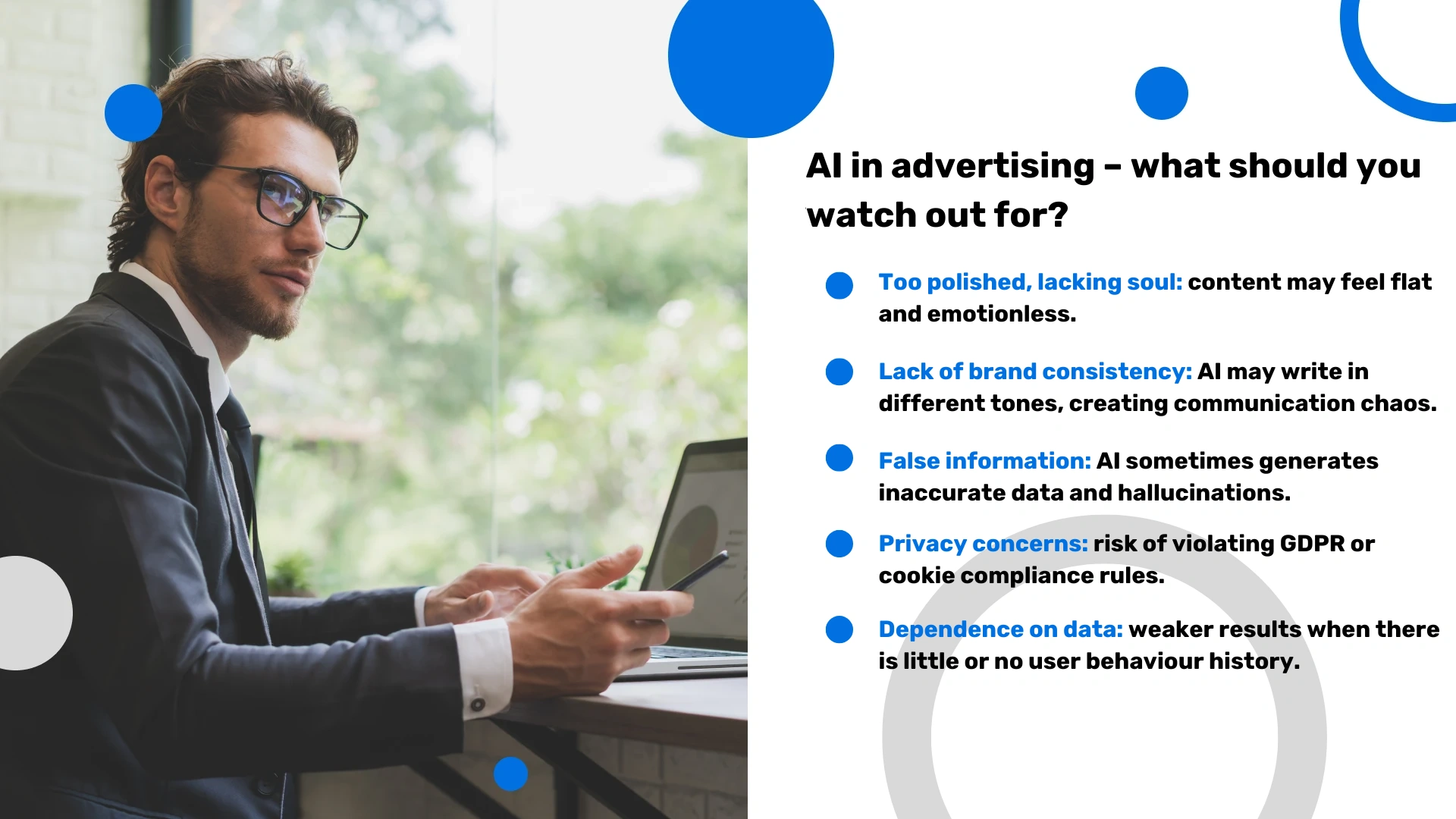
Artificial intelligence in advertising can do a great deal, but not everything. And while it is easy to be impressed by its speed, scale and precision, it is worth remembering that not everything that happens quickly is also flawless. AI is a powerful tool, but one that still needs control, correction and careful oversight. So what should you watch out for?
Too perfect to feel real
Sometimes AI-generated content can be a little too polished. Smooth, correct, stripped of errors and, unfortunately, stripped of soul. Users often sense, even subconsciously, that something feels off. And while the ad may be technically flawless, it leaves no emotional trace. And emotion is what sells.
Authenticity in the shadow of the algorithm
In an age of transparency, audiences increasingly ask: who wrote this? If a message sounds like it came from an algorithm rather than a person with real experience, it can weaken brand credibility. AI does not lie, but it also has no opinions, memories or intuition. Authenticity comes from people. That is not something you want to hand over entirely to a machine.
One campaign, too many versions
Personalisation is great, but only up to the point where it starts to blur the brand message. Too many variants, too many tones, too much inconsistency in style and values, and the audience begins to feel unsure who they are actually talking to. AI can adapt to anyone, but if it does not stay grounded in the brand’s DNA, the result can easily be the opposite of what you intended.
AI is not an oracle – it can be wrong
Language models are powerful, but they are not infallible. AI can generate a sentence that sounds credible even when it is false. It may refer to non-existent data, use fabricated quotes or build illogical conclusions. That is why every piece of AI-generated content needs to be reviewed critically, not simply copied and pasted into a campaign.
Issues around data access, privacy and legal compliance
AI runs on data. A lot of it. The more user data it has, the better it can tailor content. But this is also where privacy, marketing consent and legal regulations become critical, especially when targeting sensitive groups. You need to be careful not to cross the line where personalisation ends and surveillance begins.
AI is a revolution, but it is not a magic wand. It needs to be used wisely, with judgement, sensitivity and a human eye at the end of the process. Because while a machine can write in seconds, it is still you, the human, who decides whether what it produced will actually work and how it will affect ad performance.
So what does all this mean for AI in marketing and advertising?
So, how should you use artificial intelligence in advertising? By now, you can probably see that AI in advertising is not a passing trend. It is the new normal. And this is not only about technology. It is about how radically the way we think about communication is changing. It is also important to remember that AI is becoming part of everyday life together with a new set of challenges that need to be understood and handled consciously.
AI technology creates ads and marketing messages by generating new content based on existing data. That is exactly why, if you have reached the stage where you want to create advertising more consciously and make it truly effective, it is worth working with a partner who knows how to combine technology with intuition, tools with ideas and data with strong strategy.
Nie zlecałam tej grafiki do tłumaczenia, bo wydaje mi się tu niepotrzebna:
At Rodin, this is exactly how we talk about advertising. No empty hype, just careful thinking. No blind automation, but proven processes used with intention. And always with a focus on what will actually work, not only in theory, but above all in practice.
Whether you need SEO, a website redesign that helps you serve customers more effectively, or a tailored advertising campaign that turns budget optimisation into a reality rather than just a plan, we are here to help. Get in touch with us and book a consultation with an expert today.
Frequently asked questions
AI generated advertising content refers to ads, visuals and ad copy created using artificial intelligence, most often powered by generative AI and machine learning algorithms. Instead of relying on traditional methods, marketers can generate content faster and at scale using AI tools that analyse data, user behavior and customer behavior patterns.
In practice, this means creating multiple versions of ads tailored to specific audiences across digital channels and ad platforms. Whether it is ai generated visuals, ai video or text-based campaigns, AI’s role is to support the entire process – from ideation to final output – while still leaving space for human creativity and strategic thinking.
AI generated ads can outperform traditional methods thanks to speed, scalability and the ability to optimise campaigns in real time using predictive analytics and user behavior data. However, their effectiveness still depends on strong creative work, a clear brand voice and emotional resonance.
AI advertising platforms make it possible to create personalized ads by analysing vast amounts of data and identifying patterns in customer behavior. Based on this, AI systems can dynamically adjust messaging, visuals and formats to match the expectations of different target audiences.
For example, one ad campaign can generate multiple versions of ad creative, each tailored to specific audiences across different ad platforms. This allows advertisers to deliver more relevant advertisements, which helps drive engagement and increase brand awareness.
Generative AI supports the creative process by helping creative teams generate content from text prompts, test ideas quickly and produce ai generated visuals or ai video concepts, but real magic still comes from human creativity and strategic direction.
No, AI cannot replace human creativity. While ai use in advertising helps automate internal processes and optimise campaigns, it lacks the ability to create authentic emotional connection or understand a brand’s tone.
Brands like Coca Cola or Liquid Death succeed because of bold ideas and strong storytelling, not just technology. AI can enhance the creative process, but it cannot replace the role of a creative team in building a brand that resonates.
One major risk is the rise of “ai slop” – low-quality, repetitive ai generated ads that lack originality. There are also ethical considerations related to data usage, privacy and transparency, as well as the risk of relying too heavily on AI systems without proper creative control.
Today, there are many AI advertising platforms and ai tools used by marketers and advertisers to generate content, create ai generated campaigns and manage ads across digital channels. From conversational ai and natural language processing systems to tools for ai generated visuals, ad copy and video ad production, AI supports everything from search results to social media campaigns.
AI systems use machine learning and predictive analytics to analyse user behavior, optimise ad creative and adjust targeting or budgets automatically, helping marketers reach specific audiences more effectively and align campaigns with marketing goals.
AI usage should always be aligned with the brand voice and brand’s tone. While AI can generate content quickly, it does not inherently understand a brand’s identity, which can lead to inconsistent messaging if left unchecked.
That is why it is important to maintain creative control and ensure that every final output reflects the brand. AI should support consistency and efficiency, not replace strategic thinking or creative direction.
AI advertising is no longer limited to large advertising companies or early adopters – today, smaller brands can also use AI tools to generate content, run campaigns and compete effectively in digital advertising, reaching users with tailored advertisements and scalable solutions.