

Can you write an effective cold email?
Every company selling products or services aims to reach as many potential customers as possible. New outreach techniques are emerging all the time. In this article, we’ll dive deeper into sending cold emails and cold email outreach. You’ll find a practical guide here and learn how to run effective cold email campaigns.
If you want to expand your knowledge on cold emailing, check out our podcast.
What exactly is a cold email?
A cold email is a message sent to someone who hasn’t interacted with you before – usually a potential customer. In cold emailing, use email content that relates to the recipient’s group as much as possible. While cold emailing is widely used, its effectiveness has dropped in recent years. Why? Because some cold email campaigns are done poorly. We’ll cover this in detail later in the article.
Why most cold emails don’t work?
In most cases, it fails simply because it’s done poorly.
The most common mistake in cold emailing is “mass blasting,” sending dozens or even hundreds of identical messages to a large group of recipients. First off, this is completely ineffective because a generic, unpersonalized sales email won’t grab the prospect’s attention or interest almost anyone.
On top of that, the email address you’re sending from will get flagged as spam by spam filters and land in the spam folder. I’ll skip the details on algorithms that can blacklist your email after improper sending, but even more importantly, in the eyes of many potential customers, you risk damaging your reputation and losing any chance of building a relationship. None of your messages will be taken seriously from then on, leading to poor response rates.
IMPORTANT! If your company has its own domain, not only the sending address but all current and future email addresses registered under that same domain will end up on the blacklist.
So… can cold emails actually work?
The answer is – YES! If you put in the right work on your cold email campaign, it can be truly effective.
It’s worth noting that this is one of the more effective ways to acquire new customers and boost sales for sales teams and sales professionals. The key to success isn’t just carefully crafting the message content, but also reaching the right target audience and decision makers. It’s also crucial to regularly test different email variants to optimize your strategy, easily track open and response rates, and get better results on the fly. So, invest some time to make sure your campaign is done well.
This brings us to the customer acquisition tactics that actually work.
Turning cold emails into warm conversations
I mentioned earlier that the general rule of cold emailing is that you don’t know the recipient at all, and they don’t know you. But to make your efforts effective, I recommend taking this rule with a grain of salt and adding a personal touch.
When building your recipient list, think about whether there’s anything connecting you – any common ground like mutual connections on a social media site such as LinkedIn, or an event you both attended. They don’t have to remember you, but even the smallest common point boosts your credibility and increases positive response.
Let’s make this more practical for cold emailing: Imagine you and your company were at popular industry trade shows nearby. There were people who at least glanced at your logo and branding. There’s a higher chance they’ll open and maybe even read a message from a sender with the same company name and branding, avoiding the wrong person.
In summary: It’s crucial to write the email the right way targeting the right person, but also to target the right recipients from the prospect’s company.
Read also: How to get clients in 2026 – proven ways to win new customers
4 pillars of cold emailing
Okay, but what if you don’t have a group of recipients who might know you? Does sending cold emails have no chance of success then? Of course it does! You just need to approach it properly and nail all the other details. Here are the basic 4 pillars of cold emails, a powerful tool for sales reps.
First Pillar: Thoughtful strategy
If you’re in a specific industry, target your email distribution to customers in that exact industry. Use their terminology, add examples of your work in that field like success stories, and address their pain points. The email content should be aimed at a specific target audience.
When selecting recipients, don’t forget about your own benefits. If you’re investing time in creating a campaign, verify if your effort will pay off with those recipients and if it’s worth respecting the prospect’s time. Nobody likes wasting time, right?
Second Pillar: Processes
When planning cold email sends, think about the behind-the-scenes too:
- Who sends the messages?
- Who gets the replies?
- Who responds to them with a quick note or quick chat?
The point is to have someone experienced handling the cold email campaign and able to see it through properly, perhaps with follow up emails. That person needs to represent the company well and promote its product or service to potential clients.
Third Pillar: Measurability
You need tools to monitor the campaign and effectively measure its performance in a centralized place.
Fourth Pillar: Diligence
Let’s be honest – if you don’t invest time and energy, your chances of success are slim. Approach cold emails with real thoroughness. Personalized content and subject lines (like addressing by name or using the company name) along with a professional email signature will deliver way better results than mass blasts or unsolicited emails.
What should a good cold email look like?
How do you keep a cold email effective without sounding pushy? Here are a few golden rules for writing cold emails.
First and foremost, every email should look like it was created individually for the recipient with personalized elements. I mentioned this earlier, but it’s really key because it builds credibility right from the first impression and opening lines. Here’s how open rates break down for personalized vs. non-personalized cold emails:
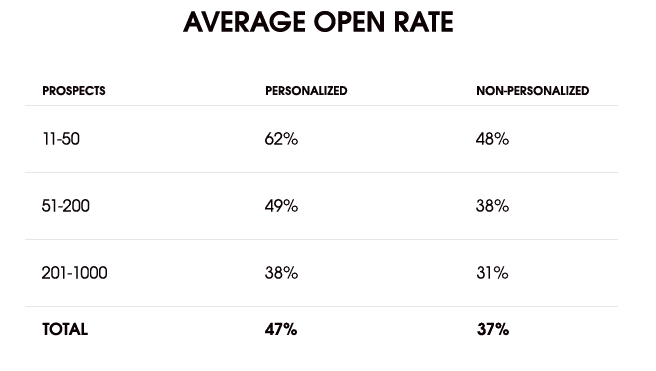
Stats on personalized vs. non-personalized emails. Source
Next up is the cold email subject line and cold email subject lines. Avoid typical salesy clichés like “last hours of the promotion” or “one-time price opportunity.” We all know how those end up – in spam. 🙂
Moving on to the email body. When writing the cold message body, remember you’re writing to a specific person. Think about what the customer might want from you and your company, briefly explain your value proposition, and offer it in the email without a hard sell. Send cold emails packed with the full value your business brings to the recipient, including relevant resources or social proof. The more attractive and beneficial the message to the point, the better your results for sales emails.
IMPORTANT! Cold email content can’t be overtly salesy – you can’t include a direct offer from your company. Remember, you’re emailing someone you don’t know and don’t have consent to process their customer data for marketing, which could lead to issues like poor customer service complaints. Examples of good and bad content are below. I hope putting it all together helps you fully grasp how effective cold emails work. 🙂
Remember, how you’re received in the first email directly impacts your chance of landing a new customer and avoiding problems like lost tickets or negative reviews.
Step-by-step guide to writing cold emails
Let’s now organize this knowledge concisely – a “how to write a cold email” guide in a nutshell.
- Define your recipient group.
Thoroughly analyze your email list and customer interactions, and start with people/companies who might know you even a little to grab the recipient’s attention. If you don’t have enough of those, focus on perfecting the other elements of your outreach efforts, ensuring you reach decision makers not the support department. - Develop a strategy.
In other words, build a process. You’re sending these to get responses, so be prepared with key points. Assign who handles sending and who responds to replies. Think this through – there’s a good chance you’ll hear back from an interested potential customer for a brief call. You only get one first impression, so don’t mess it up or risk incredibly frustrating results. 🙂 - Create a catchy email subject.
Avoid phrases typical of mass ads, though. You don’t want a spammer label from the start. A cold email subject can be intriguing or personalized to the recipient to boost response rates. - Craft a message that clearly shows your value and craft an attractive message.
Anyone can write an email, but few write good ones using an email template. Think about your best offers and attributes that have helped companies, and what a new customer might need to avoid issues like time consuming tasks that make them lose customers. Got it? That’s what your email should contain for effective cold email campaigns with a clear call to action. The content should also encourage action like a clear call to action, visiting your Facebook fanpage or company website – use Calls to Action (CTAs). Even if they don’t reply right away, they’ll know where to find you. - Send the emails and enjoy the results 🙂
Read also: The Ultimate Guide to the Best Marketing Books You Need to Read
Effective cold emailing – 3 golden rules
As you can see, cold emails are a complex topic for sales reps. I hope by now you know you can do it and it’s worth the time and attention. If we had to boil it down to 3 fundamental, must-follow rules for these campaigns, they’d be:
- Thoughtful and precise recipient list formulation targeting potential clients.
- Avoiding typical mass marketing tactics (e.g., huge-scale blasts, overtly salesy subject lines that trigger an emotional response to the trash).
- Personalized content showcasing your business’s strengths that are attractive and useful to new customers, with cold email copy that gets the prospect’s attention.
Good sales email – example
I believe after reading this, you know how to pick recipients from many clients and write an effective cold email. But let’s put it into practice with this cold email template.
Imagine your recipient is a company with a large warehouse department that struggles with time consuming inventories periodically – an incredibly frustrating pain point. Focus on defining their problems and solutions.
Subject: Does warehouse inventory always have to be such a hassle at your company?
Dear Mr. Peter,
Do your current processes and tools for conducting warehouse inventories save time for your employees?
I’m asking because we create systems that automate the inventory process, saving 80% of the time employees spend checking stock the traditional way. This lets our clients boost efficiency and redirect staff to other tasks – results we’ve delivered for many clients.
Would similar results interest you at your company? Learn more about our systems on our website rodin.pl.
This content has everything a marketing email should, while staying personalized. It’s short, to the point, identifies the recipient’s pain points from the cold email subject lines, shows a clear, measurable benefit from working with you, and includes a clear call to action.
Bad cold email – example
Here’s a made-up example of a cold email to avoid modeling after. 🙂
Subject: Warehouse inventory automation at the lowest price this year!
Dear Sir or Madam,
If your company deals with time consuming inventories, check out our systems that automate the process.
This week only – 30% off our systems. More info on our website.
See the difference? The subject alone turns people off because it screams mass ad. Add generic content that’s borderline a sales pitch, and you definitely won’t get the desired effect or positive response.
We’ve reached the end! 🙂 I hope effective cold emailing holds no more secrets for you. Wishing you success in acquiring new customers!
If you need pros to handle cold emails and other company communications, check out our offer.