
Imagine a campaign that learns your brand, anticipates what a user might need next, and builds a message more precisely than many agencies. It may sound like science fiction, but it’s already becoming reality. AI Mode Ads introduces artificial intelligence into advertising in a more dynamic and context-aware way than previous formats. How does it work? What does it change? And what could it mean for the advertising budgets of website owners?
Let’s take a closer look, because understanding this shift could reshape your marketing strategy.
The evolution of advertising in the age of AI Overviews
Before Google introduced AI Mode Ads, the first step toward AI-driven advertising came in the form of AI Overviews – short, AI-generated summaries that appear directly in search results.
These summaries showed that search engines could do more than simply point users to content. They could generate answers themselves. Instead of sending users to external websites, Google began providing ready-made responses that were concise, contextual, and often complete enough to solve the user’s problem.
Within these AI Overviews, the first AI-powered advertising elements began to appear. Not as aggressive banners or traditional sponsored links, but as subtle recommendations integrated into the answer itself. This marked an important shift in how people discover information online. Advertising stopped interrupting the user experience and instead became part of it.
Now Google is taking the next step.
With AI Mode Ads, the company is building a broader advertising ecosystem. Ads are no longer simply displayed alongside content. They can become part of the conversation itself. They interpret questions, understand context, and respond almost like a digital assistant. The result is advertising that adapts dynamically to the intent behind each search.
What is AI Mode and AI Mode Ads?
Imagine a search engine that doesn’t just understand what you’re looking for, but asks follow-up questions, anticipates your next step, and responds in full sentences as if you were having a conversation.
That is exactly what AI Mode aims to do.
This new Google feature allows users to perform more complex searches and receive multi-step answers generated by artificial intelligence. Powered by the Gemini 2.0 language model, AI Mode takes traditional search to a completely new level. Instead of scanning through links, users receive contextual summaries tailored to their specific intent.
But the change doesn’t stop at the conversation itself.
AI Mode Ads introduce a new type of advertising that feels less like promotion and more like guidance. Instead of appearing next to content, these ads can become part of the AI-generated answer. Google is currently testing the possibility of embedding them directly within responses generated by AI – similar to the AI Overviews users already see today.
This means the traditional sponsored link could evolve into a contextual recommendation woven into the narrative of the answer. It’s a significant shift that opens a new chapter in digital marketing.
At the moment, AI Mode is available in testing for Google One AI Premium subscribers in the United States.
How AI Mode Is Expected to Work?
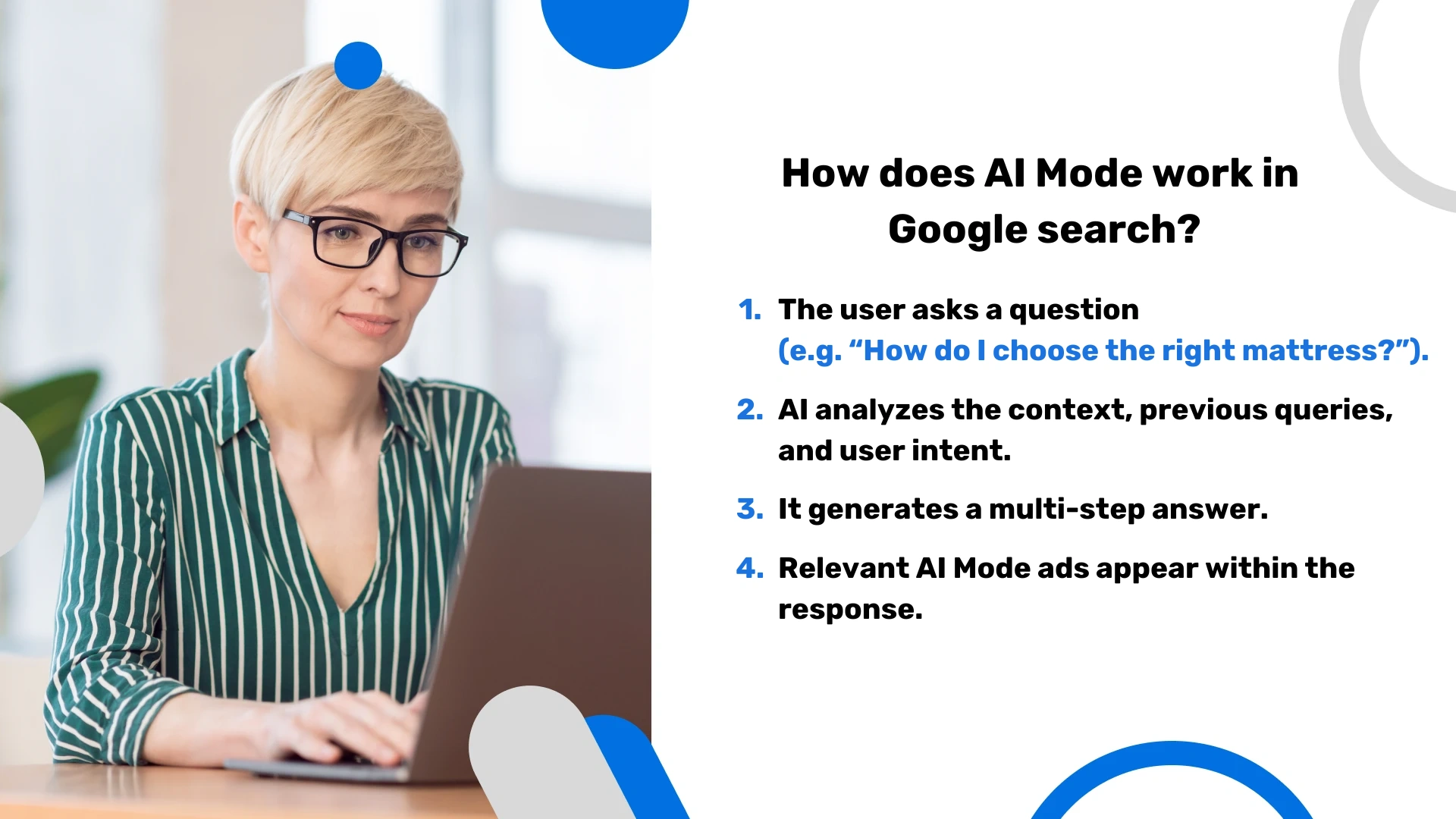
AI Mode changes the way people interact with search engines.
Instead of typing short phrases, users can ask questions conversationally and follow them up with additional queries. Artificial intelligence keeps track of context, understands previous intentions, and may even ask clarifying questions to refine the answer.
This process is powered by the Gemini 2.0 language model, which gathers information from multiple sources and combines it into clear, structured responses. Similar to the AI Overviews already visible in search.
Google has announced that it is exploring ways to introduce advertising into this conversational search experience through AI Mode Ads. Rather than displaying a classic advertisement, the system could weave sponsored content directly into the conversation.
In this model, the ad doesn’t sit beside the content. It becomes part of the answer.
These ads would be context-aware and evolve alongside the user’s questions. While Google plans to build on its experience with AI Overviews advertising, the company has not yet revealed detailed information about formats or placement.
One thing is clear: AI Mode Ads are expected to be interactive and conversational. Instead of simply reaching users, they will understand why a user needs a solution and respond in a language that feels natural to the conversation.
If AI Mode reaches the scale many expect, this type of advertising could become a new standard in digital marketing.
AI Mode and SEO strategy – a new set of rules
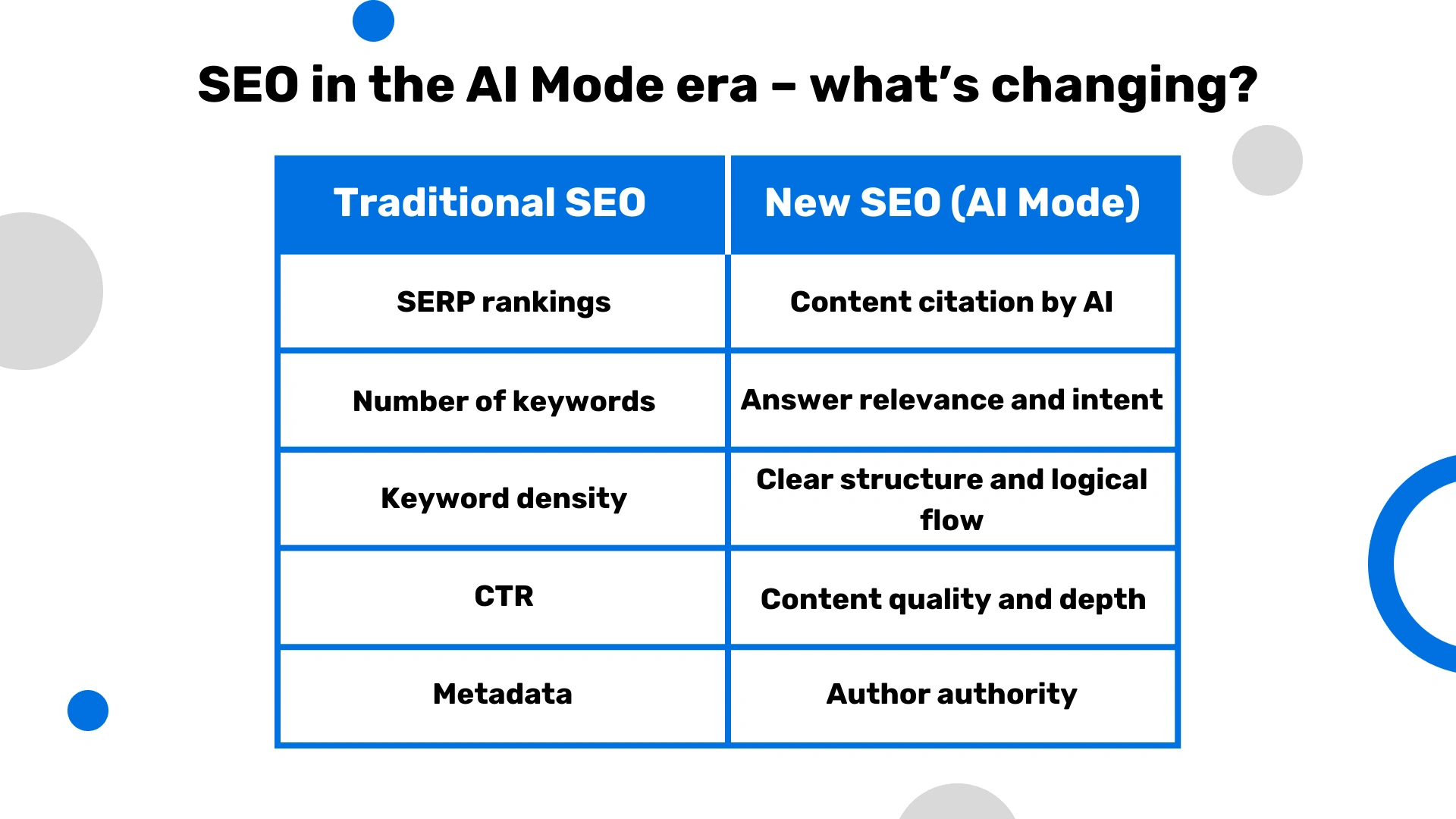
Until recently, SEO was largely about ranking as high as possible in search results. AI Mode changes that.
The goal is no longer just to appear at the top of the results page. The real challenge is becoming a source that the algorithm chooses to quote. In an AI-driven search environment, the key question becomes whether your content is valuable enough to be included in an AI-generated answer. Google doesn’t simply wait for users to click anymore. It reads, analyzes, and interprets information across multiple sources, then composes a conversational response using selected fragments of content. If your brand is not part of that response, it may effectively disappear from the user’s perspective – even if your page still ranks in the top search results.
Does this mean the end of traditional SEO?
Not necessarily. But it clearly marks the beginning of a new era where different rules apply. Keyword optimization alone is no longer enough. What matters now is the logic of the content, its structure, the credibility of the author, and how well it addresses user intent.
AI Mode rewards clarity, usefulness, and expertise. Content written purely for search engines without real value is unlikely to perform well.
For brands, this means thinking beyond SEO alone. Organic search must now work together with advertising, content marketing, social media, and email marketing. In the emerging ecosystem, visibility alone is no longer sufficient. Brands must become indispensable sources of information.
AI Mode – opportunities and risks
The introduction of AI Mode represents a major step in the evolution of digital marketing. It changes how content is created, optimized, and promoted. But like every technological shift, it also brings both opportunities and challenges.
Opportunities that are hard to ignore
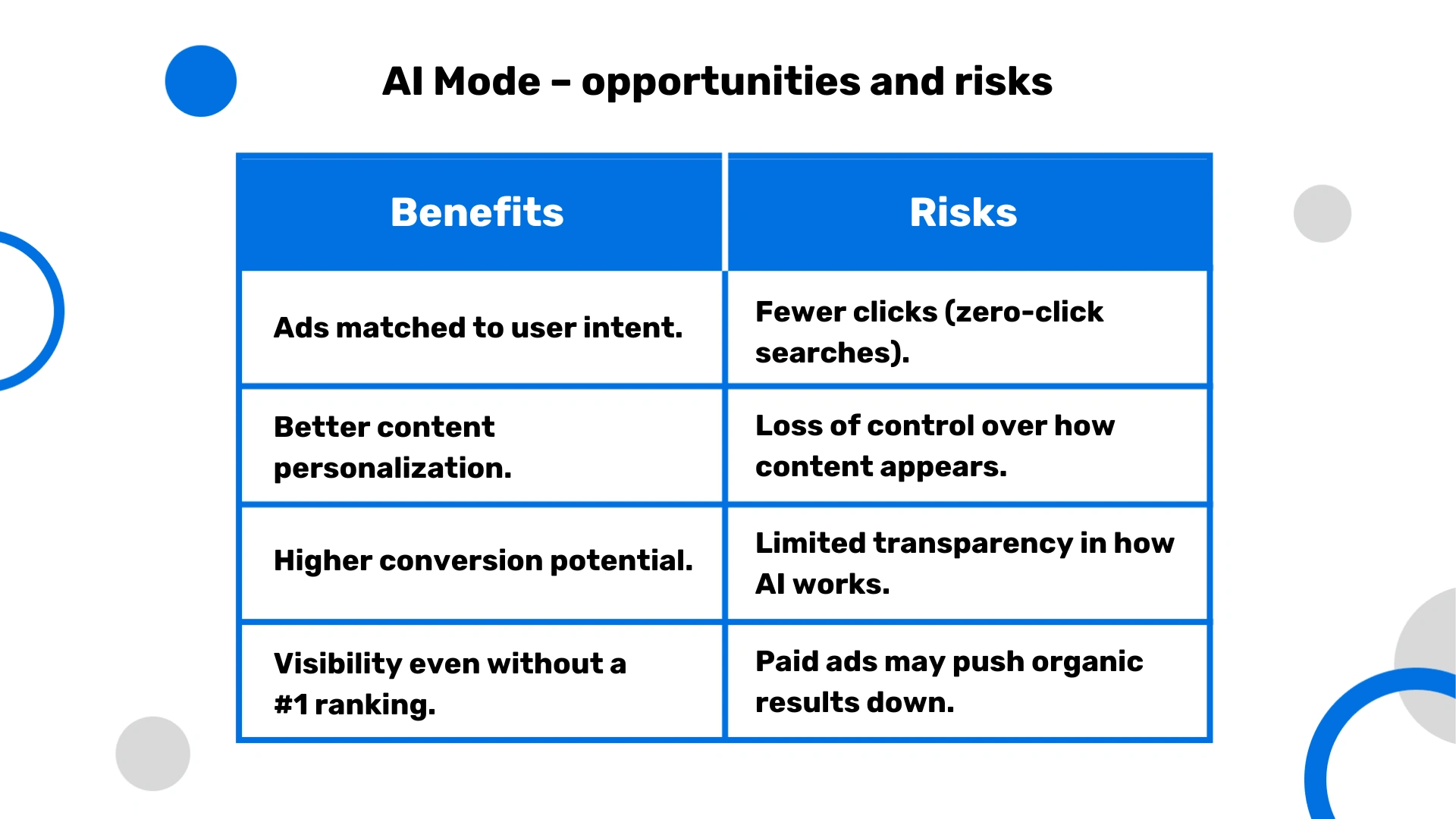
AI Mode opens entirely new possibilities for marketers and content creators. Thanks to artificial intelligence, it becomes easier to match content with user intent and respond to users’ needs in real time.
Here are some of the most significant advantages:
- Instant answers for users – AI Mode removes the need to dig through search results. Users receive clear, structured answers that are tailored to their questions and presented in a logical format.
- Advertising that guides instead of interrupting – AI Mode Ads become part of the conversation rather than a distraction. Because they appear within the context of the user’s question, they are often more relevant and more effective.
- Structured data and semantic clarity become crucial – Websites that organize their information clearly have a better chance of being used as sources for AI-generated responses.
- Expert content gains importance – The era of writing purely for SEO is fading. Google increasingly favors authoritative sources with reliable information.
- Ranking is no longer the only path to visibility – Even if your site is not in the first position in search results, it can still appear in AI-generated summaries if it provides the most relevant answer.
- Higher conversion potential through context – When advertising appears exactly at the moment a user is searching for a solution, the chances of engagement and conversion increase significantly.
Challenges and limitations you should know
AI Mode is a technological breakthrough, but it also introduces new uncertainties. The new search model may disrupt many of the assumptions that traditional SEO strategies have relied on.
- Zero-click searches – If AI delivers the answer directly, users may have no reason to click through to the original website, even when that site is cited.
- Limited transparency – Google has not fully revealed the criteria used to select sources for AI Overviews. This makes optimization more difficult.
- Traditional SEO metrics may lose importance – Metrics such as click-through rate, ranking position, or time on page may no longer tell the full story. New ways of measuring visibility will likely emerge.
- Limited control over context – AI may combine fragments of your content with information from other sources, including competitors. Brands cannot control how those elements are ultimately presented.
How to prepare your SEO strategy for AI Mode?
AI Mode represents a fundamental shift. Instead of a list of links, users receive a contextual answer generated by artificial intelligence. This means that brands must stop thinking only about rankings and start thinking about citability.
Below are several practical steps that can help businesses prepare.
Think in terms of citations, not positions
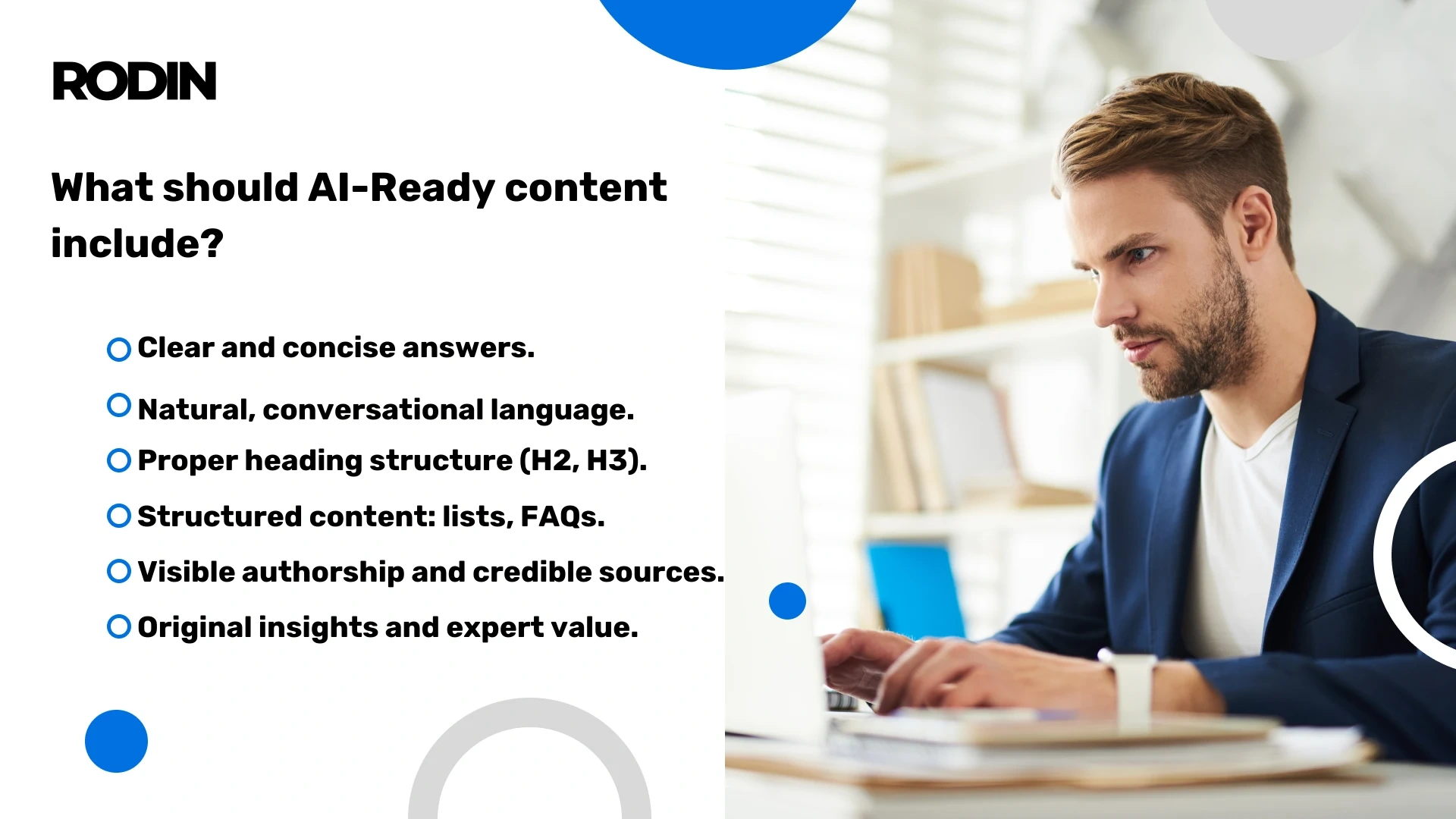
The key question becomes whether your content is selected by the algorithm as a source. Content should therefore be concise, clear, and structured so that it can easily be incorporated into AI-generated summaries.
Focus on intent rather than keywords
Artificial intelligence understands context and intent. Content should answer real questions and reflect real purchasing scenarios rather than relying on keyword repetition.
Structure your information clearly
AI systems process content differently than humans. Headings, logical hierarchy, and short paragraphs help algorithms interpret the content more effectively.
Strengthen author and domain authority
Google increasingly favors expert sources. Articles signed by real authors, supported by professional profiles and credible references, gain greater trust.
Write in a conversational tone
Content written in natural language is easier for language models to interpret. Writing as if you were explaining something to another person often leads to clearer, more effective content.
Integrate SEO and paid advertising
In AI Mode, organic and paid results are becoming increasingly interconnected. A consistent message across both channels will become essential.
Prepare for AI Mode Ads
AI Mode Ads are likely to be conversational and context-driven. Advertising messages will need to be concise and closely aligned with specific user queries.
Companies that start preparing early may gain a significant advantage.
Conclusion
Google is not simply updating its advertising tools. It is reshaping the entire landscape of digital marketing.
AI Mode represents a turning point in how users search for information and how they make purchasing decisions online. For companies and content creators, this shift demands faster adaptation and forward-looking strategies.
SEO, content marketing, and e-commerce strategies must evolve within a new ecosystem where content is not only visible but also selected and cited by artificial intelligence.
For businesses that want to remain competitive, understanding these changes early is essential.
At Rodin, we help companies navigate this transformation and prepare their marketing strategies for the AI-driven search environment. If you want your brand to stay visible in the era of AI search, it may be time to rethink your approach and start building a strategy designed for what comes next.
Frequently Asked Questions – AI Mode Ads
AI Mode Ads are part of the new Google AI Mode, where advertising appears inside AI-generated responses instead of next to them. In traditional Google Ads, ads are usually placed above or below Google search results as separate sponsored links.
With ads in AI Mode, advertising can become part of the answer itself. Instead of interrupting the search experience, the system tries to connect users with relevant businesses at the exact moment they are looking for a solution.
AI Mode turns search into a conversation. Users ask more complex queries, and Google AI responds with structured answers instead of just links. For advertisers, this means ads may appear inside AI answers or within AI Overviews. These ad placements are designed to fit naturally into the user journey rather than acting as standalone banners.
No. Existing search campaigns, shopping ads, and performance max campaigns will continue to exist. AI Mode simply introduces a new environment where those ads may appear.
Google is already experimenting with ads in AI Overviews, and the same infrastructure could support ads in AI Mode. In practice, many advertisers will likely run a mix of traditional campaigns and AI-driven formats.
Artificial intelligence already powers many parts of Google Ads through smart bidding, AI powered targeting solutions, and tools like Performance Max.
With Google AI Mode, targeting will rely even more on user behavior, internal data, and context. Instead of focusing only on keywords, AI will analyze intent and place ads where they make the most sense within the search experience.
Yes. Google has already tested ads in AI Overviews, which appear within AI-generated summaries in search results. AI Mode Ads build on that idea. The difference is that AI Mode is designed for more conversational AI search experiences, where users ask multiple questions and refine their search step by step.
At the moment, Google hasn’t confirmed entirely new campaign types, but many existing formats may evolve. For example:
- Performance Max campaigns,
- dynamic search ads,
- search and shopping ads.
These systems already rely heavily on AI and keywordless targeting, which makes them a natural foundation for advertising in AI search environments.
A good starting point is making sure your Google Ads account is structured properly and your existing assets are strong.
That includes:
- clear product descriptions,
- consistent landing pages,
- well-organized campaign structures,
- good feed hygiene for shopping campaigns,
- high quality images.
AI systems rely heavily on structured information. If your assets are clear and relevant, AI can quickly connect them to the right users.
Keywords won’t disappear, but their role may change. AI search systems are better at understanding commercial intent, meaning they don’t rely solely on exact keyword targeting. Tools like broad match, dynamic search ads, and AI Max already show how Google is moving toward intent-based advertising. In AI Mode, context may matter more than the exact phrasing of a query.
AI Mode could shorten the user journey significantly. Instead of clicking through several websites, users may receive a clear recommendation inside an AI response. If an ad appears there, it can guide users directly toward a product, service, or brand that solves their problem.
For advertisers, this creates new opportunities to reach consumers at a decisive moment in the search process.
Not fully yet. Google AI Mode is currently in early stages and available only to selected users, mainly in the United States. Advertisers are still testing ads in environments such as AI Overviews, and broader adoption may happen in the near future.
However, the direction is clear: AI will play a bigger role in online marketing, advertising strategy, and how brands appear in search results.