
Custom AI assistants for business teams
Our clients
Why more teams are turning to AI assistants?
Full control over data and security
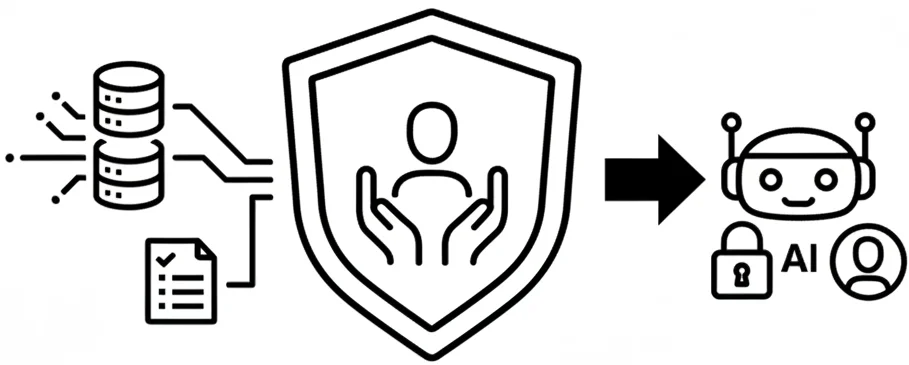
Your AI assistant works with approved data sources and predefined rules. You decide what information it can access, how it is used and where it is applied across the organisation.
Built around your communication style
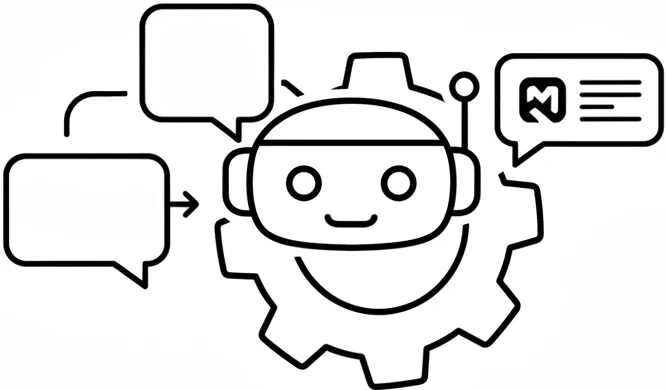
The assistant is designed to reflect the way your company communicates. Responses stay consistent with your brand, processes and internal standards instead of sounding like a generic chatbot.
Uses your internal knowledge
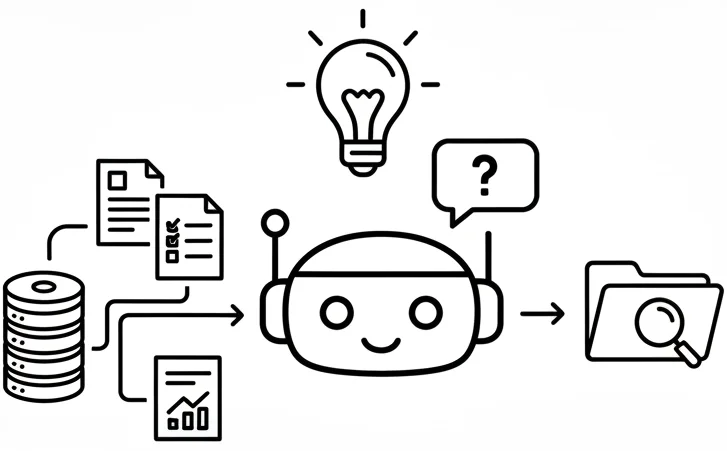
The assistant can work with company documents, procedures and knowledge bases. Information is organised and available exactly where teams need it most.
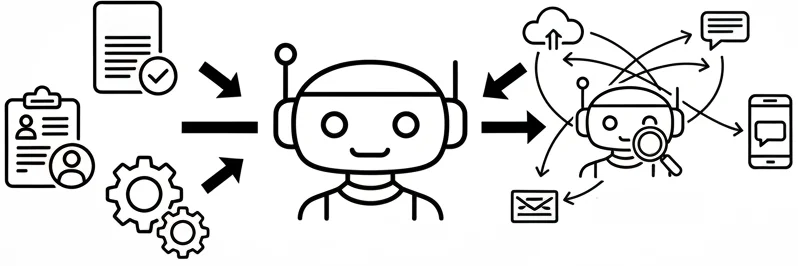
Connects with existing tools
AI assistants can integrate with CRM systems, forms and other business applications already used across the company. Information flows automatically without unnecessary manual work.
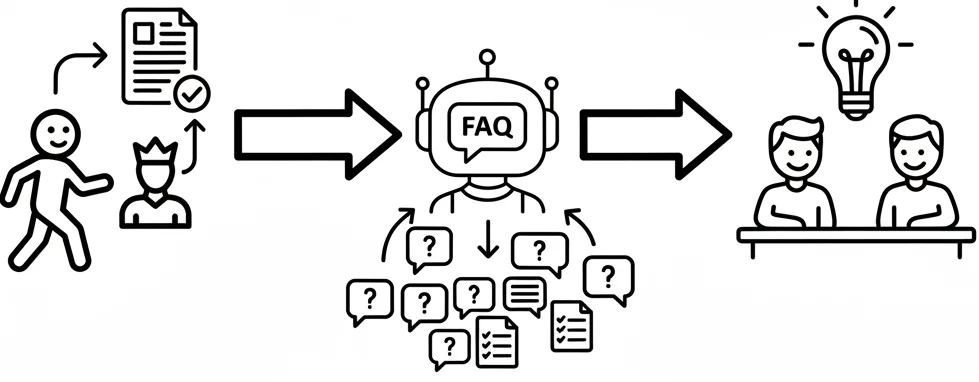
Reduces repetitive work
Routine enquiries and operational tasks can be handled automatically. Teams spend less time on repetitive activities and more time on work that requires expertise and judgement.
Why more teams are turning to AI assistants?
Full control over data and security
Your AI assistant works with approved data sources and predefined rules. You decide what information it can access, how it is used and where it is applied across the organisation.
Built around your communication style
The assistant is designed to reflect the way your company communicates. Responses stay consistent with your brand, processes and internal standards instead of sounding like a generic chatbot.
Uses your internal knowledge
The assistant can work with company documents, procedures and knowledge bases. Information is organised and available exactly where teams need it most.
Connects with existing tools
AI assistants can integrate with CRM systems, forms and other business applications already used across the company. Information flows automatically without unnecessary manual work.
Reduces repetitive work
Routine enquiries and operational tasks can be handled automatically. Teams spend less time on repetitive activities and more time on work that requires expertise and judgement.
Could AI support your team?
Let’s find out.
The earlier you start, the faster you learn
AI is quickly becoming part of everyday business operations. Companies that start earlier gain practical experience, better processes and a stronger foundation for future growth.
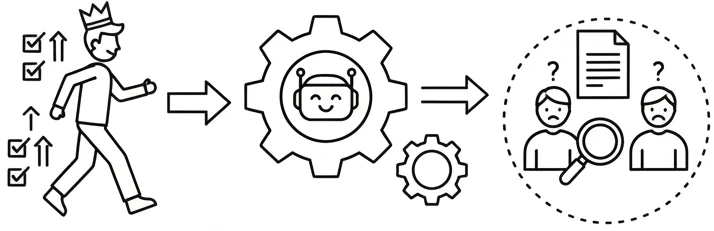
Early adopters gain momentum
Businesses are already using AI assistants to streamline daily operations and improve efficiency. Early implementation creates advantages that become harder to match over time.
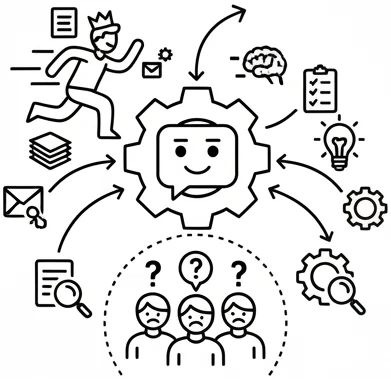
Experience
compounds
Teams that begin working with AI sooner learn faster how to organise data, improve workflows and identify new opportunities for automation.
Waiting has a
cost
As competitors improve their processes with AI, catching up becomes more difficult. The gap is often created through hundreds of small operational improvements.
What an AI assistant looks like in daily operations?
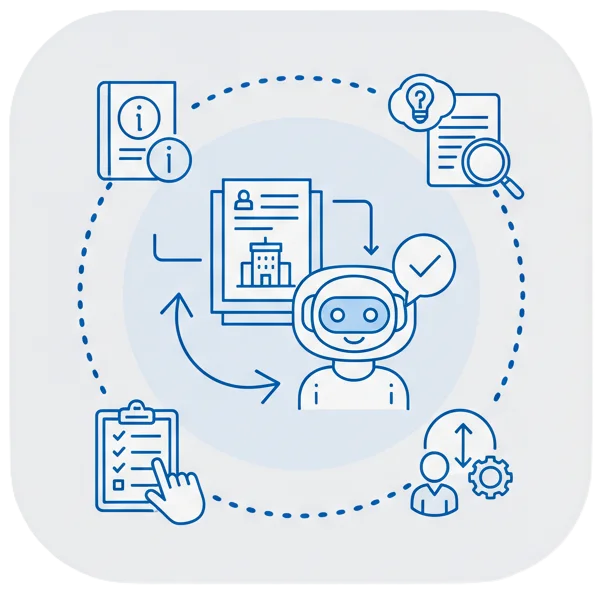
Works with your data
The assistant uses company documents, procedures and knowledge sources. Responses are based on real business information rather than generic public content.
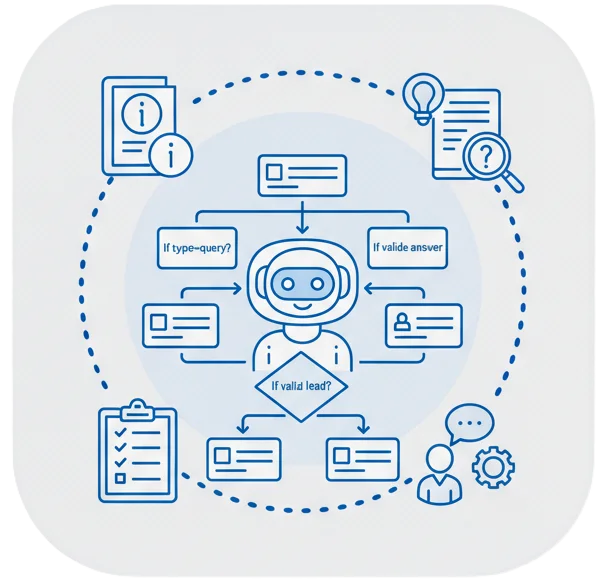
Follows defined rules
Every action follows predefined workflows and business logic. You remain in control of how information is processed and when actions are triggered.
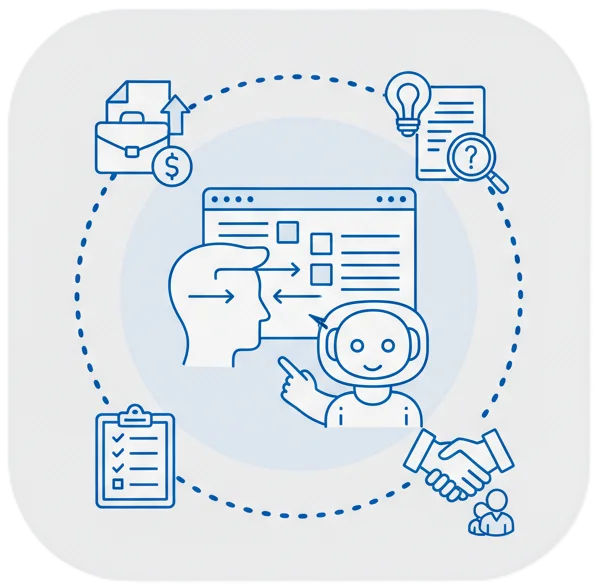
Supports decisions, not replaces people
The assistant organises information, prepares summaries and highlights relevant insights. Final decisions always remain with your team.
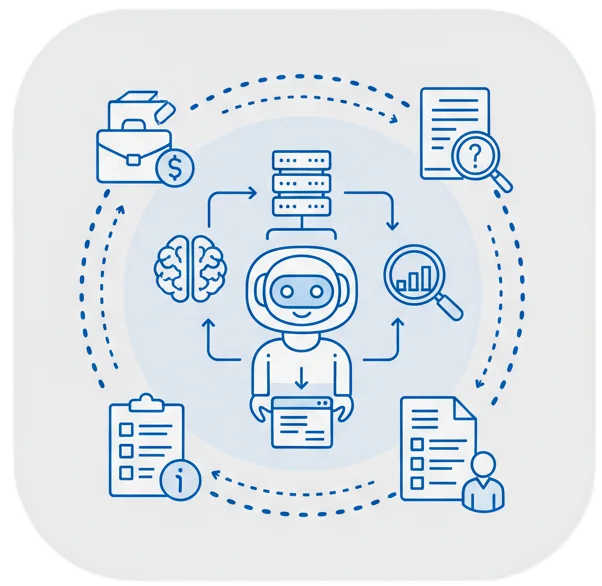
Fits into existing workflows
The assistant works with tools and processes already used across the organisation. Teams do not need to change the way they work.
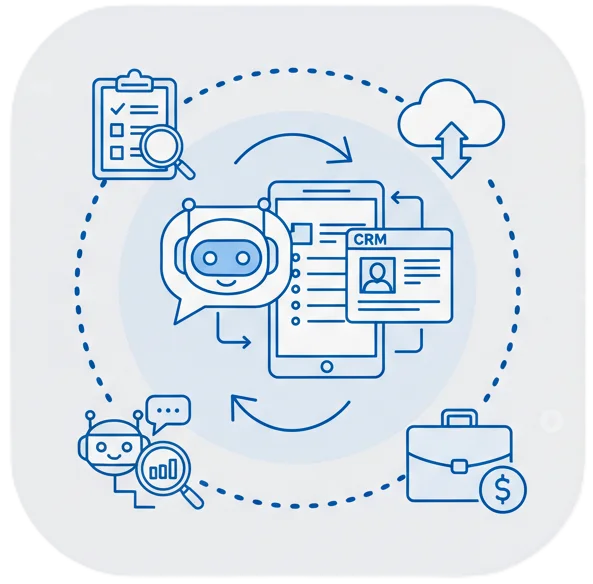
Improves over time
Interactions can be analysed and used to refine workflows and responses. The assistant becomes increasingly aligned with how the organisation operates.
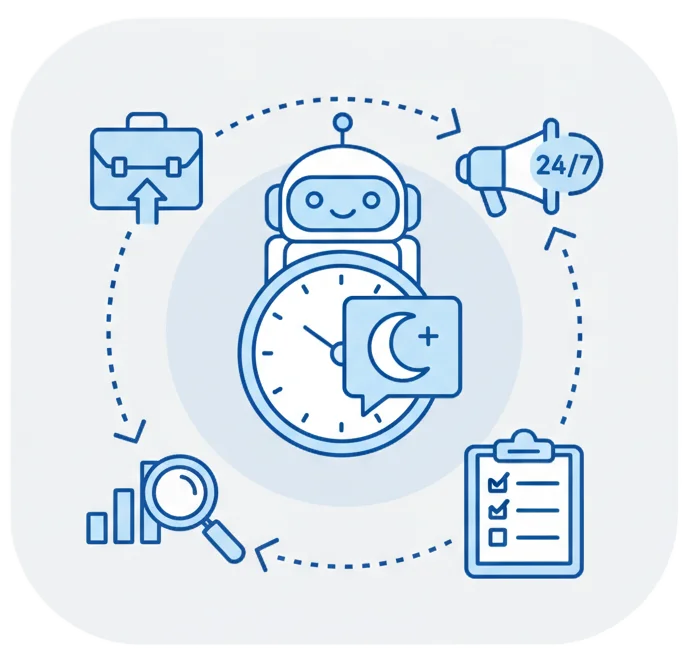
Works beyond office hours
Tasks continue running even when teams are offline. Information is organised and prepared before reaching the people responsible.
What an AI assistant looks like in daily operations?
Works with your data
The assistant uses company documents, procedures and knowledge sources. Responses are based on real business information rather than generic public content.
Follows defined rules
Every action follows predefined workflows and business logic. You remain in control of how information is processed and when actions are triggered.
Supports decisions, not replaces people
The assistant organises information, prepares summaries and highlights relevant insights. Final decisions always remain with your team.
Fits into existing workflows
The assistant works with tools and processes already used across the organisation. Teams do not need to change the way they work.
Improves over time
Interactions can be analysed and used to refine workflows and responses. The assistant becomes increasingly aligned with how the organisation operates.
Works beyond office hours
Tasks continue running even when teams are offline. Information is organised and prepared before reaching the people responsible.
Is an AI assistant the right fit for your business?
AI assistants are most valuable for organisations that want to streamline operations, work more effectively with data and reduce repetitive manual work.
Operations teams
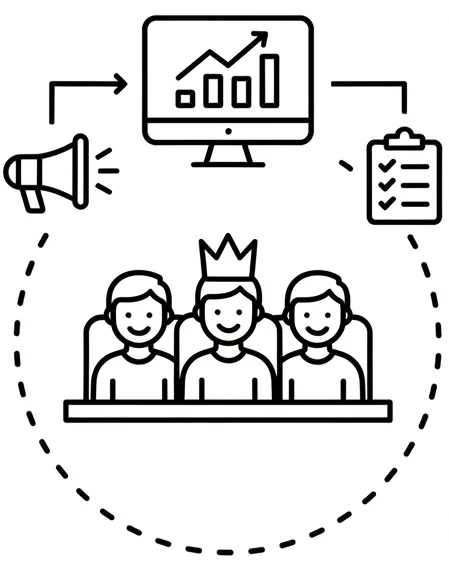
Sales teams & managers
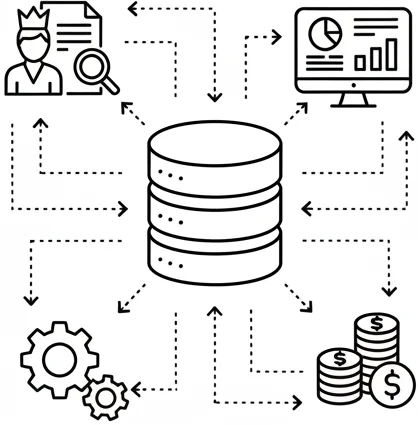
Data-driven businesses
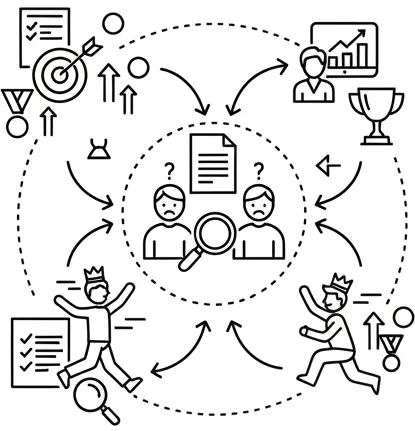
Competitive industries
What tasks can the AI Assistant take over?

Enquiry management

Lead
qualification

Suggested responses

Document processing

Decision
support

Data
organisation
See where AI fits in
We’ll identify the biggest opportunities.
AI assistant implementation in four steps

01. Process review
We identify where AI can reduce workload and improve efficiency.

02. Assistant design
We define responsibilities, data sources and communication guidelines.

03. Deployment & testing
The assistant is launched, tested and adjusted to real business scenarios.
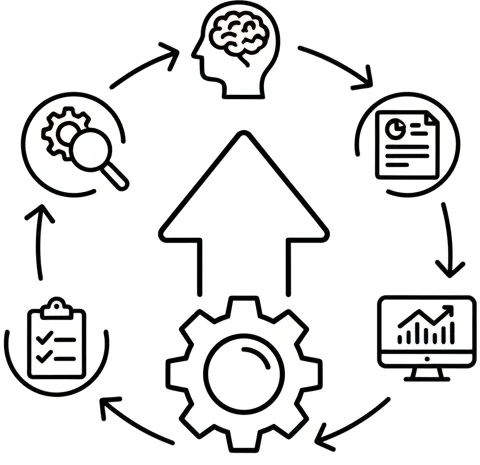
04. Optimisation & growth
Capabilities evolve alongside your processes, teams and business needs.
Why choose Rodin for AI assistant implementation?
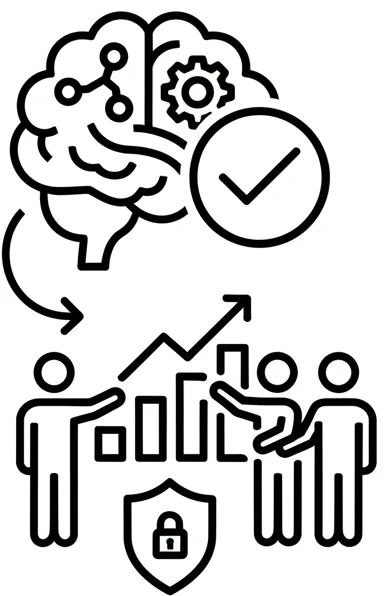
Proven AI implementation experience
We focus on AI solutions that improve everyday operations, not showcase demos. By working with real business processes, we help build assistants that are reliable, predictable and ready for practical use from day one.
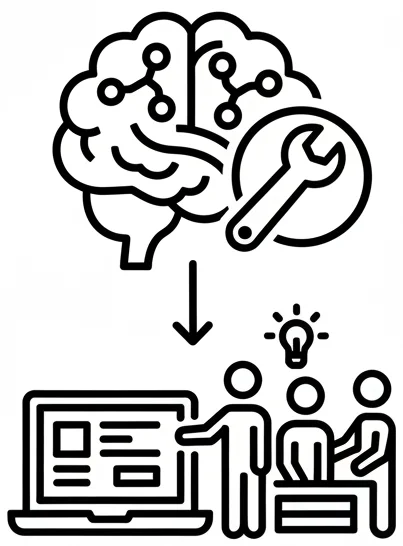
Built for real work
Our goal is not to create experimental prototypes. Every AI assistant is designed around specific tasks, workflows and business needs, so teams can start benefiting from it immediately.
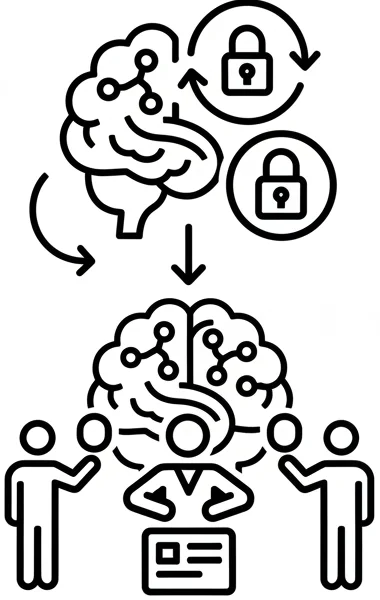
Full control, always
You decide what data the assistant uses, how it responds and where it operates. Every workflow follows predefined rules, ensuring transparency, consistency and human oversight at every stage.
Ongoing support and optimisation
An AI assistant should evolve alongside your business. As processes change and new opportunities appear, we help expand its capabilities, knowledge sources and workflows to keep delivering value over time.
Why choose Rodin for AI assistant implementation?
Proven AI implementation experience
We focus on AI solutions that improve everyday operations, not showcase demos. By working with real business processes, we help build assistants that are reliable, predictable and ready for practical use from day one.
Built for real work
Our goal is not to create experimental prototypes. Every AI assistant is designed around specific tasks, workflows and business needs, so teams can start benefiting from it immediately.
Full control, always
You decide what data the assistant uses, how it responds and where it operates. Every workflow follows predefined rules, ensuring transparency, consistency and human oversight at every stage.
Ongoing support and optimisation
An AI assistant should evolve alongside your business. As processes change and new opportunities appear, we help expand its capabilities, knowledge sources and workflows to keep delivering value over time.
Schedule a consultation
Schedule a short call to explore where an AI assistant could create the biggest impact in your business.
Frequently asked questions
An AI assistant is an AI-powered system designed to support employees by handling specific tasks, answering questions and working with company knowledge. Unlike a generic chatbot, a business AI assistant operates according to predefined rules, processes and data sources.
A personal AI assistant can help with customer communication, document analysis, reporting, calendar management and information retrieval. The key features depend on how the assistant is designed, what tools it connects with and which business processes it supports.
Although the terms are often used interchangeably, there are important differences. An AI personal assistant typically supports users by providing information, preparing responses and assisting with decision-making.
An AI agent can take actions autonomously and execute complex workflows with limited human intervention. In practice, many modern artificial intelligence solutions combine assistant and agent capabilities depending on business requirements and the selected AI model.
AI assistant implementation requires a structured approach that balances technical deployment with business strategy. The process usually starts by identifying bottlenecks, such as high customer service wait times, repetitive tasks or inefficient information flow.
Successful AI assistant integration often includes evaluating the best tech stack, configuring the hosting environment and completing data preparation. Before launch, businesses should define measurable goals, identify specific target benchmarks and establish KPIs such as response times, resolution rates and customer satisfaction.
How much time an implementation requires depends on the complexity of the project, available data, integrations and the level of customization required.
Simple assistants can be deployed within a few weeks, while larger projects involving multiple departments, other software and advanced workflows may take several months. Beginning with high-volume, low-stakes tasks is often the most effective way to manage complexity and demonstrate value quickly.
Most implementations rely on existing company knowledge, including procedures, FAQs, customer conversations, product information and internal documentation.
Successful deployment depends on thorough data preparation and access to reliable business information. Using your own data allows the assistant to provide more accurate responses and actionable insights based on real company knowledge rather than generic internet content. Maintaining a single source of truth through regular data audits is essential for long-term accuracy.
Yes. Many businesses build assistants that work directly with internal documentation, procedures, training materials and knowledge repositories.
Implementing Retrieval-Augmented Generation (RAG) allows AI assistants to access existing data sources such as FAQs, product manuals and internal documents. Grounding the assistant in a single, well-maintained knowledge base helps reduce inaccuracies and improve consistency. Modern language models with a large context window can process larger volumes of information and generate responses in natural language.
The key features of a modern AI assistant include natural language processing, machine learning, context awareness and seamless integration with existing business systems.
An AI-powered assistant can support project management, calendar management, customer inquiries, follow ups and administrative tasks. Many organizations also use custom GPTs, custom instructions and integrations with Google Sheets or other apps to create assistants tailored to their workflows.
Yes. Businesses can integrate AI assistants with CRM systems, Google Sheets, communication platforms and many other software solutions used every day.
A successful implementation depends on seamless integration with the existing tech stack. AI assistants can work closely with favorite apps and business tools, helping teams streamline operations without compromising quality or disrupting existing processes.
AI assistants can automate routine tasks, repetitive tasks and common tasks that consume valuable employee time. Examples include managing emails, scheduling meetings, creating follow ups, responding to customer inquiries and organizing business information.
Depending on the implementation, assistants can also support calendar events, patient scheduling, social media posts, fraud detection, inventory processes and resource allocation. This reduces administrative overhead and allows employees to focus on higher-value work.
Organizations should monitor performance using clearly defined KPIs established before launch. Common metrics include response times, resolution rates, user satisfaction and overall customer satisfaction.
Regularly reviewing user interactions helps evaluate the assistant’s performance and identify opportunities for improvement. Businesses should also monitor API call usage, collect feedback and optimize prompts to improve accuracy and efficiency over time.
Security should be considered from the earliest stages of implementation. Data privacy, algorithmic bias and the potential for misuse are among the most important challenges organizations must address.
Compliance with regulations such as GDPR, HIPAA and CCPA is critical when processing sensitive information. Depending on project requirements, organizations may implement end-to-end encryption, anonymization protocols and strong data governance policies to help protect company data and maintain security throughout the entire process.
The cost of implementation varies significantly depending on deployment scale, integrations, customization requirements and ongoing maintenance.
The costs associated with AI assistant implementation can range from relatively small pilot projects to enterprise-level deployments requiring substantial investment. Businesses should also consider operational costs such as cloud hosting, Google Cloud infrastructure, API call consumption and long-term optimization. Choosing between proprietary APIs and open-source models is often a key factor influencing overall costs.
In most cases, AI assistants are most effective when used to augment human teams rather than replace them. They help handle repetitive work, organize information and support daily business operations.
Many organizations begin with a risk-free pilot program focused on low-complexity, high-volume customer inquiries before automating more advanced workflows. Depending on the use case and quality of implementation, AI assistants may handle a significant share of customer inquiries before escalation to a human agent is required. This can help reduce response times and improve customer satisfaction while keeping people involved where expertise and judgment are needed.
Yes. A personal AI assistant can help professionals organize daily activities, manage calendar events, schedule meetings and complete administrative tasks more efficiently.
By reducing time spent on routine work, an AI personal assistant allows employees to focus on strategic decision making, business growth and higher-priority objectives. As new capabilities and latest features become available, assistants can continue expanding their role within the organization.
A custom AI assistant is designed around your processes, goals and business requirements rather than generic use cases.
The assistant can support teams with data analysis, decision-making and operational efficiency while delivering actionable insights from company information. For example, organizations can use AI to improve internal knowledge access, support customer service and streamline operations. A well-designed assistant grows with the business and adapts to changing needs over time.